

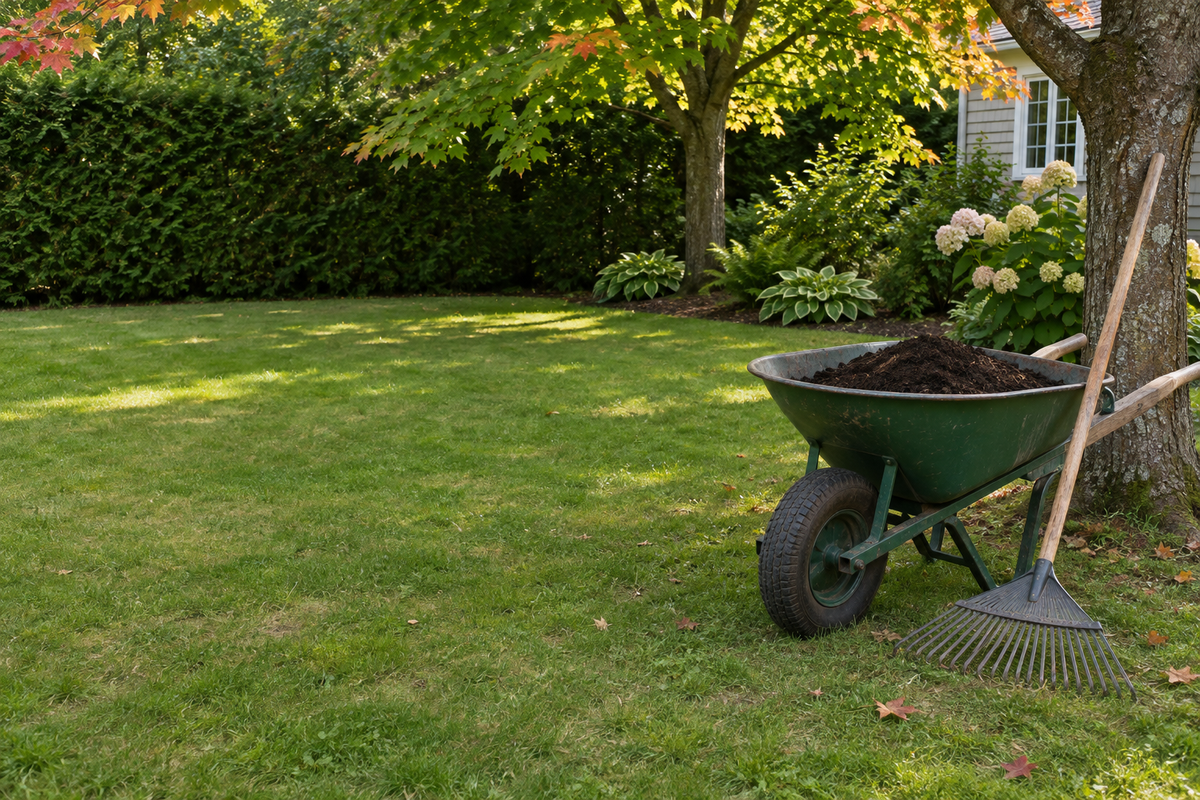
When should you topdress a lawn in Canada?
Topdressing spreads a thin layer of lawn soil or mature compost over existing grass. Overseeding adds grass seed to fill in thin areas. Do both together where the lawn needs thickening and you can keep the seedbed moist until the grass comes up.
Spring
Wait until the grass is growing and the ground is firm enough to walk on without leaving deep footprints. Spring can work well for fixing a few patches after winter.
Late summer or early fall
Overseeding often works best after the hottest weather, while there is still time for grass to establish before cold weather. Use your local growing season and the germination time on the package to plan the work.
If water pools in the same spot, the ground is sinking or the turf lifts in patches, find the cause before reseeding. A light topdressing will not fill a deep depression.
What topdressing should you use, and how much?
Use a fine lawn soil or mature screened compost that spreads without clumping. About 5 mm is a starting point for compost if the grass blades stay visible. For a packaged lawn repair mix, follow the topdressing depth on the label.
Calculate litres of topdressing
Multiply the area in square metres by the depth in millimetres. For 30 m² at 5 mm, allow about 150 L before losses. Measure only the area you will treat and round up to the bag size available.
Choose bags or bulk
Bags are easy to carry to scattered patches. For a larger area, compare the bulk volume and check access for unloading. If the calculator asks for inches, 5 mm is about 0.2 in.
Use the soil calculator
How to topdress and overseed your lawn
Prepare the lawn
Mow at your usual height and clear clumps of clippings. Lightly rake the surface of bare patches. If compacted soil is slowing infiltration, core-aerate when the ground is moist and firm.
Spread the topdressing
Put down small piles and work them in with the back of a rake. Break up clumps and brush off covered blades. Keep the layer thin and even.
Overseed where grass is thin
Choose a grass seed mix for the amount of light the area receives. Follow the package rate for overseeding. Rake or press lightly so the seed makes contact with the soil.
Water with a gentle spray
Keep the surface evenly moist while seeds germinate. Adjust for rainfall and local watering rules. Once the new grass has established, gradually water less often.
Choose grass seed for overseeding
In full sun, choose a mix suited to foot traffic and the watering you can provide. Under a tree, look for a seed blend for part shade or shade. Where light is very limited and bare patches recur, consider a ground cover suited to the site.

For a small bare spot, seed just the exposed soil. For a lawn that has thinned evenly, spread the overseeding rate listed on the bag. Different grasses in a blend may germinate at different times.
Shop grass seedHow to tell if the new grass is establishing
Check germination
Check germination against the range on the package. Give the seedlings time to root before mowing. Limit traffic, mow on firm ground and use a sharp blade. Remove no more than a third of the blade height at once.
Diagnose recurring bare spots
Check whether seed dried out, rain washed the soil away, or the ground is compacted. A patch that keeps failing along a footpath may call for redirecting traffic or adding stepping stones. A suitable seed blend still needs the right growing conditions.
Frequently asked questions
Can you topdress and overseed on the same day?
Yes. Spread a thin layer of topdressing, sow at the package rate for overseeding, then rake or press lightly. Water gently afterwards.
Should you aerate before topdressing?
Core-aerate if compaction is restricting infiltration. A lawn that absorbs water readily can often be topdressed without aerating first.
Can I topdress with compost alone?
Yes, if it is mature, screened and spread thinly. Check that grass blades remain visible after spreading it.
How much topdressing do I need for 100 m²?
At a depth of 5 mm, allow about 500 L before losses. At 3 mm, allow about 300 L. Base your estimate on the area you will actually treat.
Should grass seed be covered with soil?
Follow the package directions for seed-to-soil contact. A light pass with a rake is usually enough. Avoid burying seed under a thick layer.
When can you mow after overseeding?
Wait until the seedlings have rooted and are tall enough for a light cut. Mow when the ground is firm and remove no more than a third of the height.
















 Outils
 Compostage et écologie



