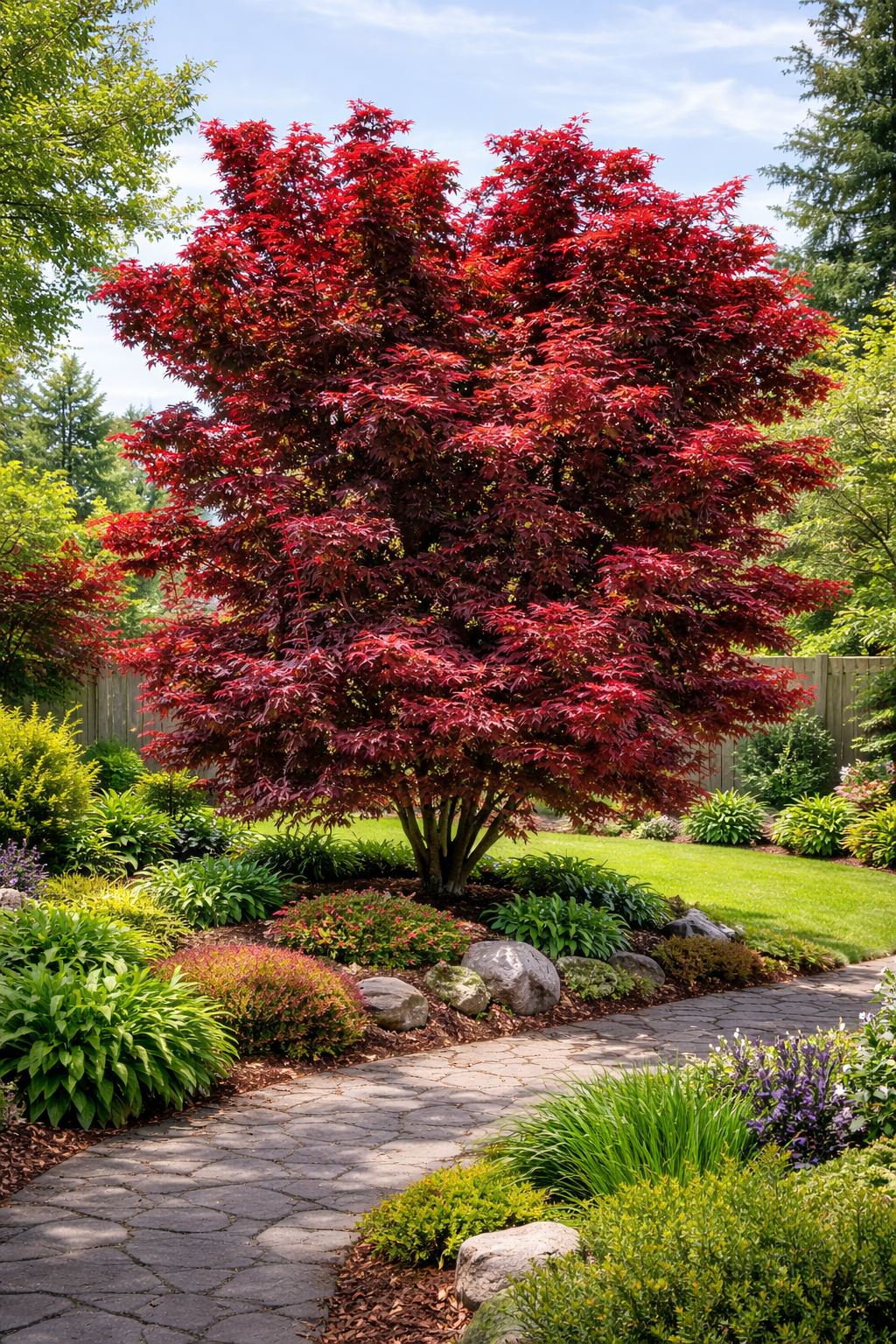
Canadian Zone 5 columnar Japanese maple with purple-red foliage

Twombly’s Red Sentinel Japanese maple

Acer palmatum ‘Twombly’s Red Sentinel’

Twombly’s Red Sentinel is a dense columnar Japanese maple reaching 2.5 to 4 m high and 1.5 to 2.5 m wide after 10 to 20 years. Its narrow outline gradually broadens with age. Leaves open bright red, become purple-red or reddish green in summer and return to red in autumn. Hardy in Canadian Zone 5, it prefers bright partial shade, a sheltered position and organic, evenly moist, very well-drained soil. Protect it from wind, salt and scorching sun. Five sale formats do not alter mature dimensions or the need to reserve long-term width around the crown. Seasonal observation confirms suitable placement.
5 gallons; 6 gallons; 10 gallons; 15 gallons; 125 cm
Each store has its own inventory.

Products and available quantities may vary between Brossard and Laval. To check a store’s inventory, please contact us directly.

Even better: visit us in store to discover the full selection available!

Share
Quantity
5 gallons; 6 gallons; 10 gallons; 15 gallons; 125 cm
Exposure
Bright partial shade, filtered light or gentle sun; protect from scorching exposure
Hardiness
Canadian Zone 5; a protected site is recommended

Discover the plant

Common nameTwombly’s Red Sentinel Japanese maple; columnar red Japanese maple
FamilySapindaceae
GenusAcer
Speciespalmatum
CultivarTwombly’s Red Sentinel
TypeColumnar deciduous small tree or large shrub
Botanical nameAcer palmatum ‘Twombly’s Red Sentinel’

Twombly’s Red Sentinel Japanese maple (Acer palmatum ‘Twombly’s Red Sentinel’) is a dense small tree or large shrub with a naturally narrow upright outline. Its columnar habit gradually broadens with age without losing strong vertical emphasis. Palmate leaves open bright red, become purple-red or reddish green through summer, then return to red in autumn. Small reddish flowers may appear in spring and be followed by discreet winged samaras. The RHS gives a height of 2.5 to 4 m and spread of 1.5 to 2.5 m after 10 to 20 years, dimensions suited to protected courtyards and narrow Canadian garden spaces when long-term width is respected.

Hardy in Canadian Zone 5, Twombly’s Red Sentinel performs best in a site sheltered from drying wind, road salt and reflected heat. Bright partial shade, filtered light or gentle morning sun helps retain colour without scorching margins. Full sun is tolerated where soil remains fresh and exposure is not excessive. Provide organic, slightly acidic to neutral, evenly moist and very well-drained soil. Keep the root flare visible, maintain 5 to 8 cm of mulch without touching the trunk and water deeply through the first two growing seasons. Avoid heavy feeding and repeated pruning, which create soft growth and disrupt the naturally dense upright form.

Use this cultivar as a vertical accent beside an entrance, in a courtyard, Japanese-style garden, narrow bed or planting viewed from the house. Still reserve up to 2.5 m of width because the outline softens and broadens over time. The 5- to 15-gallon formats and 125 cm specimen represent different production stages, not different mature sizes. Large-container culture remains temporary in cold Canadian regions because roots are more exposed to freezing. Sheltered in-ground planting is more reliable. Remove only problematic wood and rootstock shoots, and keep irrigation, mulch and winter protection accessible as the crown fills its space.

Twombly’s Red Sentinel Japanese maple with a dense columnar upright habit that becomes slightly broader with age. Palmate leaves open bright red, shift to purple-red or reddish green and return to red in autumn. The outline represents a 2.5 to 4 m by 1.5 to 2.5 m tree in a sheltered Canadian Zone 5 site.

Planting guide

From planting to establishment.

Spacing / density Space 2 to 2.5 m (6.5 to 8 ft) apart according to mature width
Best planting time Spring after hard frost or early autumn
Propagation Grafting to preserve the cultivar faithfully

Soil and care

The right care,at the right time.

Soil pH

Acidic to neutral

Minimum temperature

About -29 °C (-20 °F)

Care level

Moderate

Watering

Water slowly and deeply after planting, then keep the root ball evenly moist through the first two growing seasons. Check moisture beneath the mulch before irrigating so both drought and excess water are avoided. During a heat wave, water in the morning before leaf margins brown. Reduce frequency gradually in autumn without allowing the root ball to dry before freeze-up.

Soil type

Choose loose, organic-rich loam that remains fresh and drains very well. Where soil is poor, apply mature compost at the surface without creating an isolated pocket of amended soil. Avoid compacted clay, waterlogged depressions, alkaline construction fill and salt. A broad mulch ring protects fine roots while leaving the root flare visible and accessible for inspection through every Canadian season.

Fertilization

Fertilize sparingly. A thin surface layer of mature compost is often sufficient in suitable soil. When growth or colour appears abnormal, test the soil before adding fertilizer. Excess nitrogen produces soft shoots that are more vulnerable to cold. Stop nitrogen applications early enough for new growth to harden before the local Canadian winter and always follow product directions. Always follow labelled rates.

Moisture

Evenly moist fresh soil, never waterlogged; protect from drying wind

Seasonal care

In spring, inspect the trunk, graft union, root flare and branch unions after snowmelt. Restore 5 to 8 cm of mulch without covering bark, remove tight ties and water when rainfall is inadequate. Compare red bud break across several branches before declaring winter injury. In summer, check moisture, drainage, reflected heat and exposure when margins brown or foliage becomes greener. Watch for aphids, mites, scales, leaf spots, cankers and Verticillium symptoms, then obtain a diagnosis before treating. Prune after leaves expand to remove only dead, broken, diseased or crossing wood and rootstock shoots. Do not force a narrow column through shearing. In autumn, observe the return to red, water before freeze-up when soil is dry and collect heavily spotted leaves. In winter, direct salt-laden snow elsewhere, protect a young trunk from rodents without tightening the guard and verify insulation around a temporary container. After storms, have a major crack assessed. Reassess available width each year because the crown gradually broadens. Record irrigation, colour and scorch dates, then photograph the same branches to distinguish seasonal variation from a recurring site problem. Check emitters and shelter as neighbouring plants mature. Also verify that nearby plants, stakes and decorations do not press against branches or trunk. Test irrigation depth beneath mulch and remove only clearly dead wood after live growth has fully expanded. Record observations after major storms.

Container growing

A garden,within reach.

Suitable for a large stable, drained and frost-resistant container; insulate roots in winter for the region
Twombly’s Red Sentinel Japanese maple (Acer palmatum ‘Twombly’s Red Sentinel’)

Bloom and dimensions

Its place,in your garden.

Mature height

3 to 4 m (10 to 13 feet)

Width / spread

2.5 m (8 feet)

Flower color

Reddish and discreet

Foliage color

Bright red in spring; purple-red to reddish green in summer; red in autumn

Foliage type

Deciduous

Growth rate

Moderate

Growth habit

Dense, columnar and upright, broadening with age

Bloom period

Small reddish flowers may appear in spring before or with the foliage. They remain secondary beside bright-red leaves, and abundance varies with maturity, late frost and exposure. Some insects may visit them, so avoid non-targeted insecticides during this period. After pollination, discreet winged samaras may develop. Bloom is not the cultivar’s principal identification feature and should not be promised every year on a young specimen. Observe several seasons before treating low flower production as a problem.

Fruiting

Discreet winged samaras may follow the flowers and mature through the season. Presence varies with specimen age, pollination and late frost. Seedlings do not reproduce Twombly’s Red Sentinel faithfully because the columnar cultivar is maintained vegetatively. Remove misplaced volunteers before they compete with roots. Do not use fruit colour or abundance as the only cultivar-identification feature. Sale plants should retain a visible graft union for inspection.
Twombly’s Red Sentinel Japanese maple with a dense columnar upright habit that becomes slightly broader with age. Palmate leaves open bright red, shift to purple-red or reddish green and return to red in autumn. The outline represents a 2.5 to 4 m by 1.5 to 2.5 m tree in a sheltered Canadian Zone 5 site.

Garden associations

In goodcompany.

Companion plants

Pair Twombly’s Red Sentinel with green conifers, ferns, sedges, foamflowers, coral bells, bush honeysuckles and native perennials suited to fresh drained soil. Their foliage emphasizes red tones without competing with the vertical outline. Establish them toward the future crown perimeter without cutting roots, covering the flare or trapping low branches. Avoid invasive groundcovers and plants requiring saturated soil. Preserve open access for deep irrigation and graft-union inspection. Match moisture needs so companions do not force drought or waterlogging around the maple.

Frequently asked questions

Your questions,answered.

Does Twombly’s Red Sentinel always remain very narrow?
The young tree is distinctly columnar, but the crown gradually becomes broader with age. The RHS gives an ultimate spread of 1.5 to 2.5 m and height of 2.5 to 4 m after 10 to 20 years. Reserve this width at planting and keep branches away from walls, doors and passages. Do not maintain a rigid column through annual shearing because that destroys the natural habit and produces dense regrowth. The 5- to 15-gallon formats and 125 cm specimen describe sale size only. Correct placement preserves vertical effect with very few corrective cuts. Mature width should guide the plan from the first season.
Why does the foliage become greener in summer?
The cultivar opens bright red, then may become purple-red or reddish green through summer. This transition is normal and depends on light intensity, leaf age and season. Deep shade can strengthen green tones, while excessively hot sun may scorch margins instead of improving red. Choose bright partial shade, filtered light or gentle sun, then keep soil evenly moist. Compare several branches before declaring reversion. When one shoot remains completely different for several seasons or arises below the graft, request horticultural identification before removal. Do not add fertilizer simply to force darker colour without testing the soil. Healthy new growth confirms suitability.
Can Twombly’s Red Sentinel grow in a container in Canada?
Yes, temporarily in a large container at least 60 cm wide and deep with generous drainage holes. Use an aerated medium, keep the root flare visible and water when the upper layer begins to dry. Container roots are far more exposed to cold, wind and freeze-thaw cycles than roots in the ground. Before winter, move the pot to a sheltered position and insulate the root ball without trapping water. Do not bring the dormant tree into a warm room. Because the cultivar can reach 2.5 to 4 m, sheltered in-ground planting remains the most reliable long-term solution in Canadian Zone 5. Increase container size before roots circle densely.
Why do the leaf margins turn brown?
Margins may brown when afternoon sun is too intense, wind dries foliage, the root ball lacks water or salt reaches roots. First check moisture beneath mulch and drainage because saturated soil can produce drought-like symptoms. Observe several branches, exposure and the timing of symptoms. Water deeply when needed, direct salt-laden snow elsewhere and provide light heat protection without enclosing the crown. If dieback progresses, look for spots, cankers or Verticillium symptoms and obtain a diagnosis before treatment or fertilizer. Record recurring scorch dates to determine whether exposure or irrigation should be adjusted the following season. Compare photographs from the same branches annually.
How should Twombly’s Red Sentinel be pruned?
Respect the columnar habit as it broadens naturally with age. After leaves expand, remove only dead, broken, diseased or crossing wood and every shoot arising from the rootstock. Use clean tools and cut just outside the branch collar without leaving a stub. Never top the leader or shear the crown into a rigid column. Correct distance from walls and passages reduces future cuts. Hire a certified arborist for a large limb, crack or elevated work. Observe the outline for several seasons before removing a healthy branch simply because it contributes to mature width. Minimal pruning preserves both the winter framework and dense layered foliage.

Wildlife and pets

Life,around your plants.

Supporting wildlife

Small spring flowers may be visited by some insects and the dense crown can provide occasional shelter. Samaras may supply food, but their presence varies and is not the cultivar’s principal attraction. Add several locally native flowering and fruiting plants to support more wildlife, avoid non-targeted pesticides and maintain diverse plant layers around the maple. Regional native plants provide stronger habitat value than relying on one ornamental tree.