


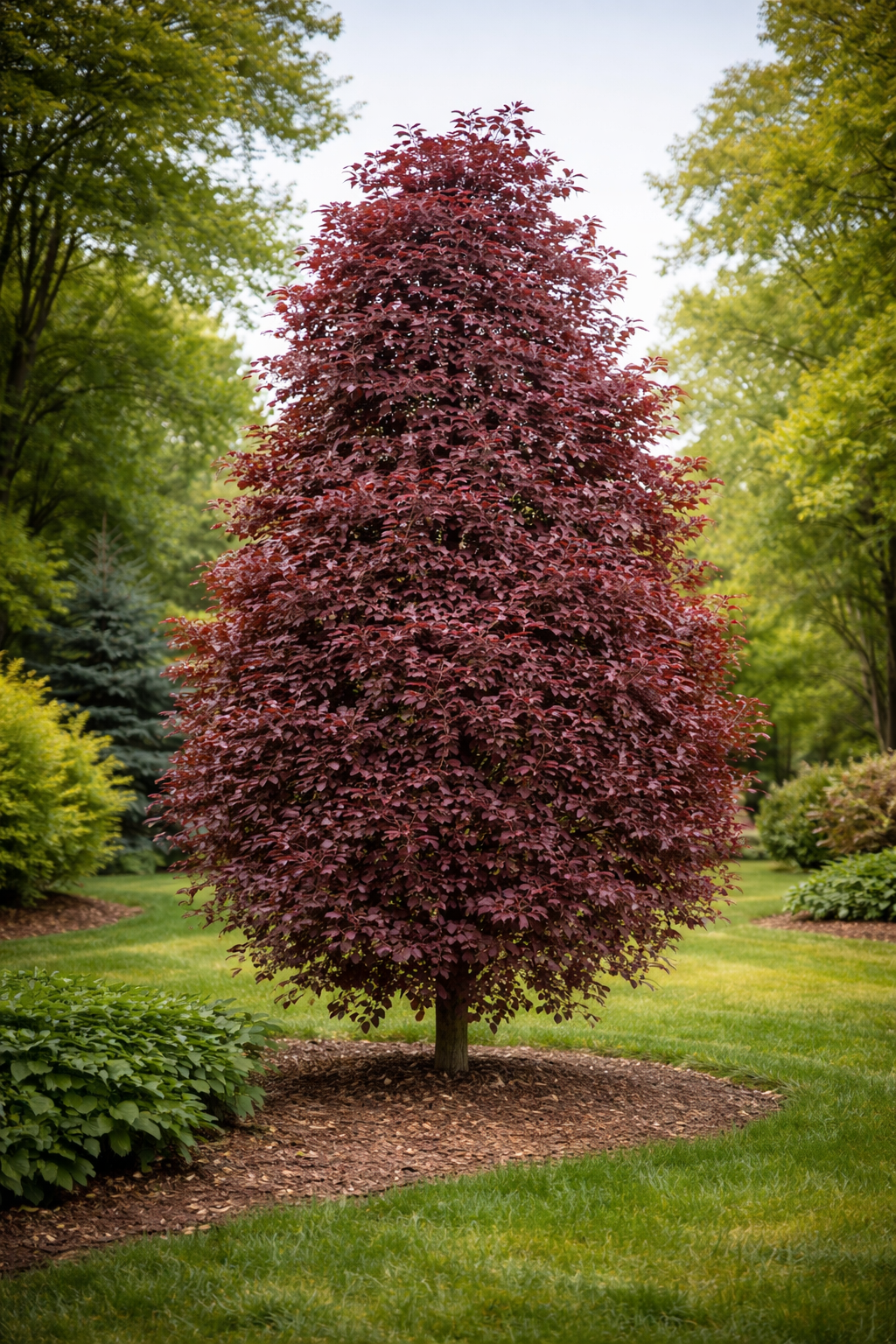
Columnar Zone 4 maple with dark-purple foliage
Crimson Sentry Norway maple
Acer platanoides ‘Crimson Sentry’
Products and available quantities may vary between Brossard and Laval. To check a store’s inventory, please contact us directly.
Even better: visit us in store to discover the full selection available!
- Quantity
- 7 gallons; 15 gallons; 200 cm; 250 cm; 50 mm
- Exposure
- Full sun; light partial shade tolerated
- Hardiness
- Canadian Zone 4
Discover the plant
Crimson Sentry Norway maple (Acer platanoides ‘Crimson Sentry’) is a narrowly upright deciduous tree selected for very dark red-purple foliage. Opposite broad leaves divided into five pointed lobes retain a burgundy tone through the growing season, then may become brownish or bronzy purple in autumn. Small yellow flowers tinged dark red appear before or with the leaves in spring. They may be followed by green and dark-red winged fruit whose widely spreading wings mature in autumn. The RHS gives an ultimate height of 8 to 12 m and width of 4 to 8 m, so the cultivar is narrower than the species but not a permanently small patio tree.
Hardy in Canadian Zone 4, Crimson Sentry prefers full sun for strong dark colour but tolerates light partial shade. Plant it in fertile, moist, well-drained soil; loam, clay and sand are acceptable where water does not remain stagnant. Keep the root flare visible, maintain 5 to 8 cm of mulch without touching the trunk and water deeply through the first two growing seasons. Once established, Norway maple tolerates urban heat and short droughts. Avoid concentrated salt, compaction and repeated heavy pruning. Remove only problematic wood after leaves expand, inspect branch unions after ice events and preserve an open soil area around the expanding root system.
In Québec, Acer platanoides is officially classified as a high-risk invasive alien plant and a priority for control. Seed can colonize woodlands, edges, vacant land and shorelines, where dense shade reduces plant diversity. Do not install Crimson Sentry beside natural habitat or a green corridor. Inspect the property and downwind areas in spring and autumn, then pull seedlings before they fruit. For a new planting close to nature, favour a locally native tree matched to the site’s dimensions and drainage. Canadian customers outside Québec should also check provincial and municipal guidance because invasive-species status and planting restrictions vary by region. Sale formats change neither mature size nor ecological responsibility.

Planting guide
From planting to establishment.
Soil and care
The right care,at the right time.
Soil pH
Minimum temperature
Care level
Drought tolerance
Watering
Soil type
Fertilization
Moisture
Seasonal care
Bloom and dimensions
Its place,in your garden.
Mature height
Width / spread
Flower color
Foliage color
Foliage type
Growth rate
Growth habit
Bloom period
Fruiting
Garden associations
In goodcompany.
Companion plants
Frequently asked questions
Your questions,answered.
How large does Crimson Sentry become?
Is Crimson Sentry invasive in Québec?
How can Crimson Sentry retain dark-purple foliage?
Which native trees can replace Crimson Sentry?
How should Crimson Sentry be pruned?
Wildlife and pets