


Native small tree with flowers, edible fruit, and fall colour
Lustre® serviceberry
Amelanchier laevis ‘Rogers’
Products and available quantities may vary between Brossard and Laval. To check a store’s inventory, please contact us directly.
Even better: visit us in store to discover the full selection available!
- Quantity
- 10 gallons; 16 gallons
- Exposure
- Full sun to partial shade; best bloom and fall colour in full sun
- Hardiness
- Zone 4
Discover the plant
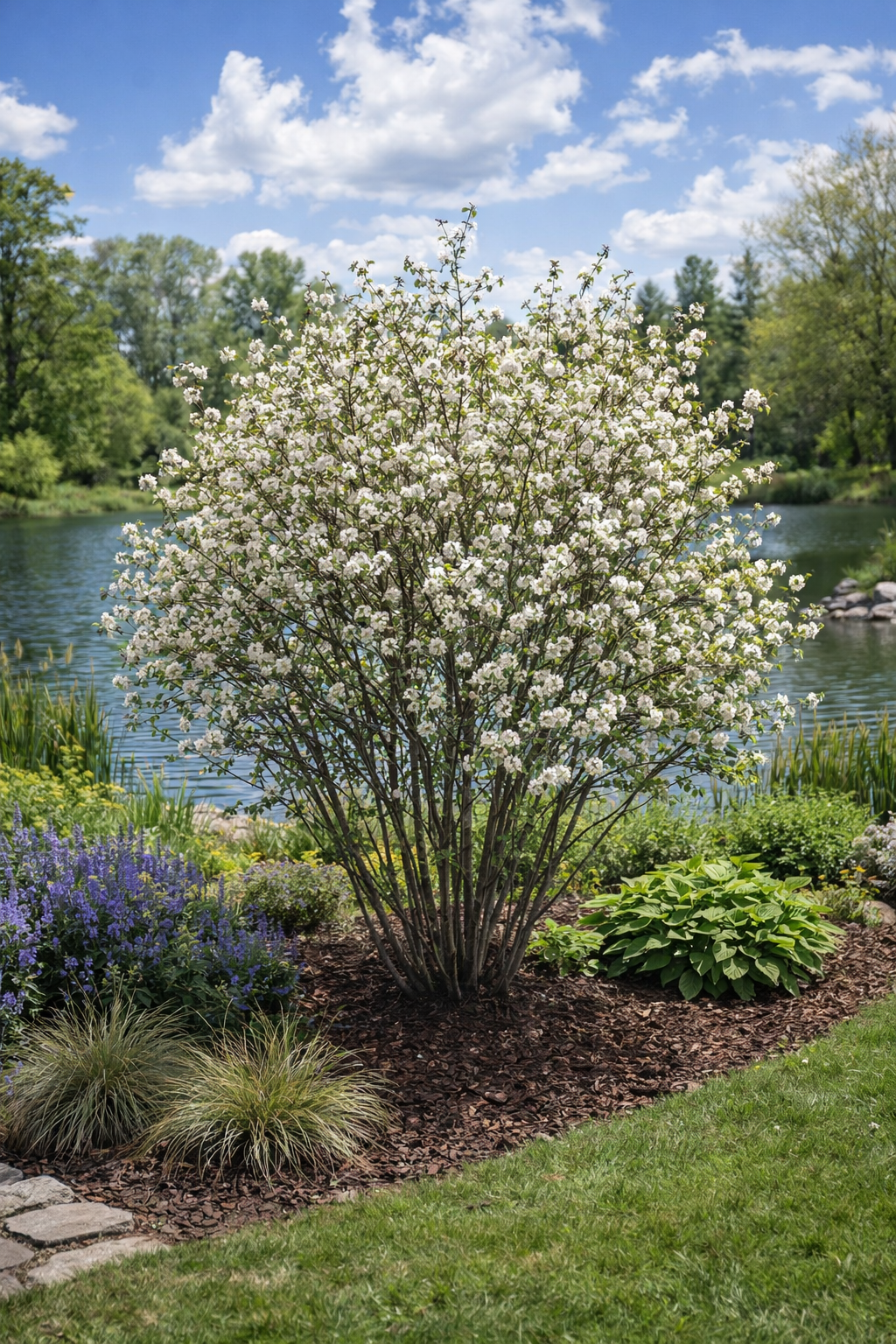
Lustre® serviceberry (Amelanchier laevis ‘Rogers’) is a native small tree with an upright open habit, selected for glossy foliage and minimal suckering. In early spring, clusters of lightly fragrant white flowers appear before or as bronze-purple leaves unfold. Small sweet edible fruit follows, ripening purple-black and attracting many birds. Foliage matures to glossy dark green in summer before turning orange-red in fall. Hardy to Zone 4, the tree reaches approximately 6 to 9 m high by 4.5 to 6 m wide (20 to 30 ft × 15 to 20 ft), providing flowers, fruit, fall colour, and smooth grey bark.
Plant Lustre® in full sun or partial shade and cool, slightly acidic to neutral, well-drained soil. Even moisture supports flowering, fruit set, and balanced growth, especially during the first two seasons. Dig a hole as deep as the root ball and twice as wide, keep the root flare level with the soil, and water thoroughly. Space trees 4.5 to 6 m (15 to 20 ft) apart. A 5 to 8 cm (2 to 3 in) organic mulch limits evaporation but should remain away from the trunk. Avoid stagnant water, very dry ground, and repeated road-salt splash.
Use this serviceberry as a small specimen tree, in a loose hedge, edible landscape, woodland edge, or bird-friendly planting. Fruit ripens in early summer; harvest when it becomes purple-black, before wildlife takes the crop. It can be eaten fresh or cooked in compote, pies, and preserves. Prune lightly and only after flowering to preserve buds formed on the previous season’s wood. Occasionally watch for rust, powdery mildew, leaf spots, and fire blight. Good air circulation and irrigation directed toward the soil reduce problems without compromising the tree’s ecological value. Several plants can create a productive naturalized grove where space allows.

Planting guide
From planting to establishment.
Soil and care
The right care,at the right time.
Soil pH
Minimum temperature
Care level
Drought tolerance
Watering
Soil type
Fertilization
Moisture
Seasonal care
Container growing
A garden,within reach.
Recommended pot size

Bloom and dimensions
Its place,in your garden.
Mature height
Width / spread
Flower color
Foliage color
Foliage type
Growth rate
Growth habit
Fragrance
Bloom period
Fruiting
Harvest
Garden associations
In goodcompany.
Companion plants
Plants to avoid
Recipe idea
From the gardento your plate.
Edible parts
Frequently asked questions
Your questions,answered.
How large does Lustre® serviceberry grow?
Is Lustre® serviceberry fruit edible?
Are two serviceberry trees needed for fruit?
When and how should Lustre® serviceberry be pruned?
Why are my serviceberry leaves spotted?
Wildlife and pets