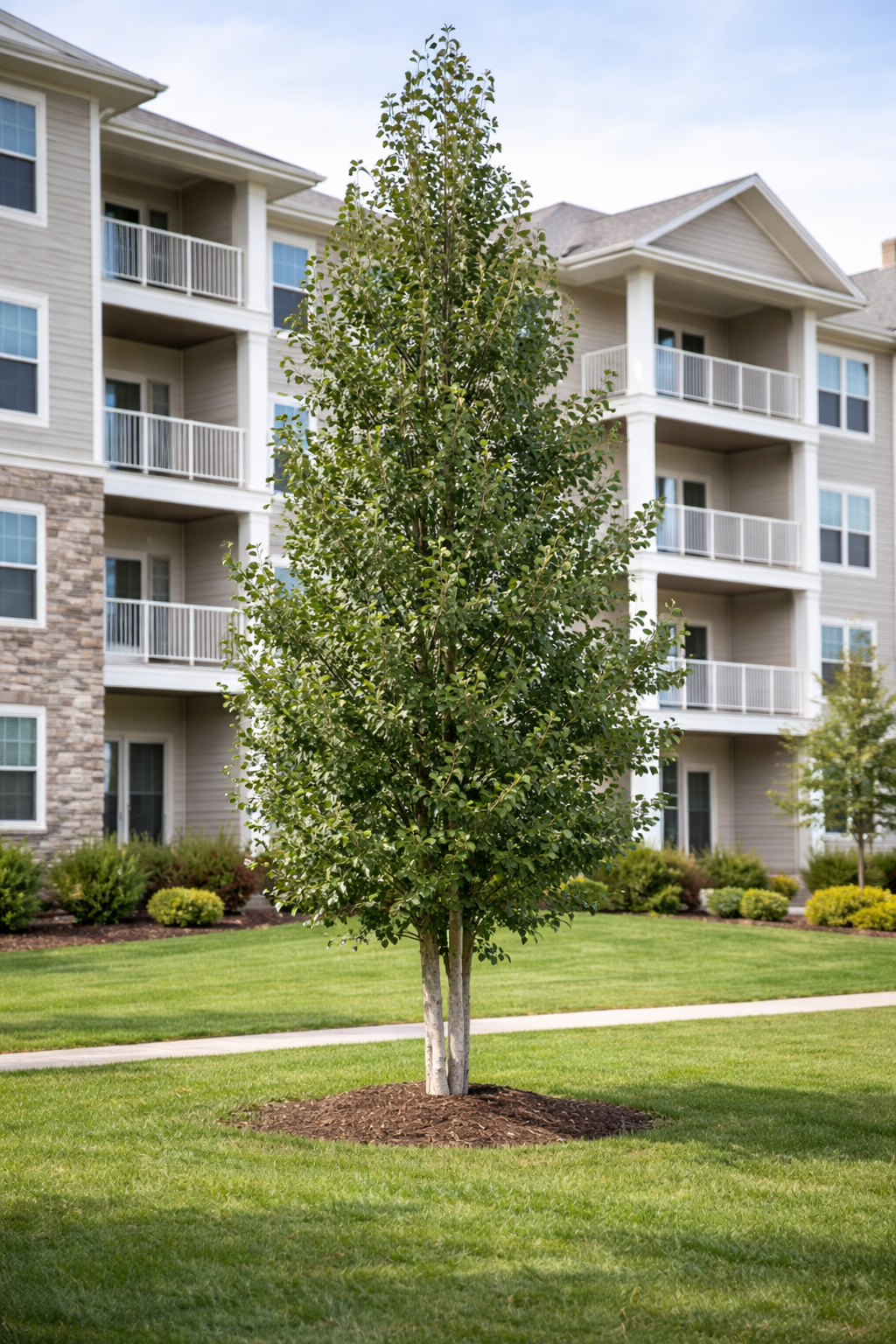
Hardy columnar white birch for narrow spaces

Dakota Pinnacle® birch

Betula platyphylla ‘Fargo’

Dakota Pinnacle® is an Asian white birch selected in Canada for its upright, narrow, densely branched habit. Dark-green foliage turns golden yellow in fall, while beige-white bark remains visible in winter. Allow approximately 10.5 to 12 m high by 3 to 3.7 m wide (35 to 40 ft × 10 to 12 ft). Hardy to Zone 3, it tolerates heat, dry periods, and alkaline soil better than many birches but prefers cool, evenly moist roots. Its columnar crown suits accents, privacy screens, boulevards, entrances, and urban allées where a conventional shade tree would become too broad. For best results, inspect soil moisture, the upper crown, and bark condition regularly.
7 gallons; 200 cm
Each store has its own inventory.

Products and available quantities may vary between Brossard and Laval. To check a store’s inventory, please contact us directly.

Even better: visit us in store to discover the full selection available!

Share
Quantity
7 gallons; 200 cm
Exposure
Full sun
Hardiness
Zone 3

Discover the plant

Common nameDakota Pinnacle® birch; Dakota Pinnacle® Asian white birch; columnar birch
FamilyBetulaceae
GenusBetula
Speciesplatyphylla
CultivarFargo
TypeColumnar deciduous tree with beige-white bark
Botanical nameBetula platyphylla ‘Fargo’

Dakota Pinnacle® birch (Betula platyphylla ‘Fargo’) is an Asian white birch selection developed by North Dakota State University for the demanding climate of the northern plains. Its narrow, stiffly upright, pyramidal crown suits properties where lateral space is limited. Dense dark-green foliage turns golden yellow in fall, then reveals bright white bark. Spring catkins and small brown cone-like fruit add subtle seasonal detail. At maturity, allow approximately 10.5 to 12 m of height by 3 to 3.7 m of spread (35 to 40 ft × 10 to 12 ft). Zone 3 hardiness makes it a dependable vertical tree for cold Canadian gardens.

Plant Dakota Pinnacle® in full sun and cool, well-drained soil that is slightly acidic to neutral. This selection tolerates heat, moderate drought, and alkaline soil better than many birches, yet consistent moisture maintains a healthier crown. Water deeply at planting and through the first seasons, especially during heat waves. Set the root flare at soil level, then apply 5 to 8 cm (2 to 3 in) of mulch without touching the trunk. Avoid compaction, standing water, and bark injury. Mulch keeps shallow roots cooler and reduces stress that can favour boring insects. An open, mulched root zone is preferable to dense turf around the trunk.

Use this birch as a vertical accent, narrow screen, boulevard tree, or architectural repetition along an entrance. Allow approximately 3.5 to 4.5 m (12 to 15 ft) between trunks to retain each crown’s individual outline; a tighter screen can require additional irrigation. Prune sparingly and remove mainly dead, broken, or crossing wood after heavy sap flow. Watch for upper-crown dieback, galleries beneath bark, mined leaves, and aphids. Slow irrigation, an uncompacted root zone, and renewed mulch support rapid growth, golden fall colour, and characteristic white bark. Its upright form brings shade and winter structure without occupying the width of a conventional birch.

Dakota Pinnacle® birch with a narrow pyramidal habit, showing dense dark-green foliage and bright white bark. Leaves turn golden yellow in fall. This view presents <em>Betula platyphylla</em> ‘Fargo’, a Zone 3 deciduous tree reaching approximately 10.5 to 12 m high by 3 to 3.7 m wide (35 to 40 ft × 10 to 12 ft), suited to vertical accents, narrow screens, boulevards, and urban allées.

Planting guide

From planting to establishment.

Spacing / density To preserve each tree’s individual form, allow approximately 3.5 to 4.5 m (12 to 15 ft) between trunks. For a more continuous narrow screen, spacing of about 3 to 3.5 m (10 to 12 ft) can work when soil remains cool and every tree receives enough light. Keep at least 3 to 3.7 m (10 to 12 ft) from walls, wires, and walkways as space permits.
Best planting time In spring after the soil thaws, or in early fall at least six weeks before persistent frost
Propagation Vegetative propagation to preserve the ‘Fargo’ cultivar faithfully

Soil and care

The right care,at the right time.

Soil pH

Slightly acidic to neutral, approximately 5.5 to 7.2; tolerates some alkalinity

Minimum temperature

Approximately -40 °C (-40 °F), Zone 3

Care level

Moderate

Drought tolerance

Yes

Watering

Water deeply after planting and keep the entire root ball evenly moist through the first seasons. Check soil beneath mulch and irrigate when the upper centimetres begin to dry. An established tree tolerates dry periods, but slow irrigation during heat waves keeps roots cool, reduces foliage dieback, and limits stress associated with boring insects. For best results, inspect soil moisture, the upper crown, and bark condition regularly.

Soil type

Cool, well-drained sandy, loamy, or light-clay soil is suitable, ideally acidic to neutral. Dakota Pinnacle® also tolerates alkaline ground and dry periods after establishment, but mulch and consistent moisture better support the crown. Avoid standing water, compaction, fill over the root flare, and surfaces that overheat the root zone. For best results, inspect soil moisture, the upper crown, and bark condition regularly.

Fertilization

A spring compost layer and organic mulch are often sufficient. When a soil test identifies a need, apply balanced slow-release fertilizer according to its label before midsummer. Avoid excessive nitrogen and late applications that produce tender growth. Correct watering, drainage, and compaction before fertilizing pale foliage. For best results, inspect soil moisture, the upper crown, and bark condition regularly. This attention supports a dense crown, pale bark, and lasting growth.

Moisture

Medium; cool soil without standing water

Seasonal care

In spring, inspect the upper crown, bark, and root flare, then remove dead or broken wood. Renew mulch without piling it against the trunk. Catkins appear in spring with or before the leaves. In summer, water slowly during hot periods and watch for mined leaves, aphids, and unusual top dieback. Look for small holes, galleries, or loosened bark that may indicate a borer. Avoid major pruning during heavy sap flow. In fall, enjoy the golden-yellow foliage, water deeply before freeze-up when soil is dry, and stop fertilizing. In winter, protect the young trunk from rodents, shovel impacts, and piles of salt-laden snow. Keep the root zone uncompacted and free of dense turf throughout the year. For best results, inspect soil moisture, the upper crown, and bark condition regularly. This attention supports a dense crown, pale bark, and lasting growth. For best results, inspect soil moisture, the upper crown, and bark condition regularly. This attention supports a dense crown, pale bark, and lasting growth. For best results, inspect soil moisture, the upper crown, and bark condition regularly. This attention supports a dense crown, pale bark, and lasting growth. For best results, inspect soil moisture, the upper crown, and bark condition regularly. This attention supports a dense crown, pale bark, and lasting growth. For best results, inspect soil moisture, the upper crown, and bark condition regularly.

Container growing

A garden,within reach.

Recommended pot size

At least 75 to 115 L (20 to 30 US gal) for a young tree temporarily
Temporary culture in a large container is possible for a young tree, but planting in the ground better supports its 10.5 to 12 m (35 to 40 ft) mature height. Choose a stable, well-drained, insulated container of at least 75 to 115 L (20 to 30 US gal). Water regularly, protect the root ball from repeated freezing and thawing, and repot or plant before roots circle severely.
Dakota Pinnacle® birch (Betula platyphylla ‘Fargo’)

Bloom and dimensions

Its place,in your garden.

Mature height

10 to 12 m (33 to 39 ft)

Width / spread

2 m (6.5 ft)

Flower color

Subtle yellow-brown to greenish catkins

Foliage color

Dark green in summer, golden yellow in fall

Foliage type

Deciduous; simple oval to triangular finely toothed leaves

Growth rate

Fast

Growth habit

Narrow, upright, columnar to pyramidal, and densely branched

Fragrance

No notable ornamental fragrance

Bloom period

Pendant male catkins and shorter female catkins appear in spring with or before the leaves. Their yellow-brown to greenish colour remains subtle; the columnar habit, foliage, and bark are the main attractions. Pollen is carried by wind. Avoid major pruning during heavy sap flow to limit bleeding and preserve the outline. For best results, inspect soil moisture, the upper crown, and bark condition regularly.

Fruiting

Female catkins become small pendant cone-like structures containing numerous winged seeds that mature in late summer. Fruit is subtle and not the main attraction. Leave it for small birds or collect debris from paved surfaces. Seedlings do not reproduce the ‘Fargo’ cultivar’s columnar form faithfully. For best results, inspect soil moisture, the upper crown, and bark condition regularly. This attention supports a dense crown, pale bark, and lasting growth.
Dakota Pinnacle® birch with a narrow pyramidal habit, showing dense dark-green foliage and bright white bark. Leaves turn golden yellow in fall. This view presents Betula platyphylla ‘Fargo’, a Zone 3 deciduous tree reaching approximately 10.5 to 12 m high by 3 to 3.7 m wide (35 to 40 ft × 10 to 12 ft), suited to vertical accents, narrow screens, boulevards, and urban allées.

Garden associations

In goodcompany.

Companion plants

Pair Dakota Pinnacle® with dark spruces or junipers, red-stemmed dogwoods, golden grasses, hostas, ferns, hardy geraniums, or spring bulbs according to available light. Choose plants with limited root competition, keep the root flare clear, and maintain continuous mulch so birch roots remain cool. For best results, inspect soil moisture, the upper crown, and bark condition regularly. This attention supports a dense crown, pale bark, and lasting growth. For best results, inspect soil moisture, the upper crown, and bark condition regularly.

Plants to avoid

Avoid compaction, overheated roots, standing water, burial of the root flare, trunk injury, and long dry periods during establishment. Prolonged stress can favour bronze birch borer and upper-crown dieback. Also watch for leaf miners, aphids, and foliar diseases. Correct watering and protect the root zone before selecting a targeted treatment. For best results, inspect soil moisture, the upper crown, and bark condition regularly. This attention supports a dense crown, pale bark, and lasting growth. For best results, inspect soil moisture, the upper crown, and bark condition regularly.

Frequently asked questions

Your questions,answered.

How large does Dakota Pinnacle® birch become?
Dakota Pinnacle® generally reaches approximately 10.5 to 12 m high by 3 to 3.7 m wide (35 to 40 ft × 10 to 12 ft). Its narrow, stiffly upright, pyramidal crown creates height without occupying the width of a conventional birch. Allow enough room for roots and keep it away from overhead wires. To preserve each tree as a distinct specimen in an allée, space trunks approximately 3.5 to 4.5 m (12 to 15 ft) apart. Tighter spacing creates a continuous screen but increases competition for water and light and can require more attentive irrigation. For best results, inspect soil moisture, the upper crown, and bark condition regularly.
Is Dakota Pinnacle® birch hardy in cold climates?
Yes. Betula platyphylla ‘Fargo’ is a Zone 3 North Dakota State University selection developed for the demanding climate of the northern plains. This hardiness suits many cold Canadian regions when the planting site is appropriate. Strong top hardiness does not protect an above-ground container root ball or a newly planted tree from drying. Water deeply before freeze-up when fall is dry, keep the root flare exposed, and apply mulch without touching the trunk. Protect young trees from rodents and piles of heavily salted snow. Container-grown roots require substantially more winter protection than roots planted in the ground. For best results, inspect soil moisture, the upper crown, and bark condition regularly.
What soil and watering suit Dakota Pinnacle® birch?
Choose cool, well-drained, slightly acidic to neutral soil and a full-sun exposure. Dakota Pinnacle® tolerates alkaline soil, heat, and moderate drought after establishment, but its roots benefit from consistent moisture. Irrigate slowly enough to moisten the entire root ball through the first seasons, then water during heat waves when the upper soil begins to dry. Apply 5 to 8 cm (2 to 3 in) of mulch without covering the root flare. Avoid standing water, compaction, and dense turf directly around the trunk. Mulch also moderates soil temperature, protects shallow roots, and reduces stress during hot dry weather. For best results, inspect soil moisture, the upper crown, and bark condition regularly.
How can bronze birch borer risk be reduced?
Dakota Pinnacle® was selected partly for resistance to bronze birch borer, but no stressed birch should be neglected. Keep roots cool with a mulched zone, water deeply during establishment and long hot periods, and avoid compaction and trunk injury. Inspect the upper crown regularly for unusual dieback. Also look for small holes, galleries beneath bark, or loosened bark. When these signs appear, obtain a prompt diagnosis. Correct watering and root-zone health first, then follow local recommendations before choosing any treatment. Preventing drought stress and physical damage remains the most useful long-term protection for a landscape birch. For best results, inspect soil moisture, the upper crown, and bark condition regularly.
When and how should Dakota Pinnacle® birch be pruned?
The narrow pyramidal form requires little pruning. Remove only dead, broken, diseased, or crossing wood and branches that genuinely obstruct a walkway. Avoid large cuts in early spring during heavy sap flow because they can bleed profusely. Work after leaves have fully expanded or during an appropriate period recommended locally to reduce this issue. Do not shorten the entire crown uniformly or remove the central leader without a structural reason. Use clean tools, cut just outside the branch collar, and do not cover the wound with paint. Appropriate placement at planting time eliminates most corrective pruning and preserves the cultivar’s upright outline.

Wildlife and pets

Life,around your plants.

Attracts birds

Yes

Supporting wildlife

Catkins and small winged seeds can feed various insects and birds, while the dense crown offers perches and light shelter. Birches also serve as host plants for some caterpillars. Add fruiting shrubs and nectar-rich perennials to diversify resources, and avoid broad-spectrum insecticides when damage remains minor.