


Exceptionally hardy columnar white birch for narrow spaces
Parkland Pillar® birch
Betula platyphylla ‘Jefpark’
Products and available quantities may vary between Brossard and Laval. To check a store’s inventory, please contact us directly.
Even better: visit us in store to discover the full selection available!
- Quantity
- 5 gallons; 7 gallons; 250 cm
- Exposure
- Full sun
- Hardiness
- Zone 2
Discover the plant
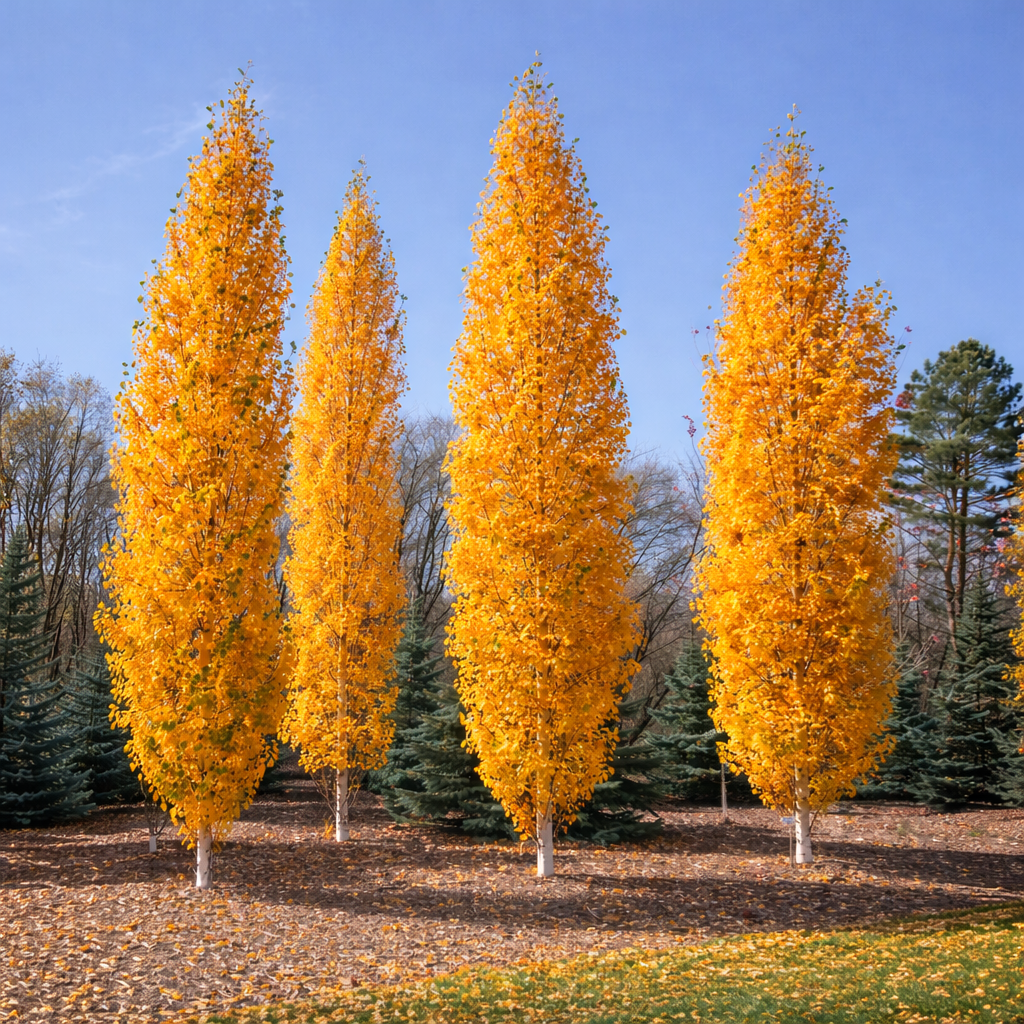
Parkland Pillar® birch (Betula platyphylla ‘Jefpark’) is a Canadian selection of Asian white birch discovered in Red Deer, Alberta. Its upright, exceptionally narrow, densely branched habit forms an elegant column for sites with limited lateral space. Dark-green foliage turns golden yellow in fall, then drops to reveal beige-white bark that brightens the winter garden. Spring catkins remain secondary to the outline and bark. Depending on conditions and training, allow approximately 9 to 10 m of height by 2 to 3 m of spread (30 to 33 ft × 7 to 10 ft). Canadian breeder information supports its use in Zone 2, making it valuable in cold prairie and northern urban landscapes.
Plant Parkland Pillar® in full sun and cool, well-drained soil that is slightly acidic to neutral. This selection tolerates heat, dry periods, and alkaline ground better than many birches, yet develops a healthier crown when roots remain cool and evenly moist. Water deeply at planting and through the first seasons, especially during heat waves. Set the root flare at soil level, then apply 5 to 8 cm (2 to 3 in) of mulch without touching the trunk. Avoid compaction, standing water, and bark injury. A maintained mulch layer reduces root stress that can favour bronze birch borer and preserves a more uniform soil temperature.
Use this birch as a vertical accent, narrow screen, entrance allée, boulevard tree, or architectural repetition in an urban yard. Allow approximately 2.5 to 3.5 m (8 to 12 ft) between trunks to retain each tree’s individual form; a tighter screen can require more pruning and irrigation. Prune sparingly, preferably after heavy sap flow has passed, to remove dead, broken, or crossing wood. Watch for top dieback, galleries beneath bark, mined leaves, and aphids. Slow irrigation, an uncompacted root zone, and renewed mulch support vigour, golden fall colour, and the characteristic pale bark. Its narrow crown provides privacy without occupying the width of a conventional shade tree.

Planting guide
From planting to establishment.
Soil and care
The right care,at the right time.
Soil pH
Minimum temperature
Care level
Drought tolerance
Watering
Soil type
Fertilization
Moisture
Seasonal care
Container growing
A garden,within reach.
Recommended pot size

Bloom and dimensions
Its place,in your garden.
Mature height
Width / spread
Flower color
Foliage color
Foliage type
Growth rate
Growth habit
Fragrance
Bloom period
Fruiting
Garden associations
In goodcompany.
Companion plants
Plants to avoid
Frequently asked questions
Your questions,answered.
How large does Parkland Pillar® birch become?
Is Parkland Pillar® birch hardy to Zone 2?
What soil and watering suit Parkland Pillar® birch?
How can bronze birch borer risk be reduced?
When and how should Parkland Pillar® birch be pruned?
Wildlife and pets