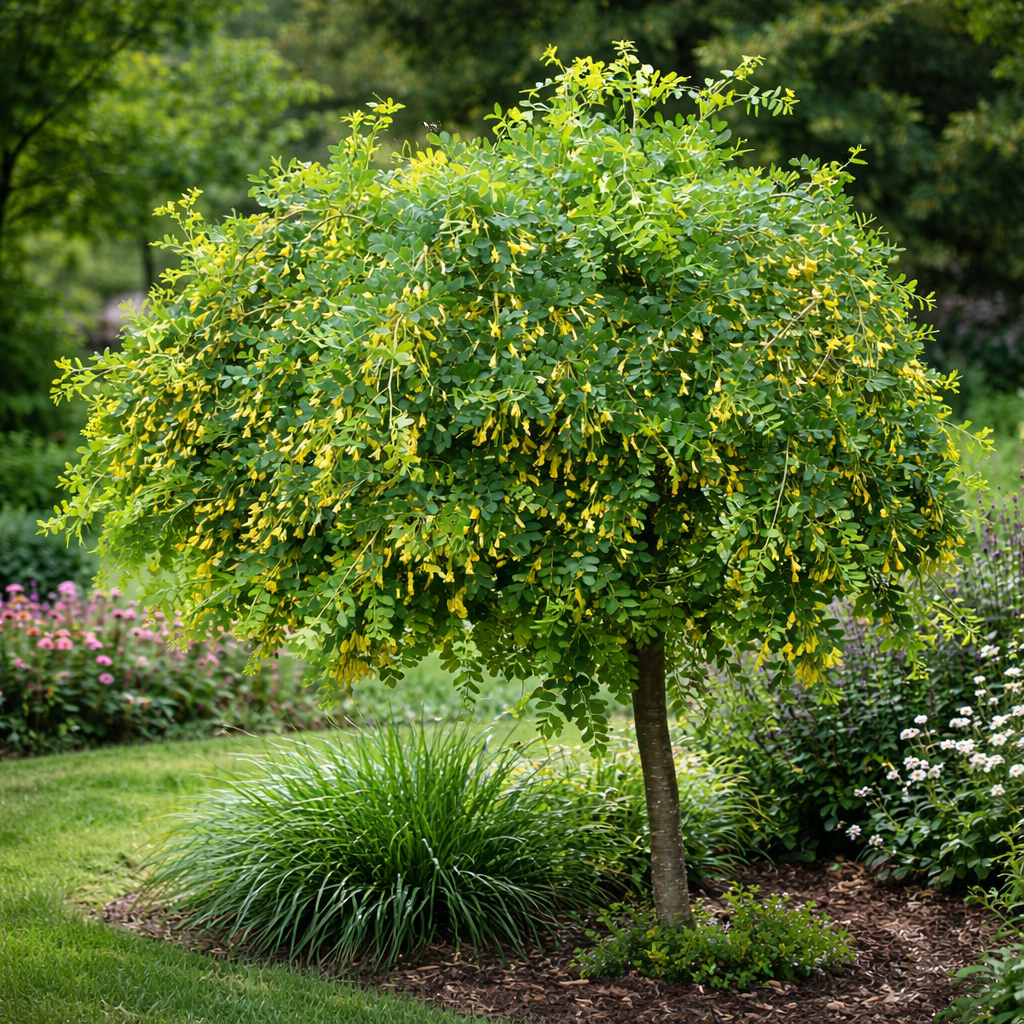
Exceptionally hardy small weeping tree with a dense crown

Pendula weeping peashrub

Caragana arborescens ‘Pendula’

Pendula weeping peashrub is a small tree grafted on a standard whose stiff arching shoots descend around the trunk. Its light-green compound leaves have oval leaflets broader than those of ‘Walker’. Yellow pea-shaped flowers appear in late spring and may be followed by slender pods. Height depends on graft position; allow approximately 1 to 2.5 m high by 1 to 2 m wide (3 to 8 ft × 3 to 7 ft). Hardy to Zone 2, it tolerates severe cold, wind, poor soil, and drought after establishment. The dense cascading crown creates a distinctive architectural accent. For best results, inspect soil moisture, the graft union, and foliage response regularly.
7 gallons; 100 cm / Standard; 150 cm / Standard
Each store has its own inventory.

Products and available quantities may vary between Brossard and Laval. To check a store’s inventory, please contact us directly.

Even better: visit us in store to discover the full selection available!

Share
Quantity
7 gallons; 100 cm / Standard; 150 cm / Standard
Exposure
Full sun
Hardiness
Zone 2

Discover the plant

Common namePendula weeping peashrub; weeping Siberian peashrub; weeping caragana
FamilyFabaceae
GenusCaragana
Speciesarborescens
CultivarPendula
TypeSmall deciduous weeping tree grafted on a standard
Botanical nameCaragana arborescens ‘Pendula’

Pendula weeping peashrub (Caragana arborescens ‘Pendula’) is a small deciduous tree generally grafted on a standard. Its stiff shoots arch and then descend around the trunk, forming a dense cascading crown. Light-green compound leaves carry oval leaflets similar to those of the species, distinguishing ‘Pendula’ from the much narrower foliage of ‘Walker’. Pale to bright yellow pea-shaped flowers appear in late spring and may be followed by slender pods. Height depends mainly on the graft position. Depending on nursery format and training, allow approximately 1 to 2.5 m of height by 1 to 2 m of spread (3 to 8 ft × 3 to 7 ft).

Plant ‘Pendula’ in full sun and well-drained soil. It accepts chalk, clay, loam, or sand and tolerates acidic, neutral, or alkaline conditions. Hardy to Zone 2, this peashrub withstands severe cold, wind, poor soil, and dry periods after establishment. Water deeply at planting and during the first seasons so the entire root ball remains evenly moist without standing in water. Set the root flare at soil level and keep the graft union exposed. Apply 5 to 8 cm (2 to 3 in) of mulch without touching the trunk, then promptly remove every shoot that emerges below the graft because it belongs to the rootstock.

Use ‘Pendula’ as a specimen in a small lawn, entrance accent, courtyard tree, architectural border feature, or living cascade above a low wall. Branches can reach the ground, so keep it away from narrow walkways and let its outline develop freely. Light pruning is sufficient to remove dead, broken, or crossing wood and shorten a shoot that blocks circulation. Avoid shearing the entire crown to one height. Watch for spider mites, aphids, and leafhoppers when foliage becomes discoloured, particularly during hot dry weather. With a protected graft union, dependable drainage, and limited root competition, this small tree maintains its distinctive weeping habit for many years.

Pendula weeping peashrub grafted on a standard, showing a dense crown of stiff arching branches that descend around the trunk. Light-green compound foliage has oval leaflets, and yellow pea-shaped flowers appear in late spring. This view shows <em>Caragana arborescens</em> ‘Pendula’, a Zone 2 deciduous tree reaching approximately 1 to 2.5 m high by 1 to 2 m wide (3 to 8 ft × 3 to 7 ft), depending on graft height.

Planting guide

From planting to establishment.

Spacing / density Allow approximately 2 to 3 m (7 to 10 ft) between trunks or between the tree and a structure so drooping branches can reach the ground without tangling. Height depends on graft position, but the crown can spread to approximately 2 m (7 ft). Keep walkways, walls, and neighbouring plants beyond the mature cascade.
Best planting time In spring after the soil thaws, or in early fall at least six weeks before persistent frost
Propagation Grafting the cultivar onto a <em>Caragana arborescens</em> standard

Soil and care

The right care,at the right time.

Soil pH

Acidic to alkaline, approximately 5.5 to 8.0; avoid extremely calcareous conditions

Minimum temperature

Approximately -45 °C (-49 °F), Zone 2

Care level

Easy

Drought tolerance

Yes

Watering

Water deeply after planting and keep the root ball evenly moist during the first seasons. Hydration is especially important during transport, storage, and transplanting. Check soil beneath mulch and irrigate when the upper centimetres begin to dry. An established tree tolerates drought well, but occasional water during a long hot period discourages spider mites and preserves dense foliage. For best results, inspect soil moisture, the graft union, and foliage response regularly.

Soil type

Well-drained chalk, clay, loam, or sand is suitable. ‘Pendula’ accepts average or poor soil and acidic, neutral, or alkaline conditions. Once established, it tolerates wind, salt, and dry periods, but a young tree’s root ball should remain evenly moist. Avoid prolonged standing water, compacted soil, and strong weed competition around the trunk. For best results, inspect soil moisture, the graft union, and foliage response regularly.

Fertilization

In poor soil, a thin spring compost layer and organic mulch are often sufficient. Caragana fixes nitrogen through bacteria associated with its roots, so heavy nitrogen application is unnecessary. When a soil test identifies a need, apply balanced slow-release fertilizer according to the label. Avoid late fertilization that produces tender growth before winter. For best results, inspect soil moisture, the graft union, and foliage response regularly.

Moisture

Low to medium after establishment; dependable drainage required

Seasonal care

In spring, inspect the graft, remove rootstock shoots, and renew mulch without covering the trunk. Yellow flowers generally appear in May. In summer, water young trees during dry periods and watch for spider mites or thrips, especially when foliage becomes pale or stippled. Remove weeds competing with the roots. In fall, stop fertilizing and confirm that ties do not constrict the standard. During dormancy, remove dead, broken, or crossing wood and shorten only shoots obstructing a walkway. In winter, protect the trunk from rodents, shovel impacts, and piles of salt-laden snow without enclosing the crown beneath fabric. For best results, inspect soil moisture, the graft union, and foliage response regularly. This attention preserves the small tree’s natural cascade and lasting vigour. For best results, inspect soil moisture, the graft union, and foliage response regularly. This attention preserves the small tree’s natural cascade and lasting vigour. For best results, inspect soil moisture, the graft union, and foliage response regularly. This attention preserves the small tree’s natural cascade and lasting vigour. For best results, inspect soil moisture, the graft union, and foliage response regularly. This attention preserves the small tree’s natural cascade and lasting vigour. For best results, inspect soil moisture, the graft union, and foliage response regularly. This attention preserves the small tree’s natural cascade and lasting vigour. For best results, inspect soil moisture, the graft union, and foliage response regularly.

Container growing

A garden,within reach.

Recommended pot size

At least 50 to 75 L (13 to 20 US gal) for a young tree
Container culture is possible in a large stable, well-drained, insulated planter. Provide at least 50 to 75 L (13 to 20 US gal) for a young tree and protect the root ball from repeated freezing and thawing. Water regularly because container roots dry faster even though the plant tolerates drought in the ground. Garden planting remains preferable for lasting vigour.
Pendula weeping peashrub (Caragana arborescens ‘Pendula’)

Bloom and dimensions

Its place,in your garden.

Mature height

2 to 3 m (6 to 10 feet)

Width / spread

3 m (10 feet)

Flower color

Bright yellow

Foliage color

Light green from spring through fall

Foliage type

Deciduous; pinnately compound leaves with oval leaflets

Growth rate

Slow to moderate

Growth habit

Weeping, arching, cascading, and dense

Fragrance

No notable ornamental fragrance

Bloom period

Pale to bright yellow flowers typical of the pea family appear in late spring. Their shape resembles a small pea blossom, and clusters develop along drooping shoots among compound leaves. Bloom adds a bright accent without hiding the weeping outline. Avoid heavy pruning immediately before flowers open; remove only dead, broken, or diseased wood and shoots developing below the graft.

Fruiting

Slender pods may form after flowering. They progress from green to brown during summer and may split open at maturity. Fruit resembles that of the species and is generally not the cultivar’s main ornamental feature. Do not present the seeds as garden food; allow pods to dry naturally or remove them if they fall on a frequently used walkway. For best results, inspect soil moisture, the graft union, and foliage response regularly.
Pendula weeping peashrub grafted on a standard, showing a dense crown of stiff arching branches that descend around the trunk. Light-green compound foliage has oval leaflets, and yellow pea-shaped flowers appear in late spring. This view shows Caragana arborescens ‘Pendula’, a Zone 2 deciduous tree reaching approximately 1 to 2.5 m high by 1 to 2 m wide (3 to 8 ft × 3 to 7 ft), depending on graft height.

Garden associations

In goodcompany.

Companion plants

Pair Pendula weeping peashrub with sedums, creeping thymes, small grasses, low junipers, spring bulbs, or hardy geraniums suited to drained soil. Choose low plants that do not hide drooping branches and keep the root flare clear. A dark evergreen background emphasizes light-green foliage and yellow flowers. For best results, inspect soil moisture, the graft union, and foliage response regularly. This attention preserves the small tree’s natural cascade and lasting vigour. For best results, inspect soil moisture, the graft union, and foliage response regularly.

Plants to avoid

Avoid standing water, burial of the graft, strong weed competition, trunk injury, and uniform shearing of the entire cascade. Extremely alkaline soil can reduce growth. Watch for spider mites and thrips during hot dry weather and for vigorous shoots below the graft. Correct water, drainage, and competition before applying treatment. For best results, inspect soil moisture, the graft union, and foliage response regularly. This attention preserves the small tree’s natural cascade and lasting vigour. For best results, inspect soil moisture, the graft union, and foliage response regularly.

Frequently asked questions

Your questions,answered.

How large does Pendula weeping peashrub become?
Size depends mainly on graft height because shoots arch and descend rather than developing a taller trunk. Depending on nursery format, site, and pruning, allow approximately 1 to 2.5 m of height by 1 to 2 m of spread (3 to 8 ft × 3 to 7 ft). A tree grafted at 100 or 150 cm establishes its crown near that height, then gains mainly in width and branch length. Let the cascade develop freely without blocking a walkway, touching a wall, or tangling with a neighbouring shrub. Placement at planting time determines how much corrective pruning will be needed later.
What is the difference between ‘Pendula’ and ‘Walker’?
Both cultivars form a weeping crown and are commonly grafted on standards. ‘Pendula’, however, carries compound leaves with oval leaflets resembling those of Siberian peashrub and creates a denser, leafier cascade. ‘Walker’ has much narrower, almost threadlike leaflets that produce a light fernlike texture. ‘Pendula’ also has stiff shoots that arch before descending. Choose ‘Pendula’ for a full, traditional-looking small weeping tree and ‘Walker’ for a finer, airier effect. Always retain the exact cultivar name because the two forms are not interchangeable, even though their cold hardiness, yellow flowers, and general soil tolerance are similar. For best results, inspect soil moisture, the graft union, and foliage response regularly.
Does Pendula caragana tolerate drought and salt?
Yes. A well-rooted specimen generally tolerates drought, poor soil, wind, and some salinity. This resilience does not replace watering during transport, planting, and the first seasons. Keep the root ball evenly moist without saturating it, then gradually extend intervals as roots explore surrounding soil. Avoid piling heavily salted snow against the trunk or graft. Mulch kept away from the root flare reduces evaporation and weed competition. In a container, water more often because the exposed root ball dries much faster than soil in the ground, even with a naturally drought-tolerant plant. Dependable drainage remains essential in every setting. For best results, inspect soil moisture, the graft union, and foliage response regularly.
How should a grafted Pendula caragana be pruned?
During dormancy, remove dead, broken, diseased, or crossing wood and shorten only shoots that block a walkway or trail undesirably. Preserve the natural arches and avoid cutting the entire crown to a uniform height. Inspect the trunk and base several times during the season. Every shoot emerging below the graft belongs to the rootstock and should be removed cleanly at its point of origin before becoming vigorous. Never cover the graft with soil or mulch. Use clean tools and avoid removing a large proportion of living foliage in one operation. Choosing enough space at planting time greatly reduces future corrective pruning.
Why is my Pendula caragana foliage turning pale?
Pale, stippled, or distorted foliage can indicate spider mites, aphids, or leafhoppers, especially during hot dry weather. Inspect leaflet undersides for fine webbing, tiny insects, white cast skins, or irregular discoloration. Also check root-ball moisture, drainage, and weed competition. Water deeply when soil is dry and reduce dust around the plant. A firm spray of water can dislodge a light spider-mite or aphid population. If damage continues, choose a targeted treatment compatible with beneficial insects and follow its label carefully. Do not apply fertilizer automatically because it will not correct pests, root stress, or poor drainage. For best results, inspect soil moisture, the graft union, and foliage response regularly.

Wildlife and pets

Life,around your plants.

Supporting wildlife

Yellow flowers provide pollen and nectar for various spring insects. The drooping crown also offers light shelter and temporary perching structure. Avoid broad-spectrum insecticides when damage remains minor, then add nectar-rich perennials nearby to extend floral resources after the caragana’s brief bloom. For best results, inspect soil moisture, the graft union, and foliage response regularly.