


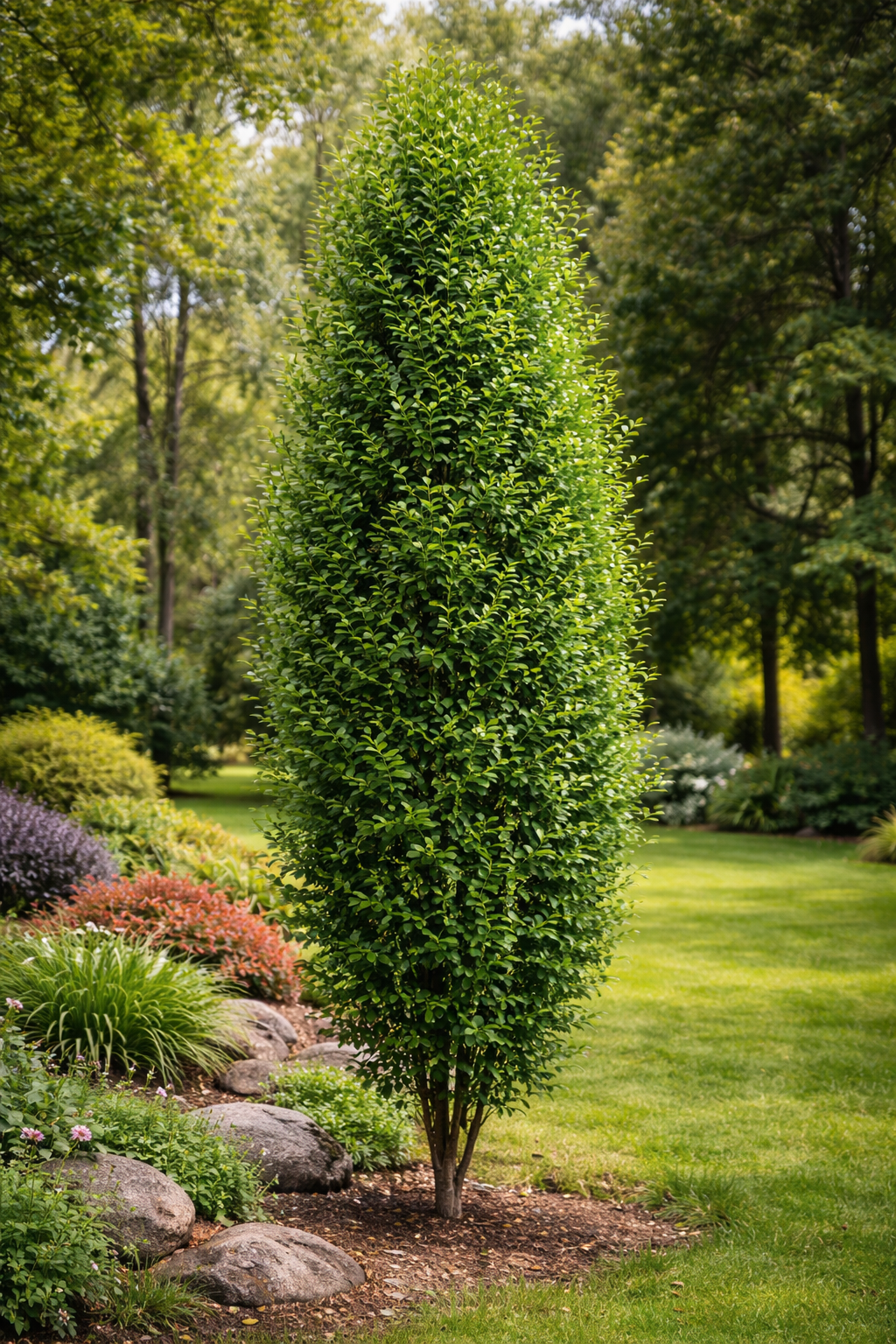
Hardy columnar tree with golden fall foliage
Columnar hornbeam ‘Frans Fontaine’
Carpinus betulus ‘Frans Fontaine’
Products and available quantities may vary between Brossard and Laval. To check a store’s inventory, please contact us directly.
Even better: visit us in store to discover the full selection available!
- Quantity
- 7 gallons; 200 cm; 15 gallons; 45 mm
- Exposure
- Full sun to partial shade
- Hardiness
- Zone 4
Discover the plant
Columnar hornbeam ‘Frans Fontaine’ (Carpinus betulus ‘Frans Fontaine’) develops a narrow upright deciduous tree suited to sites with limited lateral room. Smooth grey bark gradually darkens with age. Serrated leaves emerge fresh green, remain green through summer, and turn rich golden yellow in fall. Some foliage becomes brown and often remains attached through winter before dropping in spring, extending the screening effect. This cultivar carries green male catkins only in April and therefore does not produce the winged fruit clusters associated with female flowers. At maturity, allow approximately 8 to 12 m of height by 2.5 to 4 m of spread (26 to 39 ft × 8 to 13 ft).
Plant ‘Frans Fontaine’ in full sun or partial shade. It adapts to clay, loam, sand, or chalk and acidic, neutral, or alkaline pH. Moist, well-drained soil supports establishment, but a rooted tree also tolerates drier or wetter periods. Hardy to Zone 4, this hornbeam suits cold climates. Water deeply during the first seasons and drought, then maintain 5 to 8 cm (2 to 3 in) of mulch away from the trunk. Set the root flare at soil level, avoid compaction, and reserve enough room for mature spread even though the outline remains distinctly columnar. Established trees accept exposed or sheltered locations.
Use ‘Frans Fontaine’ as an architectural accent, narrow screen, street tree, formal row, vertical punctuation, or tall hedge. Space trees for the intended effect without compressing mature crowns. Light pruning is sufficient when grown as a tree: remove dead, crossing, or damaged wood from late summer through midwinter to reduce sap bleeding. It also accepts firmer pruning when trained as a hedge. Watch for aphids, caterpillars, leaf spots, powdery mildew, coral spot, and occasional honey fungus. Through its narrow profile, golden foliage, smooth bark, and retained brown winter leaves, this European hornbeam provides four-season structure while fitting places that would be too confined for a broad shade tree.

Planting guide
From planting to establishment.
Soil and care
The right care,at the right time.
Soil pH
Minimum temperature
Care level
Drought tolerance
Watering
Soil type
Fertilization
Moisture
Seasonal care
Container growing
A garden,within reach.
Recommended pot size

Bloom and dimensions
Its place,in your garden.
Mature height
Width / spread
Flower color
Foliage color
Foliage type
Growth rate
Growth habit
Fragrance
Bloom period
Fruiting
Harvest
Garden associations
In goodcompany.
Companion plants
Plants to avoid
Frequently asked questions
Your questions,answered.
How large does ‘Frans Fontaine’ hornbeam become?
Does Frans Fontaine hornbeam retain leaves in winter?
How far apart should columnar hornbeams be planted?
When should Carpinus betulus ‘Frans Fontaine’ be pruned?
Does Frans Fontaine hornbeam produce fruit?
Wildlife and pets