Les jardins de l'écoumène

Daucus carota

Daucus carota var. sativus

This organic carrot mix brings colour, variety and culinary interest to the vegetable garden, with an assortment of different roots that turns each harvest into an opportunity to discover another flavourful carrot. Grown for their appearance as well as their eating quality, these carrots provide a range of shapes, textures and colours that keep the garden rows interesting and add variety to meals throughout the season. Their finely divided leaves give the vegetable garden a light, airy appearance throughout growth; if plants are left in place to flower during their second year, the blooms can become particularly attractive to visiting pollinating insects.
Sold as 500 seeds
4 49 $

Sold out

Pay in 4 interest-free payments withSezzle

Delivery and pickup: view conditions

Product information
Québec product
Secure payment
Share

Discover the plant

Common nameMixed Carrots
FamilyApiaceae
GenusCarrot
Speciescarrot
TypeVegetable
Botanical nameDaucus carota var. sativus
Reproducible seedsYes

Daucus carota — Mixed Carrots. This organic carrot mix brings colour, variety and culinary interest to the vegetable garden, with an assortment of different roots that turns each harvest into an opportunity to discover another flavourful carrot. Grown for their appearance as well as their eating quality, these carrots provide a range of shapes, textures and colours that keep the garden rows interesting and add variety to meals throughout the season. Their finely divided leaves give the vegetable garden a light, airy appearance throughout growth; if plants are left in place to flower during their second year, the blooms can become particularly attractive to visiting pollinating insects.

Recommended sowing time: in spring, as soon as the soil has drained enough to be worked; adjust later sowings to the season and the intended harvest. The depth to be respected is 1 to 1.5 cm (3/8 to 5/8 in.). Germination usually takes 10 to 21 days. For germination, keep the soil at 10 to 25°C (50 to 77°F). Sow the carrot seeds directly where you intend to grow the plants through to harvest. Carrots do not tolerate having their main root disturbed or moved during growth. Prepare a fine-textured surface along the row so that the small seeds remain in good contact with the soil.

A carrot seed sows directly in its final place. With this mix of carrots, identify the row from seeding, then lighten the seedlings to allow the coloured roots to grow without bothering. Lay out short rows that you can easily reach and weed during the first few weeks of growth. Combine a section of carrots with lettuce or onions placed at a distance sufficient to keep the light. A raised board can be practical if the natural earth is heavy. Avoid inputs of coarse organic matter directly into the furrow, which may interfere with the formation of regular roots.

In the garden

Exposure
Full sun
Life cycle
Biennial grown as an annual for harvest

Sowing guide

Sowing & germination

Sowing depth

1 to 1.5 cm (3/8 to 5/8 in.)

Germination temperature

10 to 25°C (50 to 77°F)

Germination time

10 to 21 days

Sowing period

In spring, as soon as the soil is dry and workable; adjust the following seedlings to the season and type of harvest

Propagation

From seed

Growing method

Recommended sowing time: in spring, as soon as the soil has drained enough to be worked; adjust later sowings to the season and the intended harvest. The depth to be respected is 1 to 1.5 cm (3/8 to 5/8 in.). Germination usually takes 10 to 21 days. For germination, keep the soil at 10 to 25°C (50 to 77°F). Sow the seeds directly where you intend to grow the plants through to harvest. Carrots do not tolerate having their main root disturbed or moved during growth. Prepare a fine-textured surface along the row so that the small seeds remain in good contact with the soil. A hard crust that forms after watering can hinder seedling emergence: use a gentle spray and keep the soil surface loose. Clarify by cutting the excess plants at the ground level if their grubbing-up could disturb the nearby roots. Remove the weeds when they are still small, because the light foliage of the young carrots competition little. If the crown becomes exposed, cover it lightly with loose soil. Before removing a whole section, clear the top of a root to check its diameter. Lift the ground next to the row with a fork when the ground is firm; only pulling on the fan can break them.

Soil and care

Soil & care

Watering

Keep the surface wet during germination, using fine rain to keep the seeds from moving. Avoid the formation of a hard crust above the seedlings. After emergence, water deep enough to accompany rooting, then space the inputs according to the rain and texture of the soil. Regular moisture supports root growth. Avoid letting the row dry completely before saturating abruptly.

Soil type

Prepare a loose, deep and well-drained soil. Sow the seeds directly where you intend to grow the plants through to harvest. Carrots do not tolerate having their main root disturbed or moved during growth. Prepare a fine-textured surface along the row so that the small seeds remain in good contact with the soil. A hard crust that forms after watering can hinder seedling emergence: use a gentle spray and keep the soil surface loose.

Fertilization

Fertilization supports growth and should take into account the nutrients already present in the soil or potting mix. Use mature compost or a fertilizer suitable for the crop, following the recommended application rate. Avoid combining too many products, especially in a container where the roots have a limited volume of growing medium. Water as needed after applying nutrients, and observe foliage growth before deciding whether another fertilizer application is necessary.

Moisture

Keep the growing mix moist during germination, without standing water; then adjust to the crop

Seasonal care

A carrot seed sows directly in its final place. With this mix of carrots, identify the row from seeding, then lighten the seedlings to allow the coloured roots to grow without bothering. Sow the seeds directly where you intend to grow the plants through to harvest. Carrots do not tolerate having their main root disturbed or moved during growth. Prepare a fine-textured surface along the row so that the small seeds remain in good contact with the soil. A hard crust that forms after watering can hinder seedling emergence: use a gentle spray and keep the soil surface loose. Clarify by cutting the excess plants at the ground level if their grubbing-up could disturb the nearby roots. Remove the weeds when they are still small, because the light foliage of the young carrots competition little. If the crown becomes exposed, cover it lightly with loose soil. Before removing a whole section, clear the top of a root to check its diameter. Lift the ground next to the row with a fork when the ground is firm; only pulling on the fan can break them. Because the part you harvest develops beneath the soil surface, you need to make a few direct checks rather than judging readiness from the foliage alone. Gently uncover the crown or lift one plant to check whether the roots have reached the desired size. Regular growth promotes tenderness. Quickly use injured roots and store intact subjects for proper vegetable preservation. This organic carrot mix brings colour, variety and culinary interest to the vegetable garden, with an assortment of different roots that turns each harvest into an opportunity to discover another flavourful carrot.

Container growing

Container growing

Suitable for containers

Yes

Recommended pot size

A stable container with drainage holes, enough width for the plant’s spread and sufficient depth for its roots
Choose a location in full sun. Reserve this spread around the plant: 10-15 cm (4-6 in.). The useful depth of the bin must exceed the expected root length. Avoid a layer of pebbles at the bottom that would reduce this volume. Fill with loose potting mix free of large debris, then sow directly in the container. In a small tray, lighten with thin scissors to limit handling. A sufficient soil reserve slows down the drying of the row during windy days. This organic carrot mix brings colour, variety and culinary interest to the vegetable garden, with an assortment of different roots that turns each harvest into an opportunity to discover another flavourful carrot. Grown for their appearance as well as their eating quality, these carrots provide a range of shapes, textures and colours that keep the garden rows interesting and add variety to meals throughout the season. Their finely divided leaves give the vegetable garden a light, airy appearance throughout growth; if plants are left in place to flower during their second year, the blooms can become particularly attractive to visiting pollinating insects. These carrots are easy to grow in deep, biologically active soil and reward patient care with straight, tender and aromatic roots for everyday meals and for more creative dishes prepared in the kitchen.
Sachet de semences Mélange de carottes. Emballage blanc photographié de face sur un fond de bois brun. Une image du végétal occupe la partie centrale, sous le nom imprimé. De petits pictogrammes et un code-barres apparaissent au bas du sachet. La marque Écoumène figure dans la partie supérieure de cette présentation.

Bloom and dimensions

Size, flowering & harvest

Mature height

30 to 40 cm (12 to 16 in)

Width / spread

10-15 cm (4-6 in.)

Foliage type

Seasonal foliage

Bloom period

This plant normally forms its flowers during a cycle subsequent to that of the first vegetable harvest. For the production of leaves, bulbs or roots, flowering is not the desired stage. Bolting before the intended harvest can reduce the tenderness of the parts you plan to eat. Keep plants intended for seed production separate from those grown for harvest, allowing enough room for their developing flower stems.

Fruiting

This organic carrot mix brings colour, variety and culinary interest to the vegetable garden, with an assortment of different roots that turns each harvest into an opportunity to discover another flavourful carrot. These carrots are easy to grow in deep, biologically active soil and reward patient care with straight, tender and aromatic roots for everyday meals and for more creative dishes prepared in the kitchen.

Harvest

65 to 85 days after sowing
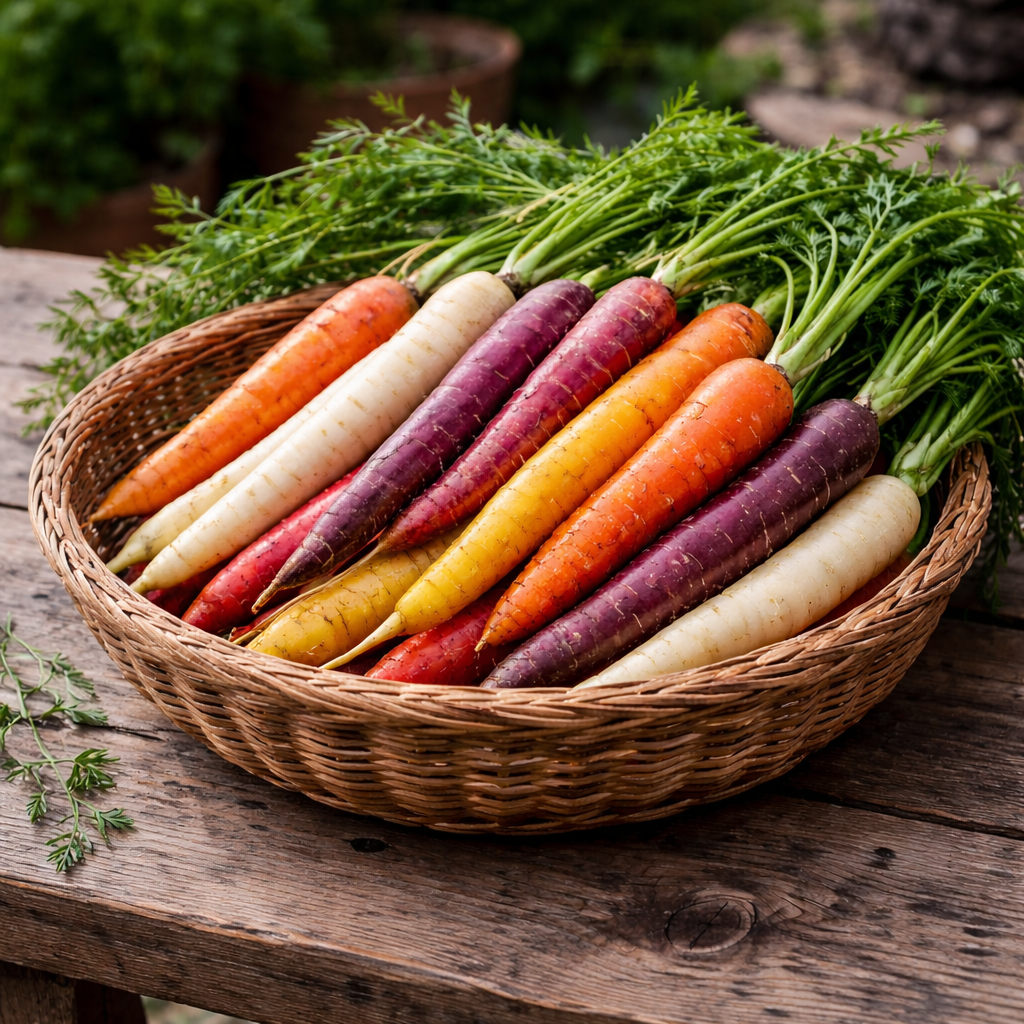
Mélange de carottes. Carottes de plusieurs couleurs réunies dans un panier. Le cadrage permet de voir les formes, les couleurs et les détails du sujet représenté. Les contours se détachent du fond de l’image, avec des différences de teinte et de texture visibles sur les surfaces. Cette vue accompagne la présentation du produit dans la boutique.

Garden associations

Companion plants & uses

Companion plants

In a mixed planting, you can reserve sections close to these plants: leek, onion, lettuce, radishes. The association is used here to organize space and crops. Allow for the height, light requirements and water needs of each plant, leaving enough room between the foliage. Keep a path clear for watering and harvesting, then remove finished crops to make room for the next planting. This arrangement makes maintenance easier without promising protection against garden pests. Lay out short rows that you can easily reach and weed during the first few weeks of growth.

Garden use

This organic carrot mix brings colour, variety and culinary interest to the vegetable garden, with an assortment of different roots that turns each harvest into an opportunity to discover another flavourful carrot. These carrots are easy to grow in deep, biologically active soil and reward patient care with straight, tender and aromatic roots for everyday meals and for more creative dishes prepared in the kitchen. The mix also lets you stagger the harvests and vary what you prepare, with flavours ranging from mild to more pronounced depending on the particular types included.

Recipe idea

From garden to table

Edible parts

Roots
Recipe idea using Mixed Carrots: roasted vegetables for four servings. Prepare 600 g of washed and peeled roots as needed, then cut them into pieces of similar size. Mix with 15 ml of olive oil, a pinch of salt and a few leaves of thyme. Spread in a dish and cook at 200°C (400°F) for 25 to 40 minutes, depending on the size of the pieces. Stir halfway through cooking. Serve when vegetables are tender in the centre and slightly coloured on the edges. Prepare the ingredients with clean utensils and adapt the cut to the size of your harvest. This recipe highlights freshly picked parts: remove damaged pieces before preparation. If you double the quantities, keep enough space in the dish to mix or cook evenly. Quickly place leftovers in the refrigerator in a closed container and consume them within two days. For a two-person meal, simply divide all quantities by two.
Mélange de carottes. Carottes de plusieurs couleurs réunies dans un panier. Le cadrage permet de voir les formes, les couleurs et les détails du sujet représenté. Les contours se détachent du fond de l’image, avec des différences de teinte et de texture visibles sur les surfaces. Cette vue accompagne la présentation du produit dans la boutique.

Frequently asked questions

Frequently asked questions

How do I grow Mixed Carrots from seed?
Recommended sowing time: in spring, as soon as the soil has drained enough to be worked; adjust later sowings to the season and the intended harvest. The depth to be respected is 1 to 1.5 cm (3/8 to 5/8 in.). Germination usually takes 10 to 21 days. For germination, keep the soil at 10 to 25°C (50 to 77°F). Sow the seeds directly where you intend to grow the plants through to harvest. Carrots do not tolerate having their main root disturbed or moved during growth. Prepare a fine-textured surface along the row so that the small seeds remain in good contact with the soil. A hard crust that forms after watering can hinder seedling emergence: use a gentle spray and keep the soil surface loose.
Can I grow Mixed Carrots in a container?
Choose a location in full sun. Reserve this spread around the plant: 10-15 cm (4-6 in.). The useful depth of the bin must exceed the expected root length. Avoid a layer of pebbles at the bottom that would reduce this volume. Fill with loose potting mix free of large debris, then sow directly in the container. In a small tray, lighten with thin scissors to limit handling. A sufficient soil reserve slows down the drying of the row during windy days. This organic carrot mix brings colour, variety and culinary interest to the vegetable garden, with an assortment of different roots that turns each harvest into an opportunity to discover another flavourful carrot.
When can I harvest Mixed Carrots?
This organic carrot mix brings colour, variety and culinary interest to the vegetable garden, with an assortment of different roots that turns each harvest into an opportunity to discover another flavourful carrot. These carrots are easy to grow in deep, biologically active soil and reward patient care with straight, tender and aromatic roots for everyday meals and for more creative dishes prepared in the kitchen. The mix also lets you stagger the harvests and vary what you prepare, with flavours ranging from mild to more pronounced depending on the particular types included. Growing this mix brings a lively and varied harvest, combining the straightforward pleasure of gardening with crop diversity and the renewed enjoyment of cooking the vegetables you have raised from seed.
How can I use Mixed Carrots in the garden?
A carrot seed sows directly in its final place. With this mix of carrots, identify the row from seeding, then lighten the seedlings to allow the coloured roots to grow without bothering. This organic carrot mix brings colour, variety and culinary interest to the vegetable garden, with an assortment of different roots that turns each harvest into an opportunity to discover another flavourful carrot. Grown for their appearance as well as their eating quality, these carrots provide a range of shapes, textures and colours that keep the garden rows interesting and add variety to meals throughout the season. Their finely divided leaves give the vegetable garden a light, airy appearance throughout growth; if plants are left in place to flower during their second year, the blooms can become particularly attractive to visiting pollinating insects.
How do I arrange a planting of Mixed Carrots?
Lay out short rows that you can easily reach and weed during the first few weeks of growth. Combine a section of carrots with lettuce or onions placed at a distance sufficient to keep the light. A raised board can be practical if the natural earth is heavy. Avoid inputs of coarse organic matter directly into the furrow, which may interfere with the formation of regular roots. Remove the weeds when they are still small, because the light foliage of the young carrots competition little. If the crown becomes exposed, cover it lightly with loose soil. Before removing a whole section, clear the top of a root to check its diameter.

Seed-starting essentials

Click a product to build your selection.

Your selection

Total