


Sale
Sold out

Vegetable
Brassicaceae
Turnip 'Petrowski' (Brassica rapa)
Product code : JAREC-0157
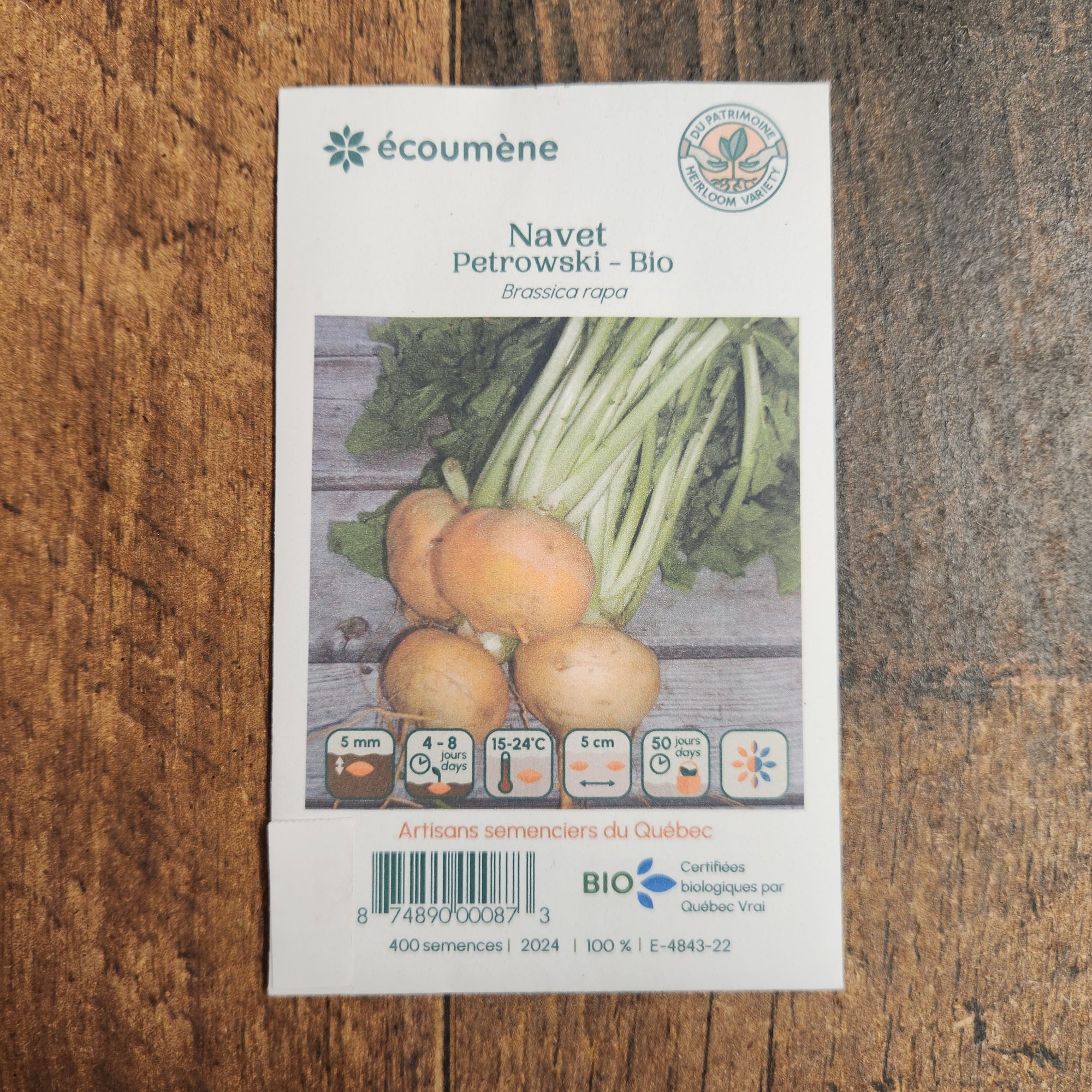
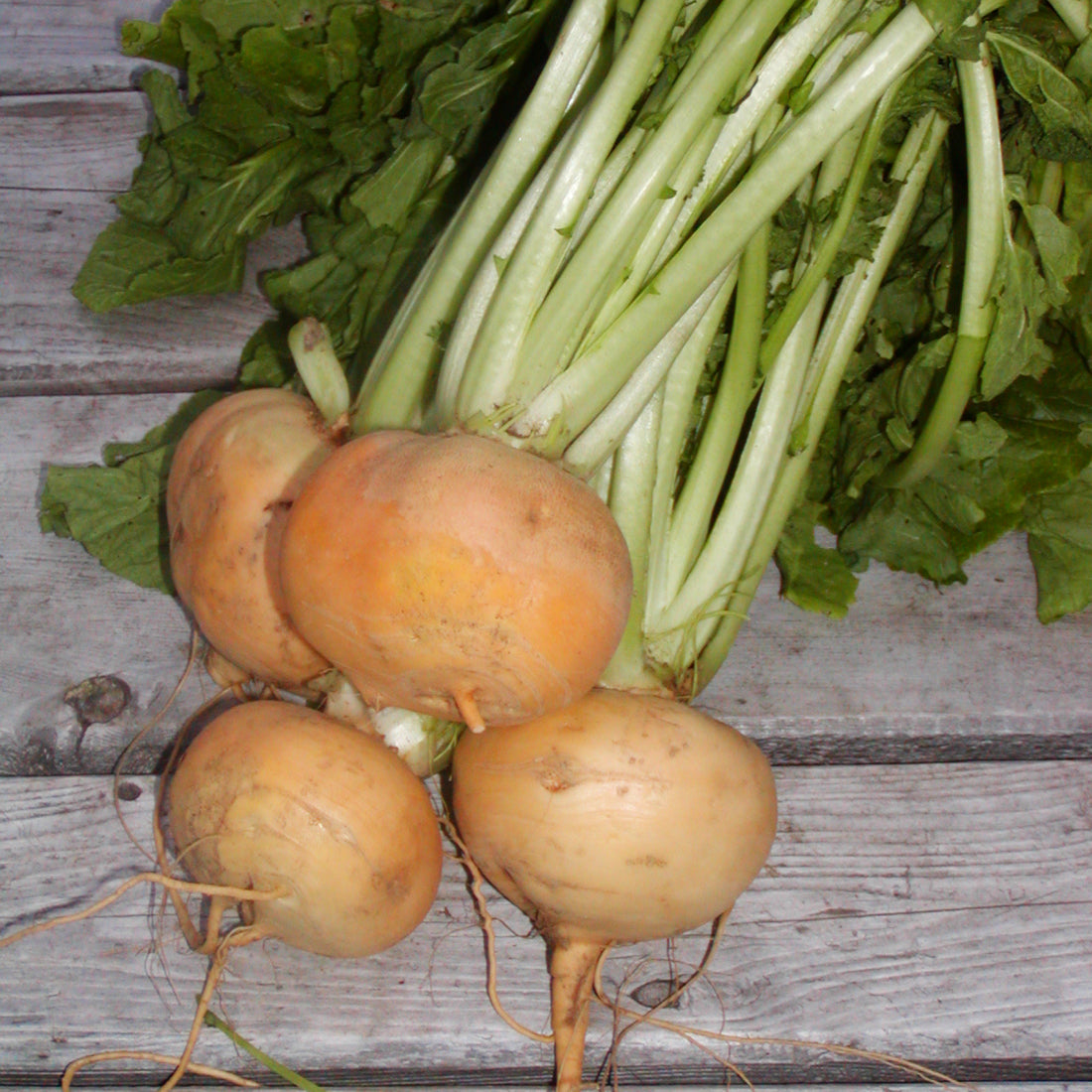
The organic 'Petrowski' turnip is an old variety of Brassica rapa particularly appreciated for the beauty of its bright yellow root, its fine flesh, and its remarkably sweet flavor. In the vegetable garden, it stands out for its fast and steady growth, offering gardeners a simple, productive, and very rewarding crop, even in modest spaces. Its round to slightly flattened roots bring a luminous touch to harvests, while its dark green foliage elegantly enlivens the rows. On the palate, its white, firm, and delicately sweet flesh reveals an aromatic finesse subtly reminiscent of carrots, making it equally interesting raw or cooked.
- Quantity
- Approximately 400 seeds
- Exposure
- Sun to partial shade
- Life cycle
- Annual
Discover the plant
Common nameTurnip 'Petrowski'
FamilyBrassicaceae
GenusBrassica
Speciesgrater
CultivarPetrowski
TypeVegetable
Botanical nameBrassica rapa
Reproducible seedsYes
Heirloom varietyYes
‘Petrowski’ Turnip (Brassica rapa). The organic 'Petrowski' turnip is an old variety of Brassica rapa particularly prized for the beauty of its bright yellow root, its fine flesh, and its remarkably sweet flavor. In the vegetable garden, it stands out for its rapid and steady growth, offering gardeners a simple, productive, and very rewarding crop, even in modest spaces. Its round to slightly flattened roots add a luminous touch to harvests, while its dark green foliage elegantly enlivens the rows. On the palate, its white, firm, and delicately sweet flesh reveals an aromatic finesse subtly reminiscent of carrots, making it equally appealing raw or cooked.
Recommended sowing period: in spring, as soon as the soil is dry enough and workable; adjust subsequent sowings to the season and type of harvest. The depth to respect is 1 to 1.5 cm (0.4 to 0.6 in). Emergence generally takes 4 to 10 days. For germination, keep the potting mix at 10 to 25 °C (50 to 77 °F). Direct sowing allows root vegetables to develop without deformation related to transplanting. Prepare a fine and even seedbed, then water gently to maintain the position of the seeds.
A row of root vegetables must remain easy to thin, weed, and water uniformly. Avoid stony or compacted areas that limit enlargement. In a raised bed, keep tall crops at a distance so as not to shade young seedlings. Spreading sowings over several small areas allows for choosing different harvest stages without having to pull up all plants at once. The organic 'Petrowski' turnip is an old variety of Brassica rapa particularly prized for the beauty of its bright yellow root, its fine flesh, and its remarkably sweet flavor.

Sowing guide
It all startswith a seed.
Sowing depth
0.4 to 0.6 in (1 to 1.5 cm)
Germination temperature
10 to 25 °C (50 to 77 °F)
Germination time
4 to 10 days
Sowing period
In spring, as soon as the ground is dry enough and workable; adjust the following sowings to the season and type of harvest
Propagation
Sowing
Growing method
Recommended sowing period: in spring, as soon as the soil is drained and workable; adjust subsequent sowings to the season and type of harvest. The recommended depth is 1 to 1.5 cm (0.4 to 0.6 in). Emergence usually takes 4 to 10 days. For germination, maintain the potting soil at 10 to 25 °C (50 to 77 °F). Direct sowing allows root vegetables to develop without deformation caused by transplanting. Prepare a fine and even seedbed, then water gently to keep the seeds in place. A dry soil crust can hinder emergence: keep the surface moist without compacting it. Thin seedlings early enough so that the roots have their definitive space. Keep rows identified until harvest. Work superficially between rows to remove young weeds without damaging cultivated roots. Check a few plants before pulling the entire harvest; size is easier to judge on a sample than on foliage alone. A root left too long can lose its tenderness. Harvest in sufficiently loose soil and separate damaged specimens from those intended for longer storage.
Soil and care
The right care,at the right time.
Care level
Regular during establishment, then adapted to growing conditions
Watering
Regular
Soil type
Loose, fertile, and well-drained
Fertilization
Fertilization supports growth and takes into account nutrients already present in the soil or potting mix. Use mature compost or a fertilizer suitable for the crop, following the dosage instructions. Avoid using multiple products, especially in a container where roots occupy a limited volume. Water as needed after application and observe the foliage development before re-fertilizing.
Moisture
Keep soil moist during germination, without waterlogging; then adjust to the crop
Seasonal care
Its round to slightly flattened roots add a bright touch to harvests, while its dark green foliage elegantly enlivens the rows. Direct sowing allows root vegetables to develop without deformation caused by transplanting. Prepare a fine, even seedbed, then water gently to maintain the position of the seeds. A dry soil crust can hinder emergence: keep the surface moist without compacting it. Thin the seedlings early enough so that the roots have their definitive space. Keep the rows identified until harvest. Work superficially between the rows to remove young weeds without damaging the cultivated roots. Check a few plants before harvesting the entire crop; size is more easily judged on a sample than on the foliage alone. A root left too long can lose its tenderness. Harvest in sufficiently loose soil and separate damaged specimens from those intended for longer storage. The harvested part develops below the surface, which requires some checks instead of a simple observation of the foliage. Gently clear a crown or lift a first plant to judge the size. Regular growth promotes tenderness. Use damaged roots quickly and reserve intact specimens for appropriate vegetable storage. Organic 'Petrowski' turnip is an old variety of Brassica rapa particularly appreciated for the beauty of its bright yellow root, its fine flesh, and the remarkable sweetness of its flavor.
Container growing
A garden,within reach.
Suitable for containers
Yes
Recommended pot size
Punctured and stable container, with sufficient width for the plant to spread out and depth for the roots
Choose this exposure: sun to partial shade. Reserve this spread around the plant: 10 to 15 cm (4 to 6 in.). A container intended for root vegetables must offer a depth compatible with their shape and length. Fill it with a loose and homogeneous mixture, without large clods or stones. Distribute the seeds over the entire surface, then thin carefully. The rim of the pot can shade the seedlings: place the potting soil at a height that allows light in while leaving room for watering. The organic 'Petrowski' turnip is an old variety of Brassica rapa particularly appreciated for the beauty of its bright yellow root, its fine flesh, and the remarkable sweetness of its flavor. In the garden, it stands out for its rapid and regular growth, offering gardeners a simple, productive, and very rewarding crop, even in modest spaces. Its round to slightly flattened roots bring a luminous touch to harvests, while its dark green foliage elegantly enlivens the growing rows. In the mouth, its white, firm, and delicately sweet flesh reveals an aromatic finesse that subtly evokes the carrot, making it as interesting raw as cooked.
Bloom and dimensions
Its place,in your garden.
Mature height
30 to 40 cm (12 to 16 in.)
Width / spread
4 to 6 in (10 to 15 cm)
Foliage type
Seasonal foliage
Bloom period
May to July
Fruiting
The organic 'Petrowski' turnip is an old variety of Brassica rapa particularly appreciated for the beauty of its bright yellow root, its fine flesh, and the remarkable sweetness of its flavor. Its round to slightly flattened roots bring a luminous touch to harvests, while its dark green foliage elegantly enlivens cultivation rows. On the palate, its white, firm, and delicately sweet flesh reveals an aromatic finesse that subtly evokes carrots, making it equally interesting raw or cooked.
Harvest
50 to 60 days after sowing
Garden associations
In goodcompany.
Companion plants
In a diverse plantation, you can dedicate neighboring sections to the following plants: carrots, beans, lettuce, spinach, peas, mint, rosemary. This arrangement serves to organize space and harvests. Respect each plant's height, light, and water requirements, without crowding the foliage. Maintain a pathway for watering and harvesting, then remove spent crops to free up space. This organization simplifies maintenance but does not guarantee protection against pests. A row of root vegetables must remain easy to thin, weed, and water uniformly.
Recipe idea
From the gardento your plate.
Edible parts
Roots
Cooking idea with 'Petrowski' Turnip: roasted vegetables for four portions. Prepare 600 g of washed and peeled roots as needed, then cut them into similar-sized pieces. Mix with 15 ml of olive oil, a pinch of salt, and a few thyme leaves. Spread in a dish and cook at 200 °C (400 °F) for 25 to 40 minutes, depending on the size of the pieces. Stir halfway through cooking. Serve when the vegetables are tender in the center and slightly browned at the edges. Prepare ingredients with clean utensils and adapt the cutting to the size of your harvest. This recipe highlights freshly picked parts: remove damaged pieces before preparation. If you double the quantities, ensure there is enough space in the dish to mix or cook evenly. Promptly refrigerate leftovers in a sealed container and consume within two days. For a two-person meal, simply halve all quantities.
Frequently asked questions
Your questions,answered.
How to successfully sow 'Petrowski' Turnips?
Recommended sowing period: in spring, as soon as the soil is well-drained and workable; adjust subsequent sowings to the season and type of harvest. The depth to respect is 1 to 1.5 cm (0.4 to 0.6 in). Emergence usually takes 4 to 10 days. For germination, maintain the potting soil at 10 to 25 °C (50 to 77 °F). Direct sowing allows root vegetables to develop without deformation related to transplanting. Prepare a fine and even seedbed, then water gently to maintain the position of the seeds. A crust of dry soil can hinder emergence: keep the surface moist without compacting it.
Can 'Petrowski' Turnips be grown in pots?
Choose this exposure: sun to partial shade. Allow this spread around the plant: 10 to 15 cm (4 to 6 in). A container intended for root vegetables must offer a depth compatible with their shape and length. Fill it with a loose and homogeneous mixture, without large clods or stones. Spread the seeds over the entire surface, then thin carefully. The rim of the pot can shade the seedlings: place the potting soil at a height that lets in light while leaving space for watering. Organic turnip 'Petrowski' is an old variety of Brassica rapa particularly appreciated for the beauty of its bright yellow root, its fine flesh, and the remarkable sweetness of its flavor.
When to harvest 'Petrowski' Turnip?
The organic 'Petrowski' turnip is an old variety of Brassica rapa particularly prized for the beauty of its bright yellow root, its fine flesh, and the remarkable sweetness of its flavor. Its round to slightly flattened roots add a luminous touch to harvests, while its dark green foliage elegantly enlivens cultivation rows. On the palate, its white, firm, and delicately sweet flesh reveals an aromatic finesse that subtly evokes carrot, making it as interesting raw as it is cooked. Productive, elegant, and delicate in flavor, the 'Petrowski' turnip deserves a prime spot in nourishing gardens.
What makes Turnip 'Petrowski' stand out in the garden?
The organic 'Petrowski' turnip is an old variety of Brassica rapa particularly valued for the beauty of its bright yellow root, its fine flesh, and its remarkably sweet flavor. In the garden, it stands out for its fast and steady growth, offering gardeners a simple, productive, and very rewarding crop, even in modest spaces. Its round to slightly flattened roots bring a luminous touch to harvests, while its dark green foliage elegantly enlivens the rows. On the palate, its white, firm, and delicately sweet flesh reveals an aromatic finesse that subtly evokes carrots, making it equally interesting raw or cooked.
How to arrange a 'Petrowski' turnip planting?
A row of root vegetables should remain easy to thin, weed, and water evenly. Avoid stony or compacted areas that restrict growth. In a raised bed, keep tall crops at a distance so as not to shade young seedlings. Spreading seedlings over several small areas allows you to choose different harvest stages without having to uproot all plants at once. Cultivate superficially between rows to remove young weeds without damaging cultivated roots. Check a few plants before harvesting the entire crop; the size is easier to judge from a sample than from the foliage alone.
For a great start to your seeds
The right extras.Right here.
Seed Starting Soil
Shop the collectionSeed starting supplies
Shop the collection





