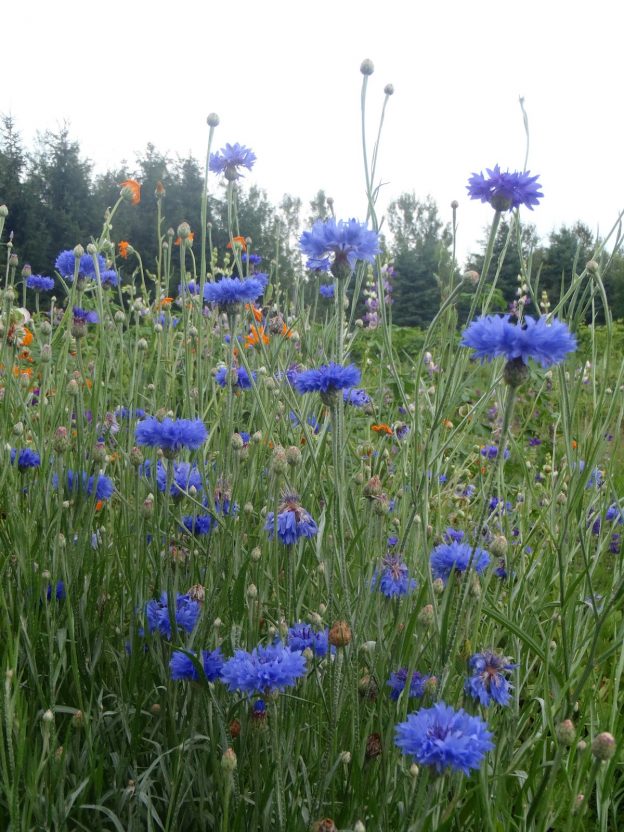
ornamental flower

Le potager ornemental de Catherine

Blue cornflower

Centaurea cyanus

Grow Blue cornflower from these flower seeds to bring out the characteristic colour, shape and growth habit of its flowers. Blue cornflower bears edible, nectar-producing blue flowers. Plant sizes vary from 30 cm (11.8 in) to 1 m (1 to 3.3 ft). The supplier reports tolerance to dry conditions, with growing in sun or partial shade. Watch the buds open and check the condition of the flowers. When the variety is suitable for bouquets, cut a few stems with a clean tool and place them in water promptly. In a flower bed, remove only the faded flowers when you want a tidy display rather than saved seeds. Sow seeds directly in the garden or transplant in late May. Sow the seeds at a depth of 6 mm (0.2 in). Leave 40 cm (15.7 in) between plants.
Sold as ±150 seeds
4 19 $

Sold out

Pay in 4 interest-free payments withSezzle

Delivery and pickup: view conditions

Product information
Advice adapted to Canada
Secure payment
Share

Discover the plant

Common nameBlue cornflower
FamilyAsteraceae
GenusCentaurea
Speciescyanus
TypeOpen-pollinated seeds
Botanical nameCentaurea cyanus
Reproducible seedsYes

Blue cornflower belongs to Centaurea cyanus. The plant completes its life cycle in one season. Medicinal, nectar-producing plant. The flowers are blue. The plant reaches 30 to 100 cm (11.8 to 39.4 in) in height. Also called cornflower, bachelor's button and bluebottle. The flowers are edible. These characteristics help you choose its position in the garden and compare this selection with other cultivars in the same group. Plan its location around its growth, leaving enough room to observe and care for the plant. The sowing date, available light and warmth received then influence the pace of growth in Quebec.

Choose sun or partial shade. Prepare a growing area with soil that allows excess water to drain away freely. Tolerates dry conditions. Sow indoors in early May. Direct sow or transplant in late May. Sow the seeds at a depth of 6 mm (0.2 in). Leave 40 cm (15.7 in) between plants. In Quebec, adjust the timing of planting to the frost risks in your particular area and to the life cycle of the plant. Keep the growing mix slightly moist during emergence without saturating it, and provide light as soon as seedlings appear. If sowing begins indoors, acclimatize the seedlings to wind and sun before planting them in the garden.

Position the plants where their flowers will remain clearly visible, taking their expected height and spread into account when arranging the planting. Leave access for watering at the base, following buds as they open and removing damaged stems. Group plants with similar requirements for light exposure and soil moisture, while avoiding crowding young plants together simply to create an immediate visual effect. Leave enough room for the foliage as it continues to grow and develop through the season. For this annual, follow flowering through the season and choose which stems to keep for their seeds. Keep labels in place to recognize each variety, even after the flowers have faded. Keep these flower seeds dry until the next sowing.

In the garden

Exposure
Full sun to part shade
Life cycle
Annual

Sowing guide

Sowing & germination

Sowing depth

6 mm (0.2 in)

Spacing / density

40 cm (15.7 in)

Sowing period

Direct sow in the garden or transplant late May.

Propagation

Seed sowing

Growing method

These seed-starting tips for Blue cornflower concern gardening in Quebec and can be adjusted to local frost risks. Sow seeds directly in the garden or transplant in late May. Sow the seeds at a depth of 6 mm (0.2 in). Leave 40 cm (15.7 in) between plants. This crop is identified as Centaurea cyanus. Arrange flowers according to their actual height: taller plants should remain visible without completely hiding a lower border. Leave access for cutting a stem or removing a faded flower. Observe a colour mix plant by plant; it does not guarantee every colour in each small group. Prepare the final growing site and seed-starting supplies first. For seed starting in pots, moisten the growing mix before filling the cells, then sow without compressing it into a hard mass. For direct sowing, remove large soil clods and mark a row that you can locate again after watering. Distribute seeds according to the intended spacing rather than pouring several into one spot. Water the growing medium gently so that the flow of water does not displace the seeds you have sown. Once the seedlings have emerged, keep the healthy young plants and allow enough space for them to continue developing. If seedlings are started indoors, gradually acclimatize them to outdoor conditions before planting them out. Handle the root ball carefully without pulling on the stem. Transplant into prepared soil, then water to help the soil settle into contact with the root ball. Blue cornflower bears edible, nectar-producing blue flowers.

Soil and care

Soil & care

Care level

Moderate

Watering

For Blue cornflower, adjust watering to the stage of growth. Water the seedbed gently so that the seeds remain in place. After establishment, check moisture near the roots rather than judging only by the appearance of the leaves. Direct water to the base and adjust the amount according to rainfall. Check a wind-exposed container more often; excess water must be able to drain freely.

Soil type

For Blue cornflower, the source recommends well-drained soil. Prepare soil that the roots can explore, without large clods around the seeds. Assess drainage after rain as well: water should not remain around the crown for long. In containers, use a growing mix rather than heavy, compacted garden soil. The fertility requirements described for this plant should guide additions, without automatically adding large amounts of compost.

Fertilization

When feeding Blue cornflower, begin with the fertility of the growing medium. Do not try to produce a large mass of leaves by applying heavy amounts of nitrogen; respect the actual needs of this crop. Before applying fertilizer, examine the soil or growing mix already in use. Measure each application according to the label and the crop's needs, without combining several products at once. In containers, account for nutrients already present in the growing mix. A plant that is suffering from a lack of water cannot be helped simply by applying additional fertilizer.

Moisture

Even moisture without saturation

Seasonal care

When caring for Blue cornflower, keep the following defining characteristic of the plant in mind: blue cornflower bears edible, nectar-producing blue flowers. Plant sizes vary from 30 cm (11.8 in) to 1 m (1 to 3.3 ft). The supplier reports tolerance to dry conditions, with growing in sun or partial shade. Monitor the flower buds throughout the growing season and use a clean tool to remove any stems that have broken. Cutting flowers to make a bouquet and keeping flowers for seed saving are two different choices for managing the plants. Retain a few seed capsules only if you want seeds, watching for them to open before dispersal. Start the season with a prepared site and labelled seedlings. During emergence, check that moisture reaches the seed zone without creating a persistent puddle. After planting, observe establishment before adding more fertilizer or pruning. Remove small weeds and check damaged leaves so that isolated damage is not mistaken for a need for fertilizer. Throughout summer, adjust watering to the condition of the soil and the rain received. Check support ties after windy weather, and do not let a tie constrict a thickening stem. Make cuts with a clean tool; do not remove a healthy stem simply to improve the view. In fall, separate what should be harvested, left in place or removed according to the plant's life cycle. After detaching the stems, put the supports away and clean your tools; take care not to move diseased plant debris into other growing areas. Whether the plant returns in spring depends on its stated life cycle, not simply on the word garden in its description. Watch the buds open and check the condition of the flowers. When the variety is suitable for bouquets, cut a few stems with a clean tool and place them in water promptly.

Bloom and dimensions

Size, flowering & harvest

Mature height

30 cm to 1 m (1 to 3.3 ft)

Bloom period

Observe flowering in Blue cornflower using these guidelines. Blue cornflower bears edible, nectar-producing blue flowers. Plant sizes vary from 30 cm (11.8 in) to 1 m (1 to 3.3 ft). The supplier reports tolerance to dry conditions, with growing in sun or partial shade. Watch the buds and flowers according to this plant's life cycle. A stated time frame shifts with growing conditions; it does not set the same date for all of Quebec. Cut flowers for bouquets only when this use is documented.

Harvest

For Blue cornflower, harvest only the plant parts confirmed as edible: flowers. Harvest healthy parts from identified plants, without mixing a similar-looking flower with this crop. Prepare the harvest using clean equipment; the rest of the plant is not automatically an ingredient.
Blue cornflower

Garden associations

Companion plants & uses

Companion plants

When choosing companions for Blue cornflower, consider light, access and space. Place this plant alongside crops with compatible light and moisture needs, preserving the space required for its foliage. Plan companion planting around the available space and growing requirements. Leave enough light and air around the plant, and keep taller neighbours from covering its foliage. A practical arrangement of plants makes watering and harvesting easier to manage; it does not, by itself, guarantee protection against insect pests or an increase in yield. Keep every crop accessible and maintain its individual spacing.

Garden use

For Blue cornflower, the aim is to highlight the colour, form and habit of the flowers. Blue cornflower bears edible, nectar-producing blue flowers. Plant sizes vary from 30 cm (11.8 in) to 1 m (1 to 3.3 ft). The supplier reports tolerance to dry conditions, with growing in sun or partial shade. Choose the use according to the part harvested and the documented harvest stage. Keep the plants in your garden clearly identified all the way through to the time of harvesting or flowering. The seeds in the packet are for starting this crop: keep the variety label beside the plants. Prepare edible harvests with clean equipment and reserve other plants for their ornamental use.

Recipe idea

From garden to table

Edible parts

Flowers
For Blue cornflower, use only the flowers, whose use as food is confirmed by the supplier. Harvest from identified plants intended for food use. Discard damaged parts and clean the harvest before preparing it. Start with a small amount as a garnish or in a preparation suited to this part of the plant. Do not substitute a similar-looking flower: colour alone does not establish edibility. The rest of the plant and the seeds in the packet are not included in this use. For a garnish, prepare the tender parts close to serving time and keep them chilled. For cooking, add the harvest to a dish suited to its texture, without assigning the same use to every plant part. This suggestion is culinary; it does not present the plant as a medicinal treatment. Respect the crop's identification and keep ornamental flowers not intended for food out of the preparation. Blue cornflower bears edible, nectar-producing blue flowers. Plant sizes vary from 30 cm (11.8 in) to 1 m (1 to 3.3 ft). The supplier reports tolerance to dry conditions, with growing in sun or partial shade.
Blue cornflower

Frequently asked questions

Frequently asked questions

How do you sow Blue cornflower seeds?
For Blue cornflower, direct sow in the garden or transplant in late May. Sow the seeds at a depth of 6 mm (0.2 in). Leave 40 cm (15.7 in) between plants. To choose a sowing date in Quebec, begin with your local frost risk, then apply the timing recommended for this crop. Always plan indoor seed starting by counting backwards from the expected planting date; do not start the seeds too early simply on principle. Prepare containers before sowing and label the variety. Maintain moisture suited to the seeds without leaving standing water. When sowing directly in the garden, prepare the row before distributing the seeds and water gently.
How much space should you allow for Blue cornflower?
For Blue cornflower, blue cornflower bears edible, nectar-producing blue flowers. Plant sizes vary from 30 cm (11.8 in) to 1 m (1 to 3.3 ft). The supplier reports tolerance to dry conditions, with growing in sun or partial shade. Arrange flowers according to their actual height: taller plants should remain visible without completely hiding a lower border. Leave access for cutting a stem or removing a faded flower. Observe a colour mix plant by plant; it does not guarantee every colour in each small group. Choose the position according to this plant's habit and growth, then leave access for watering and cutting. If the plants require a support, put it in place before their stems begin to grow longer. The distance between plants does not replace a working aisle.
How should you manage watering for Blue cornflower?
Caring for Blue cornflower requires observing the plant. Check the growing mix or soil near the roots before watering. Water must reach the root ball, and excess water must then be able to drain from the container or soil. Recent rain, wind and heat affect how often watering is needed. Water at the base rather than routinely wetting the flowers and foliage. When a plant wilts, check its root ball as well: adding water to an already saturated root ball will not solve every problem. Use a gentle stream when watering newly sown seeds. Monitor the flower buds throughout the growing season and use a clean tool to remove any stems that have broken. Cutting flowers to make a bouquet and keeping flowers for seed saving are two different choices for managing the plants. Retain a few seed capsules only if you want seeds, watching for them to open before dispersal.
How should you monitor the development of Blue cornflower?
The growth of Blue cornflower follows this profile. Blue cornflower bears edible, nectar-producing blue flowers. Plant sizes vary from 30 cm (11.8 in) to 1 m (1 to 3.3 ft). The supplier reports tolerance to dry conditions, with growing in sun or partial shade. Monitor the flower buds throughout the growing season and use a clean tool to remove any stems that have broken. Cutting flowers to make a bouquet and keeping flowers for seed saving are two different choices for managing the plants. Retain a few seed capsules only if you want seeds, watching for them to open before dispersal. Watch the buds open and check the condition of the flowers. When the variety is suitable for bouquets, cut a few stems with a clean tool and place them in water promptly. In a flower bed, remove only the faded flowers when you want a tidy display rather than saved seeds.
What growth stage should you look for in Blue cornflower?
For Blue cornflower, watch the buds open and check the condition of the flowers. When the variety is suitable for bouquets, cut a few stems with a clean tool and place them in water promptly. In a flower bed, remove only the faded flowers when you want a tidy display rather than saved seeds. Blue cornflower bears edible, nectar-producing blue flowers. Plant sizes vary from 30 cm (11.8 in) to 1 m (1 to 3.3 ft). The supplier reports tolerance to dry conditions, with growing in sun or partial shade. The schedule is a guide, but observing the plant determines the right moment. Follow the recommended stage for the part harvested, and distinguish botanical maturity from culinary quality. Harvest with a clean tool when the stem resists, and immediately sort out damaged parts. For a bouquet flower, choose a healthy stem when this use is confirmed.

Wildlife and pets

Wildlife & precautions

Supporting wildlife

The supplier describes the flowers of Blue cornflower as attractive to pollinating insects. Keep some flowers accessible while open if you want to observe these visits. The presence of insects also depends on the surrounding environment and the time of year; this information does not guarantee a particular number of visiting insects or protection against every garden pest.

Seed-starting essentials

Click a product to build your selection.

Your selection

Total