


Sale
Sold out

Modern fast-growing organic red radish
Brassicaceae
Organic colourful radish seeds
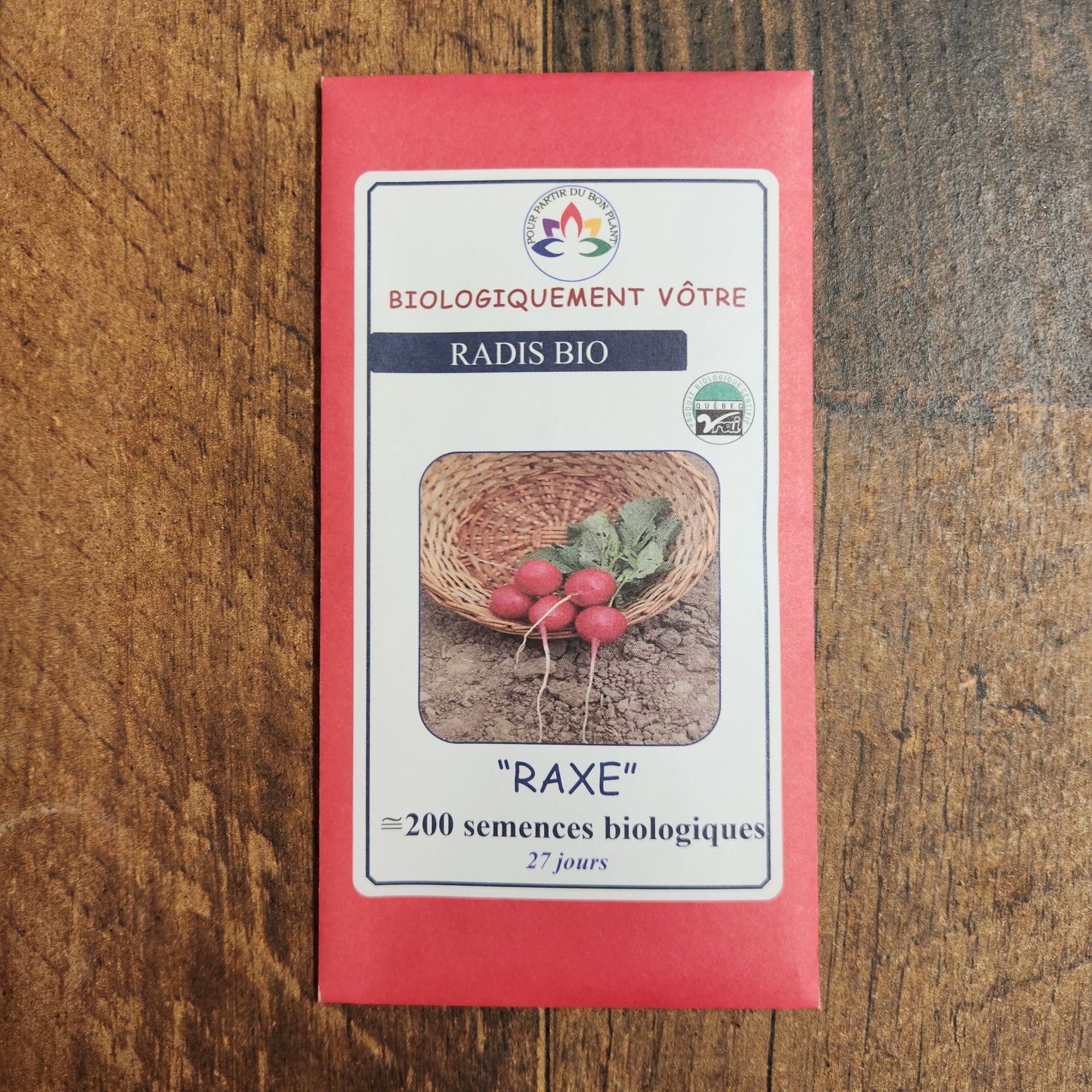
Organic 'Raxe' radish
Raphanus sativus
Product code : BIOVO-0122
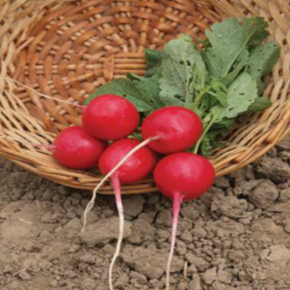
Organic Raxe radish produces bright-red, round to slightly oval roots with crisp, moderately peppery flesh. Its approximately 27-day harvest reference makes it useful for short rows sown successively in cool weather, although actual readiness depends on growing conditions. Direct sow into loose, well-drained soil and thin crowded seedlings early so each root has room to develop. Maintain even moisture rather than alternating drought and heavy watering. Lift a sample root when the shoulders reach a useful size; leaving the crop too long can reduce tenderness. Enjoy fresh slices in salads or on buttered bread, and remove leafy tops before refrigerating the roots.
- Quantity
- Approximately 200 seeds
- Exposure
- Full sun to partial shade
- Life cycle
- Annual
Discover the plant
Common nameRaxe radish
FamilyBrassicaceae
GenusRaphanus
Speciessativus
CultivarRaxe
TypeModern fast-growing organic red radish
Botanical nameRaphanus sativus
Reproducible seedsYes
Organic 'Raxe' radish (Raphanus sativus) is a fast modern variety valued for uniform round to slightly oval vivid-red glossy roots. Each selection contains approximately 200 organic seeds. This modern variety develops 15–25 cm foliage and is harvested near 27 days. Crisp tender pleasantly pungent flesh suits crudités salads garnishes and classic serving with butter and salt. Its uniform appearance makes attractive bunches and helps compare root size before lifting the rest of the row. Its fast cycle suits small gardens, raised beds, and wide containers used for staggered spring and autumn sowings.
Direct sow April through September in light loose stone-free well-drained soil approximately 1 cm deep. Maintain 10–20°C and even moisture; germination generally takes 4–10 days. Thin to approximately 5 cm so roots form without competition. Full sun suits cool weather while light partial shade may slow drying during warm periods. Make small sowings every two or three weeks and pause when heat makes roots fibrous or excessively pungent. Water at soil level, protect seedlings from flea beetles when needed, and weed shallowly so developing roots are not disturbed each week.
Begin inspecting roots near 23–25 days and generally harvest around 27 days. Gently uncover a sample root shoulder and lift once red firm crisp and still tender. Do not wait until roots become pithy split or excessively strong. Remove tops, rinse only before use, and cool promptly. Yield, exact diameter, specific varietal resistance, and maximum storage life for this harvest are variable by conditions. Lift one test root before clearing the row, then remove tops and cool sound roots promptly. Discard anything soft, mouldy, slimy, or abnormal-smelling. Store roots separately from tops.

Sowing guide
It all startswith a seed.
Sowing depth
Approximately 1 cm (⅜ to ½ in)
Spacing / density
Approximately 5 cm between plants and 20 to 30 cm between rows
Germination temperature
10 to 20 °C (50 to 68 °F)
Germination time
Approximately 4 to 10 days
Sowing period
April through September by direct sowing Adjust these dates to your local frost dates and soil conditions; Canadian growing seasons vary by region.
Propagation
Direct sowing
Growing method
Growing 'Raxe' radish from seed. This round red variety needs room for each root to expand, even when the seedbed initially looks rather sparse. Mark a short row in loose, well-drained soil and sow directly about 1 cm (3/8 in) deep. Water the covered row gently and keep the seed zone from drying or forming a hard crust. Once seedlings can be distinguished from weeds, leave approximately 5 cm between retained plants. Cut surplus seedlings rather than pulling through neighbouring roots. 'Raxe' is sold by Canadian seed growers for its ability to remain crisp at a larger size than many small bunching radishes, but that characteristic is not permission to neglect watering or leave every root indefinitely. Start checking near the product's approximately 25-day reference and lift a representative root to assess the centre. Continue harvesting according to texture and useful size. For successive crops, sow a separate labelled section instead of scattering fresh seed among mature plants, where shade and different watering needs make establishment uneven. Early spring and late-summer conditions are usually easier to manage than extreme heat. In warmer weather, inspect moisture more often and judge whether another sowing is worthwhile locally. Fine insect mesh can protect emerging foliage from flea beetles; leave access for thinning and promptly repair gaps. Remove crop residue after the final picking.
Soil and care
The right care,at the right time.
Soil pH
Approximately 6.0 to 7.0
Care level
Easy
Watering
'Raxe' radish matures quickly, so even a short dry spell can leave its uniform round to slightly oval vivid-red glossy root coarse or sharply flavoured. Before 'Raxe' radish emerges, use a gentle flow; as roots lengthen, water more deeply and let excess leave the bed. Below 'Raxe' radish, check moisture before irrigating so the centre of the root zone does not stay saturated. Mulch 'Raxe' radish lightly only after establishment, limiting abrupt wet-dry cycles that can cause cracking or uneven texture. A 'Raxe' radish container must drain freely and needs daily checks in warm wind while the edible root enlarges.
Soil type
Prepare a fine, loose seedbed for 'Raxe' radish; compacted clods interfere with the fast expansion of its uniform round to slightly oval vivid-red glossy root. Well before sowing 'Raxe' radish, work in mature compost, remove stones and undecomposed debris, and avoid fresh manure near its roots. For 'Raxe' radish, the stated soil reaction is approximately 6.0 to 7.0; confirm it with a test before amending. Level the 'Raxe' radish seedbed carefully so moisture and emergence stay uniform across the row. For potted 'Raxe' radish, use the recommended depth, light vegetable mix, and clear drainage holes.
Fertilization
Incorporate a small amount of mature compost only when soil is poor. Avoid fresh manure and nitrogen-rich fertilizer, which favour foliage over roots. In properly prepared soil, extra feeding is generally unnecessary during this very short crop. If growth remains pale, check moisture, drainage, and pH before adding a product. In containers, choose lightly enriched potting mix and follow label directions without repeated applications.
Moisture
Raxe needs cool, steady moisture to form smooth round roots without becoming pithy. Irrigate before the bed dries deeply, but never leave the crown in saturated soil. Morning watering keeps foliage drier overnight and reduces prolonged leaf wetness. A thin surface mulch after thinning can moderate evaporation, provided it does not bury seedlings or trap water against the stems.
Seasonal care
Seasonal care for 'Raxe' radish. From spring through autumn make small sowings every two or three weeks while weather remains cool. Keep the surface moist until emergence, then thin early to approximately 5 cm without disturbing retained plants. Weed shallowly and protect young leaves from flea beetles with insect netting if needed. Also monitor slugs aphids caterpillars and rots. Pause sowing during strong heat if roots become fibrous or excessively pungent. Begin inspecting near 23 days, harvest around 27 days, and remove diseased Brassicaceae residues. For seasonal care, inspect each small section separately so roots are harvested at the desired size. Even moisture during seasonal care supports tender, crisp, moderately peppery flesh. Record dates related to seasonal care to spread future sowings more effectively. During warm periods, for seasonal care, inspect each small section separately so roots are harvested at the desired size. While foliage remains healthy, even moisture during seasonal care supports tender, crisp, moderately peppery flesh. After deep watering, record dates related to seasonal care to spread future sowings more effectively. Between shallow weedings, for seasonal care, inspect each small section separately so roots are harvested at the desired size. To preserve crispness, even moisture during seasonal care supports tender, crisp, moderately peppery flesh. In practical terms, record dates related to seasonal care to spread future sowings more effectively. In the vegetable garden, for seasonal care, inspect each small section separately so roots are harvested at the desired size. For routine care, even moisture during seasonal care supports tender, crisp, moderately peppery flesh.
Container growing
A garden,within reach.
Recommended pot size
10 to 15 L, at least 25 to 30 cm (10 to 12 in) deep
Growing 'Raxe' radish in containers. Use a broad 10 to 15 L pot at least 25 to 30 cm deep, with clear drainage holes and a stable base. Fill it with fresh, loose, stone-free mix; compacted soil can restrict the uniform round to slightly oval roots. Direct-sow approximately 1 cm deep, keep the seed zone moist, and expect emergence in about 4 to 10 days at suitable temperatures. Thin early to roughly 5 cm between plants. Cut unwanted seedlings at soil level if pulling them would disturb the roots that remain. Give the container full sun in cool weather and light partial shade when warmer conditions make the surface dry too quickly. Check moisture with a finger rather than a rigid schedule, then water the full depth without leaving the pot in standing water. Avoid repeated high-nitrogen feeding because leafy growth can come at the expense of crisp roots. Start sampling near 27 days after sowing. Expose the shoulder of one root, lift it, and judge texture before harvesting the rest. Pick firm, glossy vivid-red roots before they become pithy, split, or excessively pungent. Remove foliage and cool sound roots promptly. Small successive sowings use container space more effectively than one dense planting, but pause during sustained heat and restart when radish-friendly conditions return.
Bloom and dimensions
Its place,in your garden.
Mature height
Approximately 15 to 25 cm (6 to 10 in) for the foliage
Width / spread
Approximately 5 cm (2 in) between roots
Flower color
White to pale pink
Foliage color
Green
Foliage type
Herbaceous rosette
Growth rate
Fast
Growth habit
Leaf rosette above a round root
Bloom period
A Raxe radish left beyond the normal root-harvest stage can form a branched stalk with white to pinkish flowers. Flowering is not desired when tender roots are the goal because the root becomes tougher as the plant redirects energy. Raxe is an open-pollinated variety. For seed saving, retain healthy, true-to-type plants, keep them separated from other flowering radishes to limit crossing, and allow pods to mature fully before collecting dry seed. For routine eating, harvest roots near the desired size before bolting begins.
Fruiting
No culinary fruit; round to slightly oval red root harvested young For pod formation, inspect each small section separately so roots are harvested at the desired size. Even moisture during pod formation supports tender, crisp, moderately peppery flesh. Record dates related to pod formation to spread future sowings more effectively. For pod formation, inspect each small section separately so roots are harvested at the desired size.
Days to maturity
Approximately 27 days after sowing
Harvest
Begin checking near 23–25 days and generally harvest around 27 days. Gently uncover a sample root shoulder to assess colour and size, then lift once firm crisp and still tender. Harvest progressively without waiting for perfect row uniformity. Roots left too long may become pithy fibrous split or excessively pungent. Remove tops, cool promptly, and discard any root that is soft mouldy slimy or abnormal-smelling.
Garden associations
In goodcompany.
Companion plants
Raxe radishes fit well in a planned salad succession, with lettuce or other greens in an adjacent row. Leave room for the roots to size up and make the picking edge easy to reach. Short repeat sowings are more manageable than scattering seed into every gap among mature vegetables. Once a batch is harvested, clear the space for the next intended crop. Keep any radishes retained for seed elsewhere, since a tall flowering plant no longer behaves like the compact root crop used in this companion arrangement.
Recipe idea
From the gardento your plate.
Edible parts
Root and healthy young leaves
'Raxe' radish in the kitchen. Crisp Raxe radish salad — Scrub and rinse firm roots carefully, remove tops, then slice thinly. Combine with cucumber herbs a squeeze of lemon and a small pinch of salt immediately before serving. Sound young tops may be washed and cooked in soup or pesto. Refrigerate ingredients and leftovers within two hours and discard any soft mouldy or slimy root. For this recipe, inspect each small section separately so roots are harvested at the desired size. Even moisture during this recipe supports tender, crisp, moderately peppery flesh. Record dates related to this recipe to spread future sowings more effectively. Under sufficient light, for this recipe, inspect each small section separately so roots are harvested at the desired size. When the surface begins to dry, even moisture during this recipe supports tender, crisp, moderately peppery flesh. Before the next inspection, record dates related to this recipe to spread future sowings more effectively. At harvest time, for this recipe, inspect each small section separately so roots are harvested at the desired size.
Frequently asked questions
Your questions,answered.
When should Raxe radish be sown in your region?
Direct sow April through September while weather remains cool. Place seed approximately 1 cm deep, maintain 10–20°C, and keep the surface moist; emergence generally takes 4–10 days. Make small sowings every two or three weeks to stagger harvest. During strong heat wait for cooler temperatures to reduce bolting fibrous texture and excessively pungent flavour. For the sowing schedule, inspect each small section separately so roots are harvested at the desired size. Even moisture during the sowing schedule supports tender, crisp, moderately peppery flesh. Record dates related to the sowing schedule to spread future sowings more effectively. After deep watering, for the sowing schedule, inspect each small section separately so roots are harvested at the desired size.
Why choose Raxe radish?
Raxe combines a fast approximately 27-day cycle with red round to slightly oval roots that are generally uniform and crisp. This combination makes it practical for successive sowings, small gardens, and containers. Yield, final diameter, and disease response may vary with growing conditions. For the origin of the name, inspect each small section separately so roots are harvested at the desired size. Even moisture during the origin of the name supports tender, crisp, moderately peppery flesh. Record dates related to the origin of the name to spread future sowings more effectively. Between shallow weedings, for the origin of the name, inspect each small section separately so roots are harvested at the desired size.
How can roots remain crisp and mildly pungent?
Maintain even moisture without saturating soil and harvest promptly, generally near 27 days. Drought followed by heavy watering promotes splitting and strong flavour; prolonged heat also makes flesh more fibrous. Thin to approximately 5 cm, use loose stone-free soil, and avoid excess nitrogen. Cool roots promptly after harvest and separate tops. For root quality, inspect each small section separately so roots are harvested at the desired size. Even moisture during root quality supports tender, crisp, moderately peppery flesh. Record dates related to root quality to spread future sowings more effectively. To preserve crispness, for root quality, inspect each small section separately so roots are harvested at the desired size.
When should Raxe radish be harvested?
In practical terms, begin checking near 23–25 days and generally harvest around 27 days. Uncover a root shoulder to assess colour and size, then lift a sample. Pick once firm crisp and still tender. Do not wait until it becomes pithy highly fibrous split or excessively pungent. Progressive harvest is better than waiting for complete row uniformity. For harvest timing, inspect each small section separately so roots are harvested at the desired size. Even moisture during harvest timing supports tender, crisp, moderately peppery flesh. Record dates related to harvest timing to spread future sowings more effectively. In the vegetable garden, for harvest timing, inspect each small section separately so roots are harvested at the desired size.
Can Raxe be grown in a container?
Yes. A broad 10 to 15 L container at least 25 to 30 cm deep provides useful root room for 'Raxe'. Use loose, stone-free potting mix with open drainage, sow approximately 1 cm deep, and thin to about 5 cm between plants. Keep the box in sun during cool weather, but judge watering from the mix so it remains evenly moist without saturation. Divide the surface into small successions instead of filling it all on one date. Start examining roots near 27 days after sowing; lift one to confirm the round red root is crisp and developed before harvesting the rest. Clear damaged tissue promptly and prepare the open section for another sowing while suitable cool weather remains.
Wildlife and pets
Life,around your plants.
Supporting wildlife
Raxe roots form without insect pollination. Bees become relevant later, if plants are deliberately kept through flowering for seed. In a small bed, choose which plants serve that purpose and harvest the others while tender; a flowering radish occupies much more space than the compact root crop it began as.
For a great start to your seeds
The right extras.Right here.
Seed Starting Soil
Shop the collectionSeed starting supplies
Shop the collection





