Trees and shrubs

Flamingo Willow

Salix integra

Each store has its own inventory.

Products and available quantities may vary between Brossard and Laval. To check a store’s inventory, please contact us directly.

Even better: visit us in store to discover the full selection available!

Share
Exposure
Sun / partial shade
Hardiness
Zone 4

Discover the plant

Common nameFlamingo Willow
FamilySalicaceae
GenusWillow
Speciesintegrates
CultivarFlamingo
TypeShrub
Botanical nameSalix integra

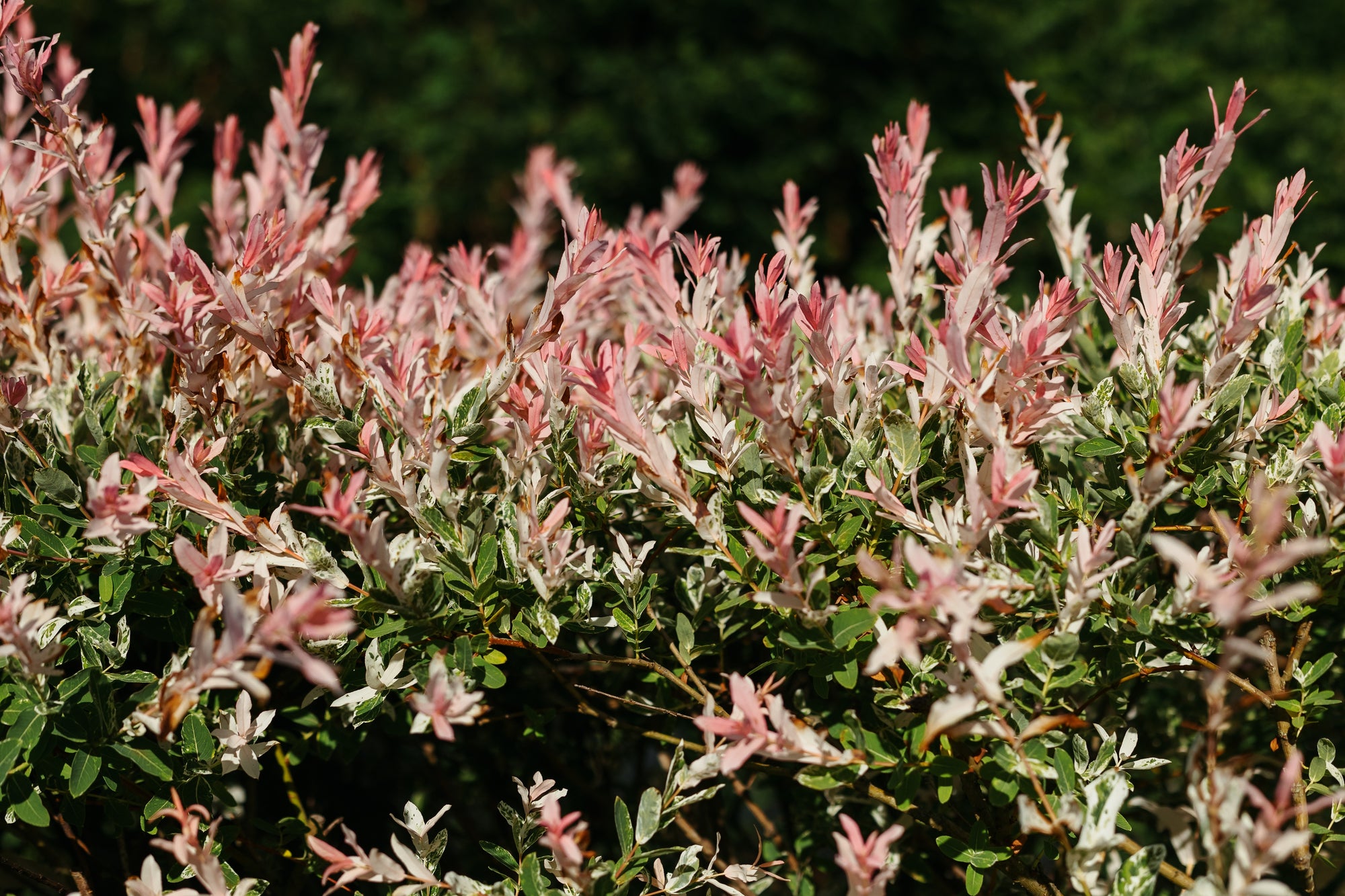
Flamingo Willow (Salix integra ‘Flamingo’). The variegated 'Flamingo' willow, Salix integra 'Flamingo', is a decorative deciduous shrub from the Salicaceae family, valued for its bright foliage which quickly transforms a flower bed or landscape. In spring, its young shoots offer a delicate blend of soft pink, cream, and pale green, creating an almost floral effect even before the garden is fully awake. In summer, the foliage becomes variegated green and white, while retaining a beautiful visual freshness. Its slender reddish branches also add interest in the cold season, while its silvery-grey spring catkins remain discreet but charming.

To plant the 'Flamingo' willow, choose a suitable exposure: sun to partial shade. The recommended soil is fresh to moist, fertile, and well-drained. Water the root ball before planting it in the ground and ensure that water can drain after planting. During establishment, check the soil moisture by hand before watering again. Spread mulch around the base, leaving the collar clear. Avoid systematic fertilizer applications without considering the soil's richness. In Quebec, choose a period when the ground is thawed and easy to work with.

Salix integra 'Flamingo' can be used as a colorful accent in flower beds, mass plantings, as a specimen plant, in wide borders, or as a low informal hedge. It also integrates very well near a terrace or in a large container, where its variegated foliage can be admired up close. It combines beautifully with ornamental grasses, dwarf conifers, dark-leaved perennials, or summer-flowering shrubs. Allow for a width of 1.5 m (5 ft) to plan this plant's space in the garden. The indicated height of 1.5 m (5 ft) helps choose its position relative to neighboring plants.

Saule Flamingo ‘Flamingo’ (Salix integra)

Planting guide

From planting to establishment.

Spacing / density {"type"=>"root", "children"=>[{"type"=>"paragraph", "children"=>[{"type"=>"text", "value"=>"\n1 plant par 1,2 à 1,5 m (4 à 5 pi), selon l’effet désiré\n\n"}]}]}
Best planting time {"type"=>"root", "children"=>[{"type"=>"paragraph", "children"=>[{"type"=>"text", "value"=>"\nPrintemps ou automne\n\n"}]}]}
Propagation Cuttings of woody or semi-woody stems

Soil and care

The right care,at the right time.

Soil pH

Slightly acidic to neutral

Minimum temperature

'-40°C

Care level

Easy to moderate

Watering

Regular watering

Soil type

Cool to moist, fertile and well-drained

Fertilization

Slow-release fertilizer 14-7-14 or 4-2-8. Fertilize monthly or as directed on the bag. Add Myke at planting.

Moisture

Fresh to moist

Seasonal care

Prune in early spring, before bud break, to stimulate the production of well-colored young shoots and maintain a dense, rounded shape. During the growing season, keep the soil moist with regular watering and organic mulch, especially during dry periods. Light spring fertilization with compost or a balanced fertilizer promotes vigorous growth without excess.

Container growing

A garden,within reach.

Recommended pot size

Grand contenant de 45 à 60 cm (18 à 24 po) de diamètre, avec bon drainage

Salix integra 'Flamingo' can be grown in a large, deep, and stable pot, ideally 45 to 60 cm (18 to 24 in) in diameter, with effective drainage holes. As this willow prefers cool soils, watering must be monitored more carefully in containers, especially during hot or windy periods. Winter protection for the pot is recommended in cold regions of Quebec to limit freeze-thaw cycles around the roots.
Saule Flamingo ‘Flamingo’ (Salix integra)

Bloom and dimensions

Its place,in your garden.

Mature height

1.5 to 2 m (5 to 7 feet)

Width / spread

1.5 m (5 feet)

Flower color

Pink

Foliage color

Green

Foliage type

Obsolete

Growth rate

fast

Growth habit

Rounded and bushy

Bloom period

Spring

Fruiting

Plain, unadorned capsules
Saule Flamingo ‘Flamingo’ (Salix integra)

Garden associations

In goodcompany.

Companion plants

Hosta, astilbe, heuchera, fern, sedge, hakonechloa, hydrangea, spirea, physocarpus, dogwood

Frequently asked questions

Your questions,answered.

When to plant 'Flamingo' willow?


Le saule ‘Flamingo’ se plante idéalement au printemps ou à l’automne, lorsque les températures sont plus fraîches et que le sol conserve mieux son humidité. Une plantation estivale est possible, mais demande un suivi d’arrosage plus rigoureux. Il est préférable de le placer dans un endroit ensoleillé et bien préparé.

How to promote the recovery of Salix integra 'Flamingo'?


La reprise est généralement bonne lorsque l’arbuste est planté dans un sol frais et arrosé régulièrement après la plantation. Il faut éviter de laisser sécher complètement la motte, surtout pendant les premières semaines. Une couche de paillis aide à garder une humidité plus stable autour des racines.

What exposure and soil are suitable for the 'Flamingo' willow?


Le saule ‘Flamingo’ préfère le plein soleil, qui favorise les plus belles couleurs de feuillage. Il pousse mieux dans un sol frais à humide, fertile et bien drainé. Un arrosage régulier est important, surtout durant l’implantation et les périodes sèches.

Can you grow 'Flamingo' willow in a pot?


Oui, le saule ‘Flamingo’ peut être cultivé en pot, surtout lorsqu’il est greffé sur tige ou gardé compact par la taille. Il faut choisir un grand contenant stable, avec un bon drainage, et arroser régulièrement pour garder le terreau frais. En hiver, une protection du pot est recommandée dans les régions plus froides.

What is the decorative interest of Salix integra 'Flamingo'?


Le principal attrait du saule ‘Flamingo’ est son feuillage printanier panaché de rose, crème et vert, suivi d’un feuillage vert marginé de blanc en été. Une taille annuelle aide à stimuler les nouvelles pousses, qui sont les plus colorées. Ses chatons printaniers peuvent aussi offrir un léger intérêt pour les pollinisateurs.

Wildlife and pets

Life,around your plants.

Supporting wildlife

It attracts certain pollinators in spring with its discreet catkins, but its main appeal remains its variegated ornamental foliage.