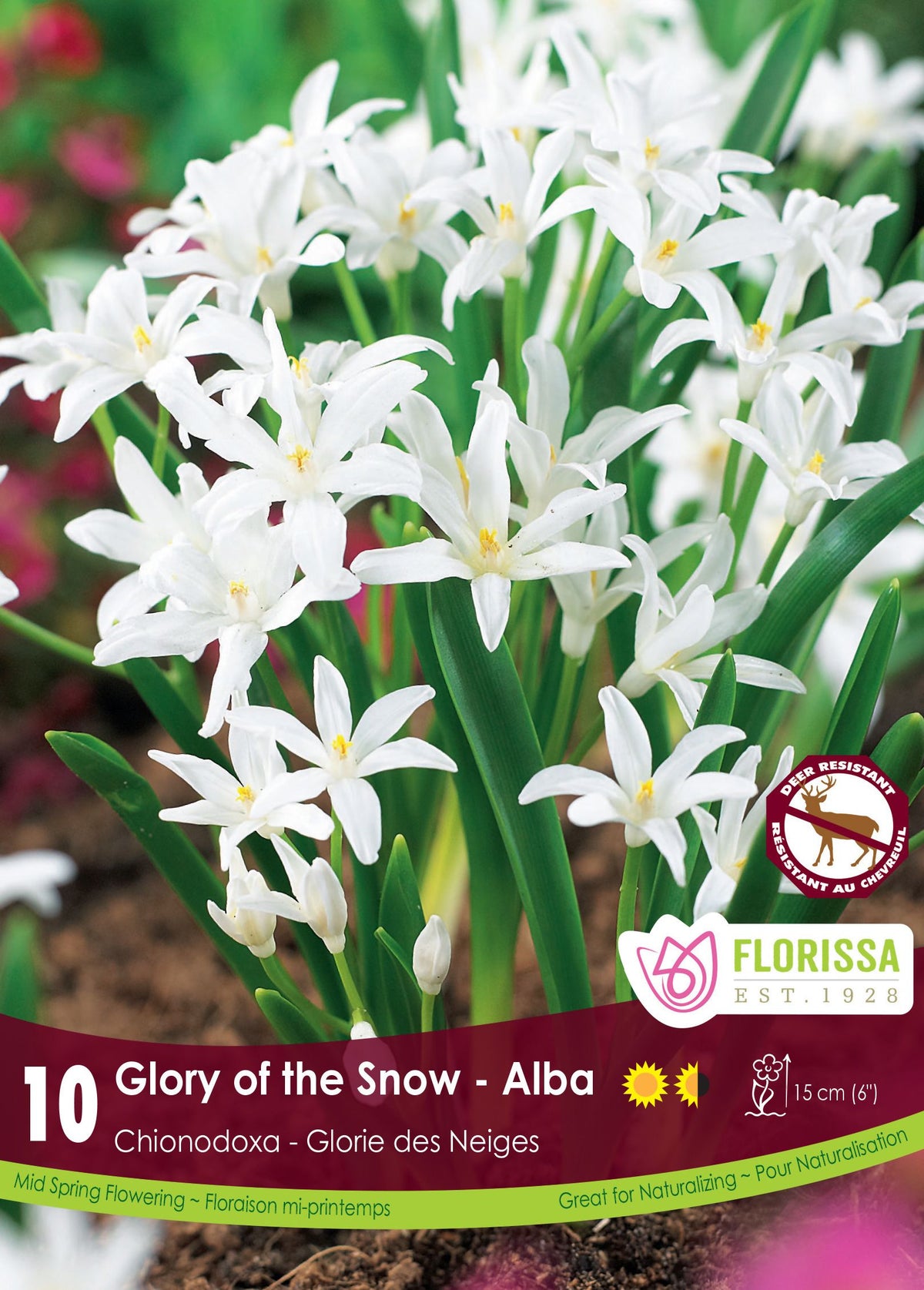
Chionodoxa Alba

Chionodoxa luciliae ‘Alba’

White Glory-of-the-Snow ‘Alba’ produces masses of delicate white star-shaped flowers above fine green foliage. This variety brings exceptional brightness to spring gardens.
5 99 $
Pay in 4 interest-free payments with Sezzle
Detailed plant guide
Advice adapted to Canada
Secure payment
2026 preorder for fall bulbs Shipping expected in October 2026.
Share
Quantity 10 bulbs
Exposure Full sun to partial shade
Hardiness Zone 3
Difficulty level Easy

Discover the plant

Family Asparagaceae
Type Bulb
Cycle Perennial

White Glory-of-the-Snow (Chionodoxa luciliae ‘Alba’) is a charming spring-flowering bulbous perennial that heralds the arrival of spring with a profusion of pure white, star-shaped blooms. Carried in delicate clusters above fine, bright green foliage, the flowers appear from March to April, often just as the last snow disappears and the garden begins to awaken. Growing only 10 to 15 cm (4 to 6 in) tall, this variety gradually forms luminous carpets of blossoms. Exceptionally hardy to Zone 3, it returns reliably year after year and thrives through Quebec winters when planted in well-drained soil.

Plant the bulbs in autumn before the ground freezes, approximately 8 cm (3 in) deep and 5 to 8 cm (2 to 3 in) apart. White Glory-of-the-Snow thrives in full sun to partial shade and prefers light, fertile soil that remains moist in spring while draining well throughout the year. Water lightly after planting, then maintain moderate moisture during active growth. Once flowering has finished, allow the foliage to yellow naturally so the bulbs can replenish their energy reserves. A light application of compost or bulb fertilizer in early spring encourages abundant, long-lasting blooms.

This variety is ideal for rock gardens, borders, open woodlands, and naturalized lawns, where it gradually spreads through bulb division and self-seeding. For a bright and lively spring display, combine it with crocuses, snowdrops, squills, botanical daffodils, or grape hyacinths. In lawns, simply delay mowing until the foliage has completely yellowed. Its exceptionally early flowers provide an important source of nectar for bees and other early-season pollinators. The bulbs can remain in place for many years, provided excessively wet soils are avoided, as prolonged moisture may lead to bulb rot.

Chionodoxa Alba

Planting guide

From planting to establishment.

Planting depth 8 cm (3 in)
Establishment temperature 8 to 12°C (46 to 54°F)
Establishment time 21 to 42 days
Best planting time Fall
Propagation Propagate by dividing bulbs after several years or by allowing natural self-seeding. This variety naturalizes readily.
Growing method
Plant the bulbs approximately 8 cm (3 in) deep in light, fertile, well-drained soil. Space bulbs 5 to 8 cm (2 to 3 in) apart. Grow in full sun or partial shade where the soil remains moist during spring. Water lightly after planting, then keep the soil slightly moist during active growth. Allow the foliage to yellow naturally so the bulbs can replenish their energy reserves. Colonies gradually expand over the years.

Soil and care

The right conditions.

Exposure Full sun to partial shade
Soil pH Neutral to slightly alkaline
Hardiness zone Zone 3
Minimum temperature -40°C (-40°F)
Watering
Keep the soil slightly moist during active growth, then stop watering once the plant enters dormancy.
Soil type
Light, fertile soil that remains moist in spring and drains exceptionally well.
Fertilization
Apply compost or a bulb fertilizer in early spring. Light feeding encourages stronger, longer-lasting blooms.
Seasonal care
Allow the foliage to yellow naturally before removing it. Avoid disturbing the bulbs unnecessarily. Divide clumps only when they become overcrowded.

Container growing

A controlled environment.

Recommended pot size
20 cm (8 in)
Container growing is easy in a pot at least 20 cm (8 in) deep with excellent drainage. Use a light, fertile potting mix that stays moist in spring while drying gradually during summer dormancy. Place the container in full sun or light partial shade. Water lightly during active growth, then reduce watering once the foliage enters dormancy. The bulbs can remain in the container for many years provided winter drainage is adequate.
Chionodoxa Alba

Bloom and dimensions

The complete profile.

Flower color Pure white
Foliage color Bright green
Foliage type Deciduous
Growth rate Moderate
Bloom period
Pure white star-shaped flowers appear as soon as the snow melts, providing an important nectar source for early pollinators.
Fruiting
None
Harvest
None
Chionodoxa Alba

Garden associations

What to plant with it.

Good companions
Crocuses, snowdrops, squills, botanical daffodils, and grape hyacinths make excellent companion plants.
Avoid planting with
The main threats are poorly drained soils that promote bulb rot and, in some gardens, rodents.
Ideal for rock gardens, borders, naturalized lawns, open woodlands, and spring gardens.

From the garden to inspiration.

The flowers are not intended for consumption. This variety is grown exclusively for its exceptionally early bloom and its ability to form beautiful carpets of flowers. It is also an excellent choice for naturalizing beneath deciduous trees and throughout lawns.

Frequently asked questions

Everything toknow.

Plant the bulbs in autumn before the ground freezes. This allows excellent root development before spring flowering.
Yes. It is fully hardy to Zone 3 and returns reliably every spring when planted in well-drained soil.
Yes. This variety naturalizes easily in lawns where mowing is delayed until the foliage has completely yellowed.
No. Allow the foliage to yellow naturally so the bulbs can store the energy needed for the following year's blooms.
Yes. Its exceptionally early flowers provide an important nectar source for bees and other early spring pollinators.

Its strengths, naturally.

Butterflies
Plants that attract butterflies

Butterflies