Anémone bourgogne et fleur de coupe

Bordeaux anemone

Anemone coronaria

Product code : 146 243 01

Bordeaux is a poppy anemone with mahogany-burgundy petals, dark violet centres, and long 40 cm stems. The Van Noort package contains five corms for spring planting after hard frost, 5 cm deep and 10 cm apart. It prefers full sun or bright partial shade, humus-rich sharply drained soil, and steady moisture during active growth. Velvety flowers excel in borders and bouquets, where their deep colour brings dramatic contrast to pale companions.
9 99 $
Pay in 4 interest-free payments with Sezzle
Detailed plant guide
Advice adapted to Canada
Secure payment
Share
Quantity
5 tubers
Exposure
Full sun to partial shade
Life cycle
Cormous perennial; naturalizes in suitable conditions

Discover the plant

Common nameBordeaux poppy anemone
FamilyRanunculaceae
GenusAnemone
Speciescoronaria
CultivarBordeaux
TypeSpring-flowering corms
Botanical nameAnemone coronaria

Bordeaux anemone (Anemone coronaria) stands out in summer with mahogany-burgundy flowers carrying a velvet texture and dark violet centres. Rich dramatic corollas rise on extra-long stems reaching 45 cm above divided green foliage. The Van Noort package contains five corms. Its sophisticated colour brings depth to borders, containers, and cut-flower bouquets and remains striking beside restrained cream or white companions. The five size 5/6 Van Noort corms create a luxurious small drift without requiring much space. In colder Canadian regions, excellent drainage protects corms during thaws and cold rain.

Soak the corms for three to four hours, then plant them in spring after the danger of hard frost 5 cm deep and 10 cm apart. Choose full sun or bright partial shade and loose, humus-rich, fertile but sharply drained soil. Water after planting and maintain even moisture during active growth without saturation. in colder Canadian regions sites exposed to wet thaws, use a raised bed or a container that can be protected easily. Avoid hollows and heavy wet mulch around the planting. The five size 5/6 Van Noort corms create a luxurious small drift without requiring much space.

Bordeaux is especially valuable in a cutting garden, where long straight stems supply graphic flowers for contemporary arrangements. Pair it with cream tulips, white daffodils, pale grape hyacinths, and silver foliage to emphasize the dark petals. Cut coloured buds as they begin opening, then retain enough leaves on the plants. Flowers support pollinators, the plant is generally deer resistant, and every part is toxic when eaten. Gloves are sensible when handling many corms or stems. The five size 5/6 Van Noort corms create a luxurious small drift without requiring much space.

A group of Bordeaux anemones showing velvety mahogany-burgundy flowers with dark violet centres on long upright 40 cm stems

Planting guide

Plant well.Grow beautifully.

Spacing / density

100 mm (4 in.) between corms

Best planting time

Spring after frost; fall starting requires frost-free overwintering

Propagation

Corm division and offset separation during dormancy

Growing method

Soak Bordeaux corms in room-temperature water for three to four hours. In spring after hard frost, prepare a full-sun or bright partial-shade site with loose, fertile, sharply drained soil. Incorporate mature compost and fine grit when soil is heavy. Set each corm 5 cm deep; if its orientation is unclear, place it on its side. Leave 10 cm between units and group all five corms. Water after planting. In colder Canadian regions, finish before lasting frost, then apply light mulch only after the soil freezes. Remove protection in spring and maintain even moisture without standing water. Deadhead flowers, then allow foliage to yellow completely. In sites that are too cold or wet, grow in containers and overwinter corms cool, dry, and frost free. Group all five corms to create a generous display that remains easy to read from the path. Always let foliage yellow completely so it rebuilds reserves for the following growing season. Monitor drainage, slugs, and aphids so every developing problem can be corrected quickly. Harvest flowers early, when a coloured bud is just beginning to open.

Soil and care

The right care,at the right time.

Soil pH

Neutral to slightly alkaline, approximately 6.5 to 7.5

Minimum temperature

Protect the tubers from frost during cold Canadian winters

Watering

Water deeply after planting, then let the surface dry slightly. In spring, keep soil evenly moist while leaves, buds, and flowers develop, without saturation. Morning watering directed at the base limits disease. Reduce moisture gradually as leaves yellow and provide almost none during dormancy. Check containers frequently because wind and sun dry them faster, but always empty saucers after watering. Feel the upper mix before deciding whether another irrigation is needed.

Soil type

Bordeaux prefers sandy loam enriched with organic matter and excellent drainage. Add mature compost to support flowering, then mix fine grit or coarse sand into compacted soil. Corms tolerate standing water poorly and may rot quickly during winter thaws. A raised bed suits clay sites. Avoid fresh manure, sealed planting pockets, and low areas where meltwater gathers.

Fertilization

Before planting, blend mature compost into the soil without placing concentrated fertilizer against corms. In spring, apply balanced low-nitrogen feed as leaves unfold and again when buds begin. Water before feeding. Excess nitrogen creates soft foliage and fewer flowers. Stop fertilizing as soon as leaves yellow, and never feed dormant or stored corms.

Moisture

Moderate, consistent moisture during active growth encourages 40 cm stems and well-formed flowers. Maintain free air movement around the foliage. Never allow soaked mulch or water to collect over the crown. After flowering, drier conditions should accompany the corm’s natural rest. During storage, provide a cool, dry, ventilated atmosphere and inspect regularly for mould or softness.

Seasonal care

In spring after hard frost, rehydrate corms for three to four hours, prepare sharply drained soil, and plant them 5 cm deep with 10 cm spacing. Water once to settle soil. In cold cold Canadian regions sites, wait until the ground freezes before adding light mulch. Through winter, monitor water movement during thaws. In spring, remove mulch gradually, uncover shoots, and keep soil moist without saturation. Feed lightly as foliage unfolds and again at bud stage. The 40 cm stems normally support themselves, although a windy site may need discreet support. Harvest blooms as coloured buds begin opening or deadhead regularly. Watch for aphids, slugs, botrytis, and rot. After flowering, retain every leaf until yellow, then cut dry foliage at soil level. Reduce watering with dormancy. Divide crowded groups every three or four years. Where soil stays cold and wet, lift corms, dry them in shade, and store them in a breathable container in a cool, dry, frost-free place. Group all five corms to create a generous display that remains easy to read from the path. Always let foliage yellow completely so it rebuilds reserves for the following growing season. Monitor drainage, slugs, and aphids so every developing problem can be corrected quickly. Harvest flowers early, when a coloured bud is just beginning to open.

Container growing

A garden,within reach.

Choose a container 25 to 30 cm wide and 25 cm deep, with several drainage holes, for all five corms. Fill it with light potting mix enriched with compost, perlite, or fine grit. After soaking for three to four hours, plant 5 cm deep and leave 8 to 10 cm between corms. Water to settle the mix and place in full sun or bright partial shade. During growth, keep the substrate lightly moist, empty the saucer, and rotate the pot for straight stems. Feed lightly as leaves unfold and again at bud stage. Deadhead flowers but keep foliage until it yellows. For a cold Canadian regions winter, move the pot to a dark, cool, dry, frost-free room, or insulate it in a sheltered position where water cannot enter. Resume watering gradually when shoots emerge. Group all five corms to create a generous display that remains easy to read from the path. Always let foliage yellow completely so it rebuilds reserves for the following growing season. Monitor drainage, slugs, and aphids so every developing problem can be corrected quickly.
A group of Bordeaux anemones showing velvety mahogany-burgundy flowers with dark violet centres on long upright 40 cm stems

Bloom and dimensions

Its place,in your garden.

Bloom period
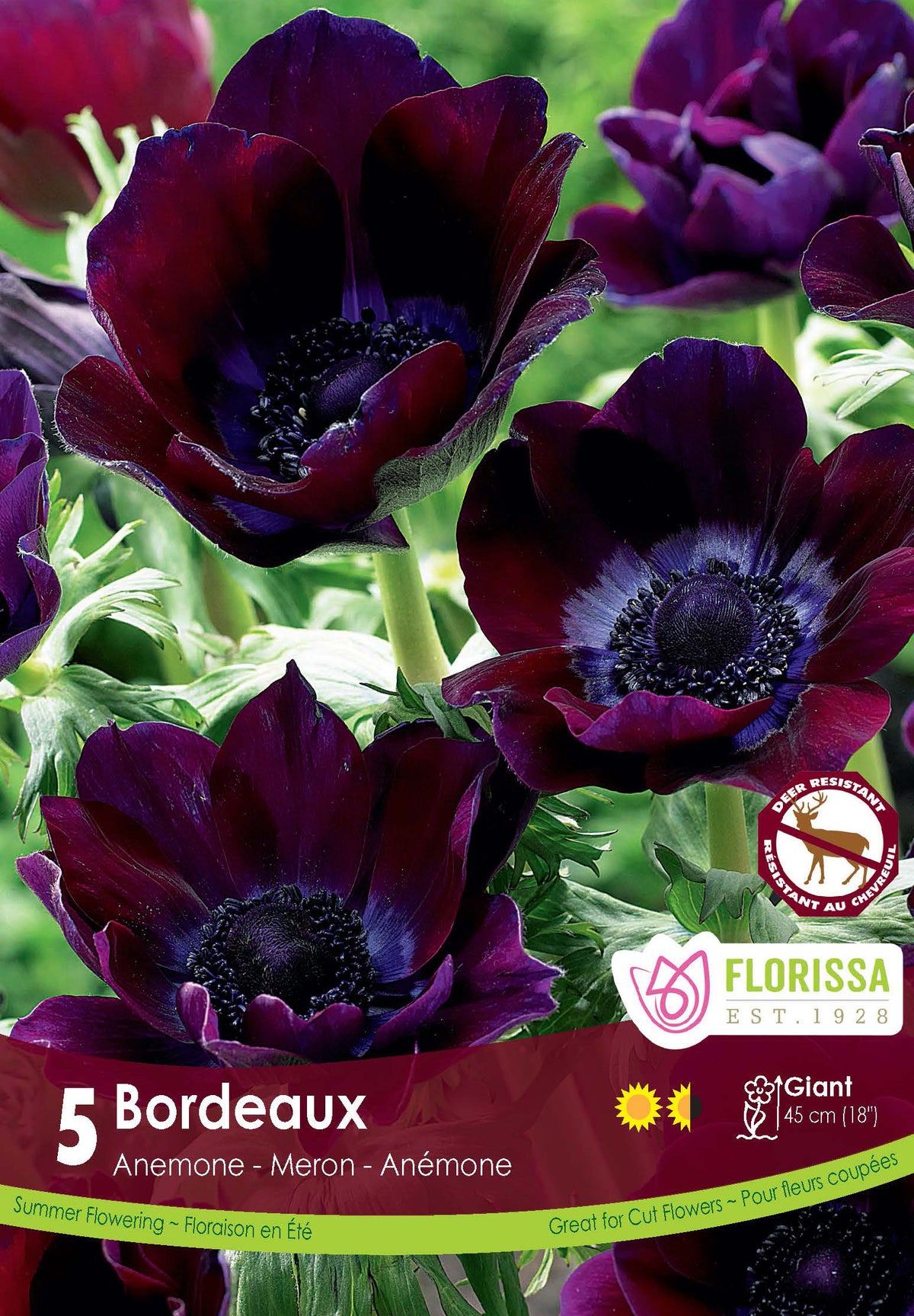
In summer, Bordeaux carries large single to semi-double burgundy flowers, sometimes brushed with raspberry, around a very dark centre on upright 40 cm stems. Buds open progressively, and regular cutting supports following stems. Harvest as a coloured bud first cracks open for longer vase performance. Finely divided green foliage frames the corollas without hiding them.
A group of Bordeaux anemones showing velvety mahogany-burgundy flowers with dark violet centres on long upright 40 cm stems

Garden associations

In goodcompany.

Companion plants

Pair Bordeaux with white daffodils, cream tulips, blue grape hyacinths, pale hyacinths, pansies, forget-me-nots, and primroses. These partners bloom at the same time, emphasize burgundy, and appreciate drained soil. Later perennial geraniums or catmint can conceal yellowing foliage. Leave enough room for air circulation and prevent dense roots from competing with the corms. Repeated small groups create a more coherent composition than one isolated planting.

Frequently asked questions

Your questions,answered.

How many corms are in a Bordeaux package?
The Van Noort package contains five corms. Group them in a short drift or container to concentrate burgundy colour. Leave 10 cm between corms and plant 5 cm deep. Size 5/6 describes commercial circumference. Before planting, inspect every corm, discard soft or mouldy specimens, and soak firm ones for three to four hours in room-temperature water. Mark the group so emerging young shoots are not disturbed.
Why is Bordeaux suited to bouquets?
Van Noort describes Bordeaux as an excellent cut flower because its extra-long stems reach 40 cm. Harvest when a coloured bud begins opening; the flower will continue unfolding in water. Use a clean tool, cut early in the morning, and immediately place stems in a cool bucket. Retain enough leaves on plants to feed the corms. In the vase, refresh water and keep flowers away from ripening fruit and direct heat.
When and how should the corms be planted?
Plant corms in spring after the danger of hard frost. Rehydrate them for three to four hours, then set them 5 cm deep and 10 cm apart in humus-rich perfectly drained soil. Choose full sun or bright partial shade. Water after planting, then keep the soil lightly moist during growth without waterlogging. A raised bed or gentle mound suits heavy wet cold Canadian regions soil. Apply light mulch only after the ground has frozen.
Can Bordeaux overwinter in colder Canadian regions?
The Van Noort listing indicates Zones 5 through 10, but cold Canadian regions survival depends strongly on drainage and freeze-thaw cycles. Protect the planting from standing water and apply light mulch only after the ground freezes. In a cold wet site, grow in containers or lift corms after foliage yellows. Dry them in shade, then store them cool, dry, and frost free in a breathable container. Inspect stored corms periodically for mould.
What is the exact flower colour?
Petals are a rich burgundy approaching mahogany, with a velvet surface and a very dark violet centre. Colour can appear almost chocolate under soft light and redder when sunshine passes through the petals. This variation gives bouquets exceptional depth. Pair Bordeaux with white, cream, pale yellow, blue-grey, or silver foliage rather than many saturated colours so its sophisticated character remains clear. The dark centre reinforces the jewel-like quality.