Ornamental bulbs

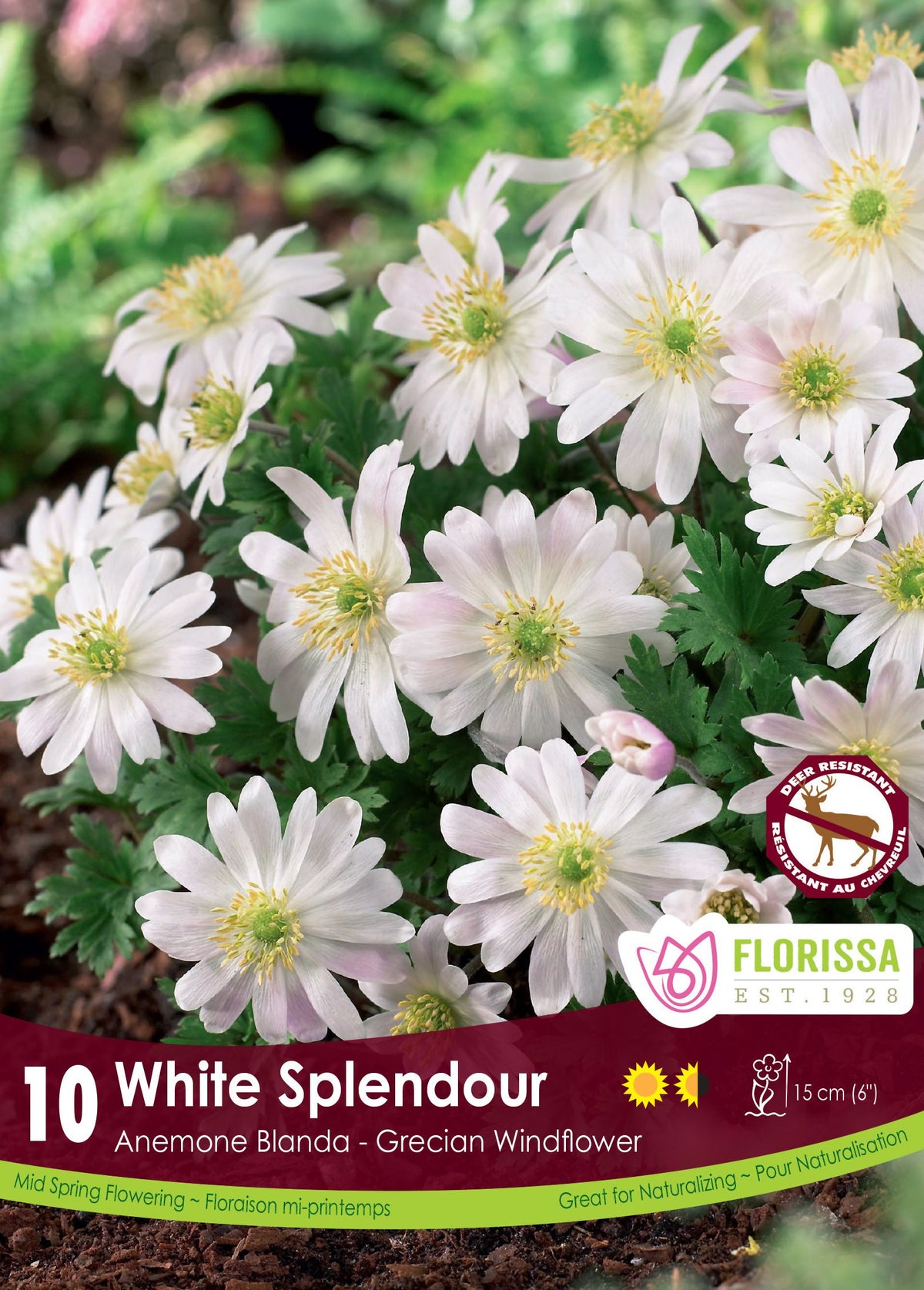
Anemone 'White Splendour' (Anemone blanda)

Anemone blanda ‘White Splendour’

Anemone blanda ‘White Splendour’ produces an abundance of pure white star-shaped flowers with golden centres. Its delicate foliage forms a luminous carpet in naturalized gardens.
9 49 $
Pay in 4 interest-free payments with Sezzle
Detailed plant guide
Advice adapted to Canada
Secure payment
Share
Quantity 10 tubers
Exposure Full sun to partial shade
Hardiness Zone 4
Difficulty level Easy

Discover the plant

Family Ranunculaceae
Genus Anemone
Species blanda
Cultivar White Splendour
Type Tuber
Cycle Perennial

White Splendour Grecian Windflower (Anemone blanda ‘White Splendour’) brightens the garden from March to April with a profusion of pure white, star-shaped flowers highlighted by golden centres. Its finely divided, fresh green foliage forms a low, delicate carpet that beautifully showcases this early spring display. Reaching 25 to 30 cm in height, this tuberous perennial brings freshness and brightness to gardens that are only beginning to bloom. Hardy to Zone 4, it performs well in Quebec gardens and gradually naturalizes to form beautiful spring colonies over the years.

Plant the tubers in fall at a depth of approximately 5 cm, spacing them 10 to 15 cm apart. Soaking the tubers in lukewarm water for a few hours before planting helps rehydrate them and encourages faster establishment. This anemone prefers full sun to light partial shade and fertile, light, perfectly drained soil with a neutral to slightly alkaline pH. Water lightly after planting, then keep the soil evenly moist during active growth without allowing it to become waterlogged. After flowering, allow the foliage to turn yellow naturally so the tubers can replenish their reserves before entering dormancy.

Ideal for rock gardens, open woodland gardens, naturalized lawns, borders, and containers, this anemone creates an especially elegant effect when planted in groups. It pairs beautifully with crocuses, snowdrops, grape hyacinths, squills, and dwarf daffodils to create colourful displays from the first warm days of spring. Its early flowers attract bees and many other pollinators, providing an important nectar source at the beginning of the season. As it naturalizes, it forms a long-lasting, low-maintenance, and luminous spring groundcover.

Anemone 'White Splendour' (<em>Anemone blanda</em>)

Planting guide

From planting to establishment.

Planting depth 5 cm (2 in)
Spacing / density Space plants or bulbs 10 to 15 cm apart.
Establishment temperature 10 to 15°C (50 to 59°F)
Establishment time 21 to 42 days
Best planting time Fall
Propagation Divide the tubers or separate colonies during dormancy. This method faithfully preserves the variety.
Growing method
Soak the tubers in lukewarm water for a few hours before planting to improve establishment. Plant them approximately 5 cm (2 in) deep in light, fertile, perfectly drained soil. Space the tubers 10 to 15 cm (4 to 6 in) apart. Choose a location in full sun during spring or light partial shade beneath deciduous trees. Water lightly after planting, then keep the soil lightly moist during active growth. Allow the plants to naturalize to create a flowering carpet over time.

Soil and care

The right conditions.

Exposure Full sun to partial shade
Soil pH Neutral to slightly alkaline
Hardiness zone Zone 4
Minimum temperature -34°C (-30°F)
Watering
Water lightly during active growth to keep the soil fresh without excess moisture. Reduce watering once the foliage disappears.
Soil type
Light, fertile, and perfectly drained soil. Avoid heavy or waterlogged soils.
Fertilization
Apply a small amount of compost in spring. Light fertilization is sufficient to support abundant flowering without encouraging excessive foliage growth.
Seasonal care
Allow the foliage to yellow naturally before removing it so the tubers can replenish their reserves. Water moderately during active growth. Avoid excess moisture during dormancy. Divide colonies when they become overcrowded.

Container growing

A controlled environment.

Recommended pot size
20 to 25 cm (8 to 10 in)
Suitable for containers in a free-draining mix; protect from frost when hardiness requires it.
Anemone 'White Splendour' (<em>Anemone blanda</em>)

Bloom and dimensions

The complete profile.

Flower color Pure white
Foliage color Fresh green
Foliage type Deciduous
Growth rate Moderate
Bloom period
Pure white star-shaped flowers appear very early in spring and attract the first pollinators. They brighten rock gardens and open woodland areas.
Fruiting
None
Harvest
None
Anemone 'White Splendour' (<em>Anemone blanda</em>)

Garden associations

What to plant with it.

Good companions
Crocuses, snowdrops, grape hyacinths, squills, and dwarf daffodils make excellent companion plants. They bloom at the same time and create beautiful spring carpets.
Avoid planting with
The main problems are slugs on young shoots and poorly drained soils that encourage tuber rot.
Ideal for rock gardens, open woodland gardens, naturalized lawns, borders, and containers. It forms beautiful flowering carpets in spring.

From the garden to inspiration.

The flowers are not intended for consumption. They are grown primarily for their early flowering and exceptional ornamental value. This variety is perfect for creating flowering carpets beneath trees and in rock gardens. The blooms are also charming in small spring bouquets.

Frequently asked questions

Everything toknow.

Tubers are best planted in fall to benefit from cool soil conditions. They may also be planted very early in spring after soaking them beforehand.
Yes. Soaking the tubers in lukewarm water for a few hours rehydrates them and speeds up establishment. It also encourages more vigorous growth.
Yes. It gradually multiplies and forms beautiful flowering carpets in rock gardens, beneath deciduous trees, and in lightly mown lawns.
Yes. Its compact habit makes it perfect for containers and window boxes with excellent drainage. It flowers abundantly with good spring light.
Keep the soil lightly moist during active growth and allow the foliage to yellow naturally before removing it. The stored energy promotes excellent flowering the following year.

Its strengths, naturally.

Not recommended for pets

Pets

Butterflies
Plants that attract butterflies

Butterflies