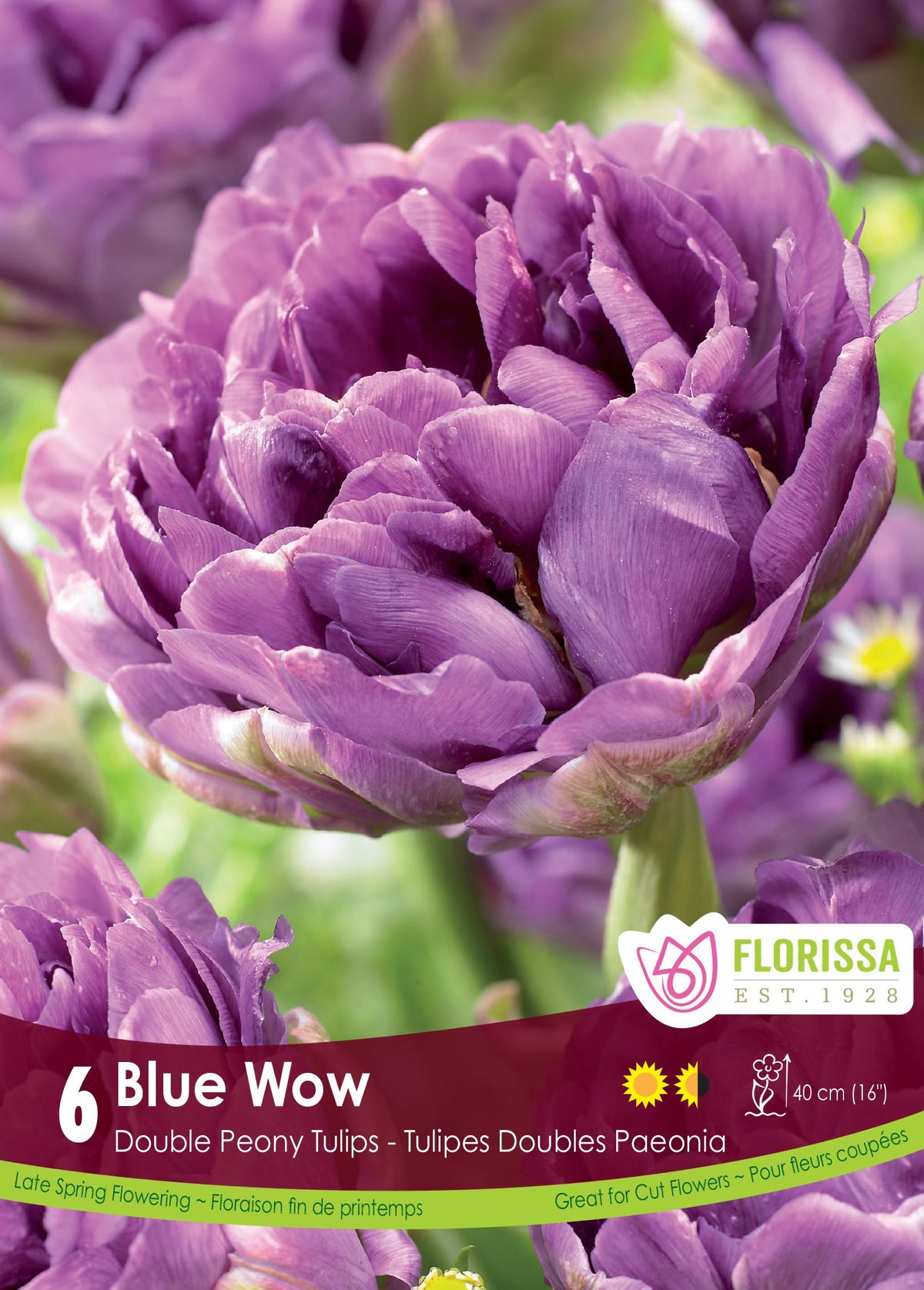
Blue Wow Tulip

Get ready to be dazzled by the 'Blue Wow' tulip, a late-blooming double variety with an impressive volume and an intense, almost unreal bluish-purple color. With its layered petals and massive peony-like shape, it instantly becomes the star of opulent beds, luxurious pots, and dramatic bouquets. Its late flowering provides a beautiful finale to spring, with an allure that is at once romantic, theatrical, and surprisingly modern. Easy to grow, very hardy, and incredibly floriferous, it is perfect for those who want a show-stopping tulip. Height: 40 to 50 cm (16 to 20 in). Planting period: September to October, before the first frosts.
10 99 $
Pay in 4 interest-free payments with Sezzle
Detailed plant guide
Advice adapted to Canada
Secure payment
2026 preorder for fall bulbs Shipping expected in October 2026.
Share
Quantity
6 bulbs
Exposure
Sun

Discover the plant

Common nameTulip Blue Wow
FamilyLiliaceae
GenusTulip
TypeBulb
Botanical nameTulip

Blue Wow Tulip (Tulipa). Prepare to be dazzled by the 'Blue Wow' tulip, a late double variety with impressive volume and an intense, almost unreal bluish-purple color. With its layered petals and massive peony-like form, it instantly becomes the star of opulent flowerbeds, luxurious pots, and dramatic bouquets. Its late flowering offers a beautiful grand finale to spring, with an allure that is at once romantic, theatrical, and surprisingly modern. Easy to grow, very hardy, and incredibly floriferous, it is perfect for those who want a show-stopping tulip. In pots: Spectacular in large decorative containers, either alone or with contrasting foliage.

Plant tulips in the fall, in soil that is still easy to work before it freezes. Choose a sunny spot with well-drained soil, then loosen the soil to a sufficient depth. Place the bulbs with the pointed end up and respect the planting depth indicated for their size. When planting in groups, leave space between the bulbs to allow roots to develop. Water after backfilling if the soil is dry. Avoid areas where water pools after rain and mark the planting site so as not to damage the bulbs during subsequent gardening work.

In spring, monitor moisture during growth and water at the base if a dry period persists. Remove faded flowers while keeping the leaves green. This foliage allows the bulb to replenish its reserves; wait for it to yellow naturally before cutting it and avoid braiding it. In containers, check for dryness more often than in the ground and always allow excess water to drain. Re-growth and flowering in subsequent years depend on the variety and growing conditions. Keep bulbs out of reach of children and animals: tulips are ornamental and not for consumption.

Tulipe Blue Wow ( Tulipa ) : une tulipe double violette aux pétales nombreux. Le visuel Florissa présente la plante et son nom dans la partie inférieure de l’étiquette. La photographie occupe presque toute la surface, tandis que le bandeau du bas rassemble les indications du produit. Cette vue permet de reconnaître son apparence et de distinguer la variété présentée.

Planting guide

Plant well.Grow beautifully.

Planting depth

15 cm (6 in.)

Spacing / density

4 to 5 in (10 to 12 cm)

Growing method

Plant tulips in the fall, in soil that is still easy to work before it freezes. Choose a sunny spot with well-drained soil, then loosen the soil to a sufficient depth. Place the bulbs point-up and respect the planting depth indicated for their size. When planting in groups, leave space between the bulbs to allow roots to develop. Water after backfilling if the soil is dry. Avoid areas where water remains on the surface after rain and mark the planting location to avoid damaging the bulbs during subsequent gardening. In spring, monitor moisture during growth and water at the base if a dry spell persists. Remove faded flowers while keeping the leaves green. This foliage allows the bulb to replenish its reserves; wait for it to yellow naturally before cutting it and avoid braiding it. In containers, monitor for dryness more often than in the ground and always allow excess water to drain. Regrowth and flowering in subsequent years depend on the variety and growing conditions. Keep bulbs out of reach of children and pets: tulips are ornamental and not for consumption.

Soil and care

The right care,at the right time.

Watering

During growth, water at the base when the soil surface begins to dry out. Take rainfall into account: if the soil remains moist, wait before adding more water. Continue to monitor moisture after flowering as long as the leaves are green, then reduce watering when they naturally yellow. Avoid standing water around the bulbs. In pots, check the potting mix more frequently and allow excess water to drain freely through the drainage holes.

Soil type

Rich, loose, well-drained. Observe your location after a rain to identify areas where water remains on the surface for a long time. Work the soil when it is not waterlogged: intervening when it is soggy risks compacting it around the roots. Adapt amendments to the actual soil texture, without systematically adding sand or fertilizer. If you are growing in containers, use an appropriate substrate and ensure that the drainage holes remain clear.

Fertilization

Bulb fertilizer recommended in the fall. Observe the dosage indicated on your fertilizer packaging and measure the quantity before applying it. Take into account compost and other additions already made to avoid fertilizing the same planting twice. Distribute the product according to its instructions; avoid concentrated contact with roots or storage organs.

Seasonal care

Plant tulips in the fall, in soil that is still easy to work before it freezes. Choose a sunny spot with well-drained soil, then loosen the soil to a sufficient depth. Place the bulbs pointy end up and observe the planting depth indicated for their size. When planting in groups, leave space between the bulbs to allow roots to develop. Water after backfilling if the soil is dry. Avoid areas where water pools on the surface after rain and mark the planting so as not to damage the bulbs during subsequent gardening tasks. In spring, monitor moisture during growth and water at the base if a dry spell persists. Remove faded flowers while keeping the leaves green. This foliage allows the bulb to replenish its reserves; wait for it to yellow naturally before cutting and avoid braiding it. When planting in containers, check for dryness more often than in the ground and always allow excess water to drain. Re-growth and flowering in subsequent years depend on the variety and growing conditions. Keep bulbs out of reach of children and animals: tulips are ornamental and not edible. As the seasons progress, observe new shoots, soil moisture, and the condition of the stems. A durable label helps locate the planting during its dormancy. Clean tools after cutting diseased parts and remove degrading debris around the base of the plant.

Container growing

A garden,within reach.

Container gardening requires planning for the necessary root volume and the plant's final height. Choose a stable pot with drainage holes and a suitable planting medium. Leave enough space to respect the recommended depth and spacing, rather than crowding plants to immediately fill the pot. Place the container in the indicated exposure and regularly check the moisture, especially in hot or windy weather. A pot is more exposed to temperature variations than planting in the ground. Therefore, plan for a wintering location compatible with the plant's needs and your region's climate from the outset. Plant tulips in the fall, in soil that is still easy to work before it freezes. Choose a sunny spot with well-drained soil, then loosen the soil to a sufficient depth. Place the bulbs pointy end up and respect the planting depth indicated for their size. When planting in groups, leave space between the bulbs to allow roots to develop. Water after backfilling if the soil is dry. Avoid areas where water remains on the surface after rain and mark the planting location to avoid damaging the bulbs during subsequent gardening work. In winter, protect the container according to the plant's needs: its roots are more exposed to cold than when planted in the ground.
Tulipe Blue Wow ( Tulipa ) : une tulipe double violette aux pétales nombreux. Le visuel Florissa présente la plante et son nom dans la partie inférieure de l’étiquette. La photographie occupe presque toute la surface, tandis que le bandeau du bas rassemble les indications du produit. Cette vue permet de reconnaître son apparence et de distinguer la variété présentée.

Bloom and dimensions

Its place,in your garden.

Mature height

40 to 50 cm (16" to 20")

Bloom period

Prepare to be dazzled by the 'Blue Wow' tulip, a late double variety with impressive volume and an intense, almost surreal bluish-purple color. Its late bloom provides a beautiful grand finale to spring, with a look that is at once romantic, theatrical, and surprisingly modern. For planting in the ground: Perfect for English-style beds, lush borders, or late spring gardens. Ultra-dense double flower, purple with bluish reflections.
Tulipe Blue Wow ( Tulipa ) : une tulipe double violette aux pétales nombreux. Le visuel Florissa présente la plante et son nom dans la partie inférieure de l’étiquette. La photographie occupe presque toute la surface, tandis que le bandeau du bas rassemble les indications du produit. Cette vue permet de reconnaître son apparence et de distinguer la variété présentée.

Garden associations

In goodcompany.

Companion plants

To accompany Blue Wow Tulip, you could consider muscari, pansies, or forget-me-nots. Choose neighboring varieties based on their height, flowering period, and the colors you wish to combine. Above all, ensure their sun exposure and water requirements are suitable for the same location. Maintain enough distance so that the leaves do not mask young shoots and to allow easy access to each plant for maintenance. These combinations are meant to compose the garden's decor; they do not guarantee protection against pests or diseases. Adjust the layout after observing one growing season.

Frequently asked questions

Your questions,answered.

How to successfully plant Tulip Blue Wow?
Plant tulips in the fall, in soil that is still easy to work before it freezes. Choose a sunny spot with well-drained soil, then loosen the soil to a sufficient depth. Place the bulbs with the tip facing upwards and observe the planting depth indicated for their size. When planting in groups, leave space between the bulbs to allow the roots to develop. Water after backfilling if the soil is dry. Avoid areas where water remains on the surface after rain and mark the planting location to avoid damaging the bulbs during subsequent gardening work. Keep a durable label to easily find this planting during its dormant period.
What kind of light should I provide for Tulip Blue Wow?
The recommended exposure is full sun. Observe the light in your chosen spot in the morning and afternoon, as the shade from trees or buildings changes throughout the day. Also consider neighboring plants: their foliage can obscure a young plant as it grows. For container plants, place the pot where you can move it if conditions become too hot or too shady. Appropriate exposure must go hand in hand with suitable soil and watering. If you move a plant started indoors to the outdoors, gradually accustom it to garden conditions to avoid too abrupt a transition for young leaves.
How do I adjust the watering?
Water according to the actual soil moisture, taking into account rain, heat, and wind. Check below the surface before deciding to water again: soil that is dry on the surface can still be moist at the root level. Direct water to the base of the plant and let it penetrate, without keeping the plant in saturated soil. Containers generally require more frequent checks because they dry out faster. Make sure their drainage holes remain clear and empty any saucers that retain water. Also adapt care to the plant's cycle: active growth and a dormant period do not require the same water input.
What should I plan for container gardening?
Container gardening requires planning for the necessary root volume and the plant's final height. Choose a stable pot with drainage holes and a growing medium suitable for planting. Leave enough space to respect the recommended depth and spacing, rather than crowding the plants to immediately fill the pot. Place the container in the indicated exposure and regularly check the moisture, especially in hot or windy weather. A pot is more exposed to temperature variations than a plant in the ground. Therefore, plan for a wintering location from the outset that is compatible with the plant's needs and your region's climate.
What care should be provided after the growing season?
In spring, monitor humidity during growth and water at the base if a dry spell persists. Remove faded flowers while keeping the leaves green. This foliage allows the bulb to replenish its reserves; wait for it to yellow naturally before cutting and avoid braiding it. In containers, check for dryness more often than in the ground and always allow excess water to drain. Regrowth and flowering in subsequent years depend on the variety and growing conditions. Keep bulbs out of reach of children and animals: tulips are ornamental and not edible.