


Fragrant late-autumn and winter crocus
‘Fontenayi’ Winter Crocus
Crocus laevigatus ‘Fontenayi’
Product code : VAN-143-121-01
- Quantity
- 10 corms
- Exposure
- Full sun to light partial shade
- Life cycle
- Naturalizing cormous perennial
- Hardiness
- Zones 4 to 10; protect from excessive winter wet
Discover the plant
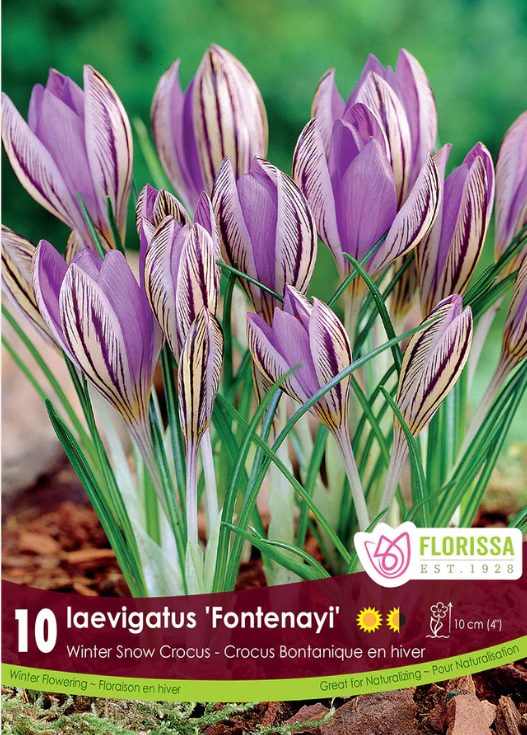
‘Fontenayi’ Winter Crocus (Crocus laevigatus ‘Fontenayi’) provides fragrant flowers from late autumn into midwinter. Its pale lavender goblets have buff outer petals finely striped and feathered purple, with white anthers surrounding a branched orange stigma. Long narrow foliage marked by a white central stripe accompanies the blooms. At about 5 to 10 cm tall, this Greek crocus remains delicate close to the ground. The Van Noort retail package contains 10 corms. Suitable for Zones 4 to 10, it chiefly requires gritty soil and protection from excessive winter wet, especially where repeated thaws or persistent rainfall keep ordinary garden beds saturated.
Plant the 10 corms in early autumn, ideally from September through October, setting them 5 cm deep and 5 cm apart. Choose full sun in poor to moderately fertile, sandy or chalky soil that drains freely. Position corms pointed end upward, water lightly after planting, then maintain only moderate moisture during active growth. Avoid compact clay, waterlogged hollows, and nitrogen-rich feeding. In cold or rainy regions, favour a sheltered rock garden, warm wall, or container protected from persistent precipitation. Keep the growing medium comparatively dry during dormancy and mark the planting so resting corms are never disturbed.
Crocus laevigatus ‘Fontenayi’ suits rock gardens, gravel gardens, raised borders, sunny courtyards, and containers sheltered from excessive water. Gather all 10 corms to appreciate their fragrant flowers when few other plants are open. Combine them with hardy cyclamen, low sedums, and small grasses that tolerate similarly rapid drainage. Blooms may supply pollen and nectar to insects active on mild winter days. Afterwards, let foliage complete its cycle and yellow fully. Divide overcrowded groups during dormancy and immediately replant firm corms, protecting new plantings from rodents and birds. In containers, keep drainage holes open and never leave pots standing in water.

Sowing guide
It all startswith a seed.
Sowing depth
Spacing / density
Germination temperature
Germination time
Sowing period
Propagation
Growing method
Soil and care
The right care,at the right time.
Soil pH
Minimum temperature
Care level
Drought tolerance
Watering
Soil type
Fertilization
Moisture
Seasonal care
Container growing
A garden,within reach.
Recommended pot size

Bloom and dimensions
Its place,in your garden.
Mature height
Width / spread
Flower color
Foliage color
Foliage type
Growth rate
Growth habit
Fragrance
Bloom period
Fruiting
Harvest
Garden associations
In goodcompany.
Companion plants
Plants to avoid
Frequently asked questions
Your questions,answered.
When and how should Crocus laevigatus ‘Fontenayi’ be planted?
Why does Crocus laevigatus ‘Fontenayi’ fail to flower?
Is Crocus laevigatus ‘Fontenayi’ hardy in Quebec?
How should foliage be managed after autumn flowering?
Does Crocus laevigatus ‘Fontenayi’ produce edible saffron?
Wildlife and pets