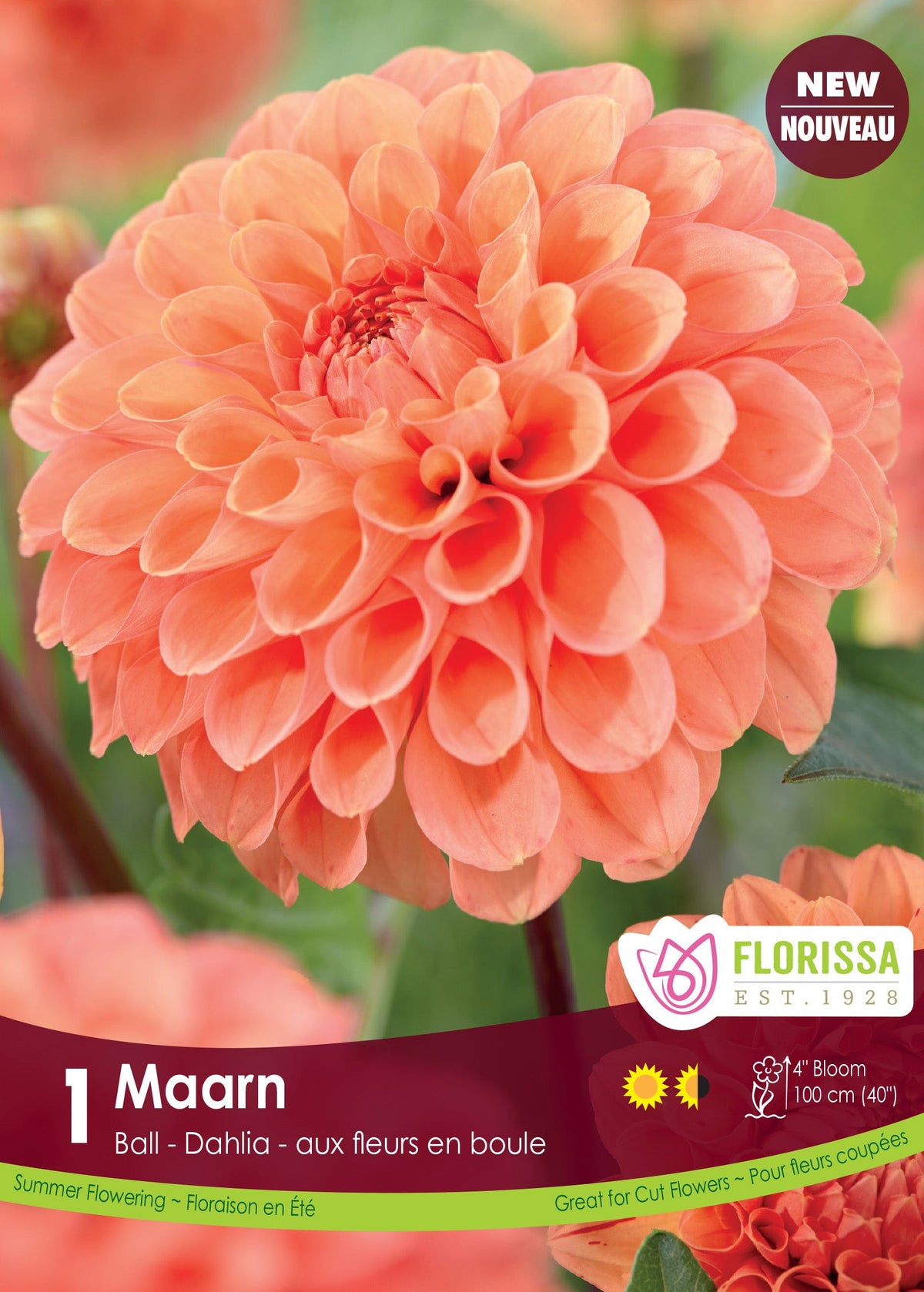
'Maarn' pompon dahlia

Dahlia × pinnata

Dahlia pompon 'Maarn' (Dahlia × pinnata 'Maarn') captivates with its perfectly spherical flowers, composed of short, neatly arranged petals. Their bright orange hue, delicately nuanced with apricot, stands out beautifully against the dense, dark green foliage. Borne on stems reaching approximately 90 cm (35 in), this tender perennial offers abundant blooms from July until the first frosts. Its harmonious habit and the regularity of its pompons bring warmth, rhythm, and structure to summer arrangements. Not hardy in Quebec, this dahlia must be cultivated as a seasonal plant, and its tubers must be stored away from frost during winter. Plant the tuber in spring, once all risk of frost has passed, in a location receiving at least six hours of direct sunlight per day.
8 99 $
Pay in 4 interest-free payments with Sezzle
Detailed plant guide
Advice adapted to Canada
Secure payment
Share
Quantity
1 tuber
Exposure
Sun
Life cycle
Tender perennial
Hardiness
Zone 8

Discover the plant

Common nameDahlia pompom 'Maarn'
FamilyAsteraceae
GenusDahlia
TypeTuber
Botanical nameDahlia × pinnata

Dahlia Pompon 'Maarn' (1 tuber), offered by Van Noort

?? A burst of mandarin orange for an explosion of color! ??

Dahlia Pompon 'Maarn' is a must-have for those looking for a spectacular and long-lasting bloom. With its bright tangerine orange flowers, this variety produces an abundance of strong stems ideal for bouquets. Its dark foliage creates a striking contrast, highlighting the vibrancy of its flowers.

?? This dahlia offers generous flowering from early summer until the first frosts, illuminating the garden with its bright colors.


?? Characteristics of the variety

?? Height : 100 cm (40")
?? Exposure : Full sun
?? Hardiness : Not hardy (to be dug up before winter)
?? Deer Resistance : Low
?? Water requirements : Medium (cool, well-drained soil)
?? Ideal soil : Light, rich and well drained
?? Flowering : June to October
?? Quantity : 1 tuber


?? Planting and growing Dahlia 'Maarn'

?? When to plant?
??? From March to May , after the last risk of frost, for continuous flowering until autumn.

?? Where to plant it?
?? In a mass : Brings height and a luminous touch to floral arrangements.
?? In a pot : Ideal for brightening up terraces and balconies.
?? As cut flowers : A favorite of florists for its long, sturdy stems.

?? How to plant?
1?? Loosen the soil and enrich it with compost.
2?? Plant the tuber 10 cm deep , buds facing upwards.
3?? Space the plants 50 cm apart to allow them to develop well.
4?? Water lightly after planting , then more regularly during dry periods.

?? Tip : Stake the stems to prevent them from bending under the weight of the flowers and pinch the young shoots for even more abundant flowering.


?? Dahlia 'Maarn' Care

?? Watering : Regular but moderate to avoid rotting of the tubers.
?? Fertilizer : A supply of fertilizer rich in potassium promotes vibrant flowering.
?? Pruning : Cut off faded flowers to encourage new flowers to appear.
?? Wintering :
?? Before the first frosts , dig up the tubers, let them dry and store them in a cool, dry place.


?? Why choose the Dahlia 'Maarn'?

? A vibrant tangerine color that catches everyone's eye
? Abundant and prolonged flowering until the first frosts
? Ideal for bouquets thanks to its strong stems and long vase life
? Easy to grow and maintain, perfect for all gardeners

?? Add a sunny and vibrant touch to your garden with the Dahlia 'Maarn'! ?

Dahlia pompon ‘Maarn’ ( Dahlia ) : une fleur de dahlia orange abricot, arrondie et composée de nombreux pétales. Le visuel Florissa présente la plante et son nom dans la partie inférieure de l’étiquette. La photographie occupe presque toute la surface, tandis que le bandeau du bas rassemble les indications du produit. Cette vue permet de reconnaître son apparence et de distinguer la variété présentée.

Planting guide

Plant well.Grow beautifully.

Planting depth

10 cm (4 in)

Best planting time

Spring

Propagation

Divide the tubers in spring when each section has at least one viable eye. This method ensures the characteristics of this variety are faithfully preserved.

Growing method

Plant the tuber after the last frost in fertile, light, and well-drained soil. Bury it approximately 10 cm (4 in.) deep with the 'eyes' facing upwards. Water lightly until the first shoots appear, then gradually increase watering. Pinch back young shoots to encourage better branching and more flower stems. Regularly remove faded flowers to prolong blooming until the first frost. An organic mulch helps maintain uniform moisture throughout the season. Plant the tuber in spring, when all risk of frost has passed, in a location receiving at least six hours of direct sun per day. Rich, loose, and well-drained soil, amended with compost, will promote vigorous growth and continuous flowering. Bury the tuber approximately 10 cm (4 in.) deep, with the 'eyes' facing upwards, then water lightly until shoots appear. Afterwards, keep the soil uniformly moist, but not waterlogged. In autumn, dig up, dry, and store the tubers in a cool, dry place. The 'Maarn' pompom dahlia naturally finds its place in sunny beds, borders, flowerbeds, large containers, and cut flower gardens.

Soil and care

The right care,at the right time.

Soil pH

Slightly acidic to neutral

Minimum temperature

5 °C (41 °F)

Care level

Easy

Watering

Water regularly to maintain an evenly moist soil without excess water. Organic mulch reduces evaporation and helps maintain constant humidity during hot periods. Before watering, check the moisture level beneath the surface with your finger rather than following a fixed schedule. Recent rain, wind, and container cultivation can quickly alter needs.

Soil type

For 'Maarn' pompon dahlias, choose loose, well-drained soil where water does not linger around the roots or tubers. Check the drainage after rain: water should be able to drain away from the root zone. Work the soil when it is dry enough to avoid compaction. Adjust soil amendments based on its actual texture. In containers, use appropriate potting soil and a pot with drainage holes.

Fertilization

Apply a potassium-rich fertilizer as soon as the first flower buds appear to support abundant flowering. Avoid excessive nitrogen, which primarily promotes foliage development. Follow the dosage indicated on your fertilizer packaging and measure the quantity before applying it. Take into account any compost and other additions already made to avoid over-fertilizing the same plants.

Seasonal care

For Dahlia pompon 'Maarn', plant in the spring once all risk of frost has passed and the soil has sufficiently warmed. Choose a sunny spot, sheltered from strong winds, with fertile, well-drained soil. Place the tuberous roots with the crown and buds facing upward, being careful not to break the fragile attachments. Install a stake at the time of planting if support will be needed to avoid damaging the roots later. Water sparingly at first, then adjust the amount as the foliage grows. Avoid constantly waterlogged soil around the tubers, especially before the first shoots appear. During the summer, water at the base when the soil dries out and tie the stems as needed with soft ties. Regularly deadhead faded flowers to encourage the formation of new buds. For bouquets, choose fully opened flowers and use a clean tool to make a clean cut. In the fall, plan to overwinter the tubers in a frost-free environment: dahlias do not survive the winter in the ground in Quebec. After the growing season ends, carefully dig up the clump, let the surface dry, and store it in a cool, well-ventilated, frost-free space. Periodically inspect it for damaged parts. Throughout the seasons, monitor new growth, soil moisture, and the condition of the stems.

Container growing

A garden,within reach.

Recommended pot size

35 cm (14 in)
For Dahlia pompon 'Maarn', container cultivation requires providing enough volume for the roots and the plant's final height. Choose a stable pot with drainage holes and a substrate suitable for planting. Allow enough space to respect the recommended depth and spacing, rather than crowding the plants to fill the pot immediately. Place the container in the indicated exposure and check moisture regularly, especially during hot or windy weather. A pot is more exposed to temperature fluctuations than planting in the ground. Therefore, plan for a wintering location from the start that is compatible with the plant's needs and your region's climate. Plant in the spring once all risk of frost has passed and the soil has sufficiently warmed. Choose a sunny spot, sheltered from strong winds, in fertile, well-drained soil. Position the tuberous roots with their crown and buds facing upward, without breaking the fragile attachments. Place a stake at the time of planting if support will be needed, to avoid damaging the roots later. Water moderately at the start, then adjust the amounts according to foliage growth.
Dahlia pompon ‘Maarn’ ( Dahlia ) : une fleur de dahlia orange abricot, arrondie et composée de nombreux pétales. Le visuel Florissa présente la plante et son nom dans la partie inférieure de l’étiquette. La photographie occupe presque toute la surface, tandis que le bandeau du bas rassemble les indications du produit. Cette vue permet de reconnaître son apparence et de distinguer la variété présentée.

Bloom and dimensions

Its place,in your garden.

Mature height

90 cm (36 in)

Width / spread

30 to 40 cm (12 to 16 in.)

Flower color

Orange apricot

Foliage color

Dark green

Foliage type

Lapsed

Growth rate

Quick

Bloom period

Abundant flowering of apricot-orange pompom flowers from July until the first frosts. Dahlia pompon 'Maarn' (Dahlia × pinnata 'Maarn') captivates with its perfectly spherical flowers, composed of short and neatly arranged petals. A rich, loose, and perfectly drained soil, amended with compost, will promote vigorous growth and continuous flowering. Weather conditions and the stage of development at the time of planting can affect the appearance of flowers.

Harvest

July to October. Harvest flowers when fully open for excellent vase life. Continue to remove spent blooms to maintain abundant flowering.
Dahlia pompon ‘Maarn’ ( Dahlia ) : une fleur de dahlia orange abricot, arrondie et composée de nombreux pétales. Le visuel Florissa présente la plante et son nom dans la partie inférieure de l’étiquette. La photographie occupe presque toute la surface, tandis que le bandeau du bas rassemble les indications du produit. Cette vue permet de reconnaître son apparence et de distinguer la variété présentée.

Garden associations

In goodcompany.

Companion plants

To accompany Dahlia pompon ‘Maarn’, consider cosmos, zinnias, or ornamental sages. Choose neighboring varieties based on their height, flowering period, and the colors you wish to combine. Most importantly, ensure their sun exposure and water needs are suitable for the same location. Leave enough space so that leaves do not obscure young shoots and to allow easy access to each plant during maintenance. These combinations help compose the garden's aesthetic; they do not guarantee protection against pests or diseases. Adjust the layout after observing one growing season.

Frequently asked questions

Your questions,answered.

'Maarn' pompon dahlia: how to successfully plant 'Maarn' pompon dahlias?
For Dahlia pompon 'Maarn', plant in spring once all risk of frost has passed and the soil has sufficiently warmed up. Choose a sunny spot, sheltered from strong winds, in fertile, well-drained soil. Position the tuberous roots with their crown and buds facing upward, being careful not to break the fragile attachments. Place a stake at the time of planting if support will be needed, to avoid damaging the roots later. Water sparingly at the start, then adjust watering as the foliage grows. Constantly waterlogged soil around the tubers should be avoided, especially before the first shoots appear.
'Maarn' pompon dahlia: what light requirements should be planned for the 'Maarn' pompon dahlia?
For Dahlia pompon 'Maarn', the recommended exposure is as follows: sun. Observe the light at the chosen location in the morning and afternoon, as the shade from trees or buildings changes throughout the day. Also take neighboring plants into account: their foliage may hide a young planting as it develops. In a container, place the pot where you can move it if conditions become too hot or too shaded. Appropriate exposure must go hand in hand with suitable soil and watering. If you move a plant started indoors to the outdoors, acclimate it gradually to garden conditions to avoid a transition that is too abrupt for the young leaves.
'Maarn' pompon dahlia: how to adjust watering?
For 'Maarn' pompon dahlias, water according to the actual moisture of the soil, taking into account rainfall, heat, and wind. Check below the surface before deciding to water again: soil that is dry on top may still be moist at the root level. Direct the water to the base and allow it to soak in, without keeping the planting in saturated soil. Containers generally require more frequent checks because they dry out faster. Ensure that their drainage holes remain clear and empty any saucers that collect water. Also adapt care to the plant’s cycle: active growth and a rest period do not require the same amount of water.
'Maarn' pompon dahlia: what should be considered for container growing?
For the 'Maarn' pompon dahlia, container cultivation requires providing enough volume for the roots and the plant's final height. Choose a stable pot with drainage holes and a suitable potting mix. Allow enough space to maintain the recommended planting depth and spacing, rather than crowding the plants to fill the pot immediately. Place the container in the indicated exposure and check moisture levels regularly, especially in hot or windy weather. A pot is more exposed to temperature fluctuations than planting in open ground. Therefore, plan ahead for an overwintering location compatible with this plant's needs and your region's climate.
'Maarn' pompon dahlia: what care is required after the growing season?
For 'Maarn' pompon dahlia, water at the base during the summer when the soil dries out and stake the stems as needed using soft ties. Regularly remove faded flowers to encourage the formation of new buds. For bouquets, choose fully opened flowers and use a clean tool to make a clean cut. In the fall, plan to overwinter the tubers away from frost: dahlias do not survive the winter in the ground in Quebec. After the growing season ends, carefully dig up the clump, let its surface dry, and store it in a cool, well-ventilated, frost-free area. Periodically inspect it for damaged parts.

Wildlife and pets

Life,around your plants.