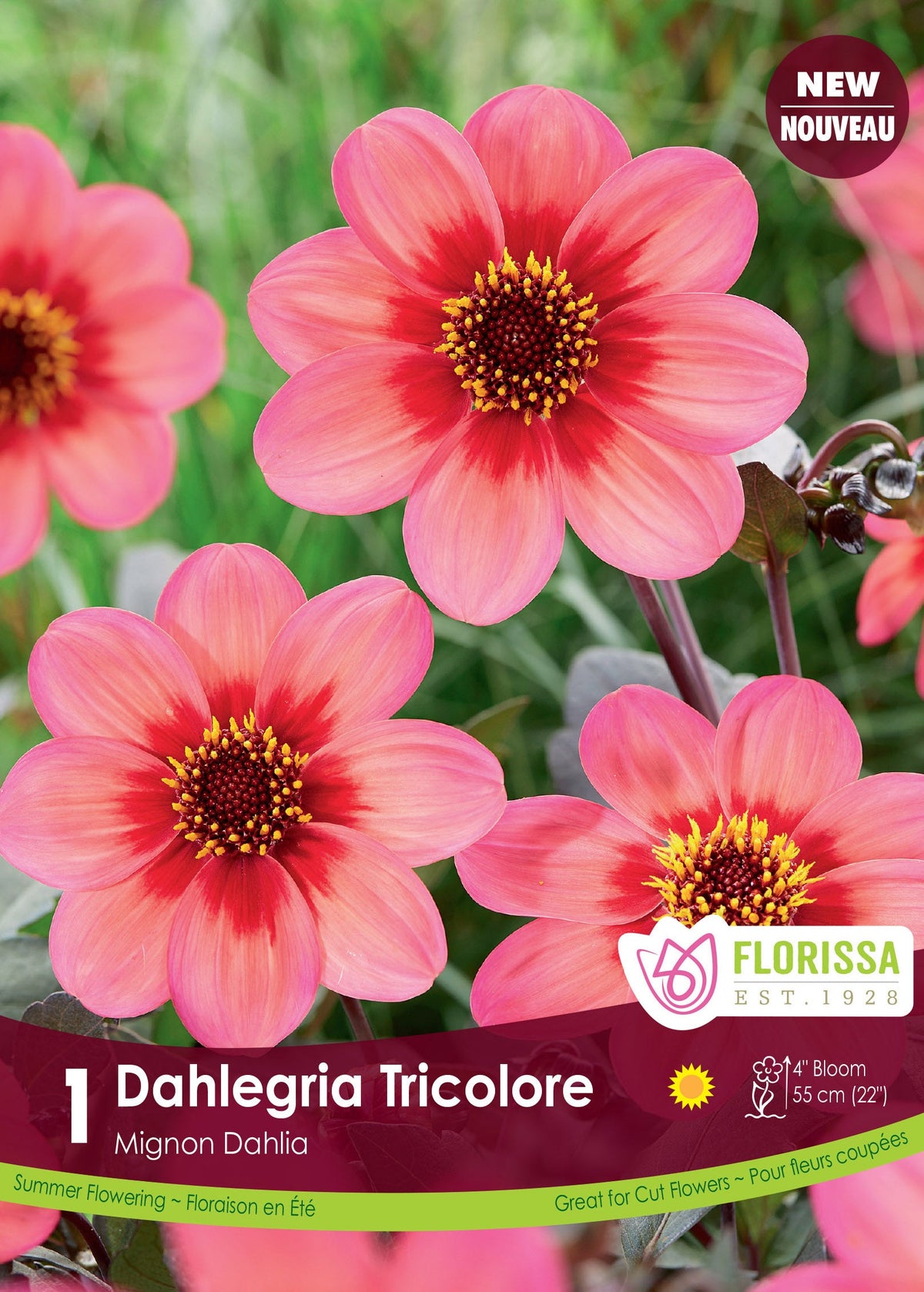
Compact tricolour-flowered Mignon dahlia

‘Dahlegria Tricoloree’ Dahlia

Product code : VAN-327-417-30

One No. 1 tuber produces a compact 60 cm Mignon dahlia with single pink, peach, and red flowers above dark green foliage flushed with purple.
8 99 $
Pay in 4 interest-free payments with Sezzle
Detailed plant guide
Advice adapted to Canada
Secure payment
Share
Quantity
1 tuber
Exposure
Full sun
Life cycle
Tender perennial grown as an annual in cold climates
Hardiness
Zone 8; lift the tuber in colder regions

Discover the plant

Common name‘Dahlegria Tricoloree’ Mignon dahlia
FamilyAsteraceae
GenusDahlia
SpeciesHorticultural hybrid
CultivarDahlegria Tricolore (Dahlgr85)
TypeDormant tuber
Botanical nameDahlia
Reproducible seedsYes

‘Dahlegria Tricoloree’ Dahlia (Dahlia × hortensis) Dahlegria Tricoloree dahlia is a single-flowered Mignon selection registered as ‘Dahlgr85’. Its 7 to 10 cm flowerheads carry broad pink petals shaded peach, marked red at the base around a brown disc that opens dark yellow. This changing palette stands out against dark green leaves flushed purple and similarly purple stems. The upright clump grows approximately 60 cm tall and 50 cm wide. It flowers from midsummer until the first frosts. Van Noort supplies one No. 1 tuber suited to containers, sunny borders, and gardens visited by pollinators, where every open centre remains clearly accessible through the flowering season.

Plant the tuber in spring after the final frost once soil has warmed. Lay it horizontally 10 cm deep with the bud facing upward, keeping 50 cm between plants. Choose full sun and fertile, humus-rich soil that stays moist yet drains perfectly. Water sparingly before shoots emerge, then deeply at the base whenever the surface begins to dry. Incorporate mature compost and later use fertilizer moderate in nitrogen and richer in potassium when buds appear. Pinch young shoots to branch the clump. Remove faded flowerheads regularly to extend flowering, maintain a tidy plant, and keep fresh open discs available to visiting insects.

Place Dahlegria Tricoloree near the front or middle of a border, in a large stable container, or among nectar-rich plants. Its pink, peach, red, and yellow tones pair with white sweet alyssum, blue salvias, purple verbenas, and golden grasses. Single flowers expose pollen and nectar directly to bees, butterflies, and hoverflies. Cut a few fully open stems for arrangements without removing every garden resource. In colder Canadian regions, wait until the first frost blackens foliage, cut stems back, lift the tuber carefully, and allow its surface to dry. Store it labelled somewhere cool, dark, dry, and frost-free until spring, checking occasionally and retaining only firm healthy tissue.

An upright Dahlegria Tricoloree clump reaches 60 cm with dark green leaves flushed purple

Sowing guide

It all startswith a seed.

Sowing depth

10 cm (4 in.)

Spacing / density

50 cm (20 in.) between plants

Sowing period

May to early June once soil is warm

Propagation

Division of a tuber carrying a viable bud

Growing method

After frost, set the tuber 10 cm deep, allow 50 cm, water without saturation, pinch, feed moderately, and remove faded flowerheads.

Soil and care

The right care,at the right time.

Soil pH

Slightly acidic to neutral

Minimum temperature

5 °C (41 °F)

Care level

Moderate

Watering

Water lightly before emergence, then deeply at the base when the surface dries, without saturating the crown or wetting foliage in the evening. Open flowers offer pollen.

Soil type

Prepare fertile, humus-rich, loose, freely drained soil retaining even moisture without holding water around the tuber.

Fertilization

Incorporate mature compost at planting, then apply fertilizer moderate in nitrogen and richer in potassium from bud formation. Open flowers offer pollen and nectar to bees, butterflies.

Moisture

Maintain even moisture during growth and bud formation, always accompanied by rapid drainage after rainfall or irrigation.

Seasonal care

In spring, prepare, plant, and pinch. In summer, water, feed, and deadhead. In autumn, lift. In winter, inspect the tuber.

Container growing

A garden,within reach.

Recommended pot size

at least 45 cm (18 in.) in diameter and depth
Grow one tuber in a stable container at least 40 cm wide, freely drained with fertile potting mix, then monitor moisture, feeding, heat, and winter storage.
An upright Dahlegria Tricoloree clump reaches 60 cm with dark green leaves flushed purple

Bloom and dimensions

Its place,in your garden.

Mature height

60 cm (24 in.)

Width / spread

50 cm (20 in.)

Flower color

Pink shaded peach, red base, and brown-yellow disc

Foliage color

Dark green flushed with purple

Foliage type

Deciduous after frost

Growth rate

Fast

Growth habit

Compact upright clump

Bloom period

Single flowers reach about 7 to 10 cm and repeat from midsummer until the first frosts. Pink shades gently into peach, while a red base surrounds the brown disc opening dark yellow. Regular removal of faded flowerheads supports new bud production and keeps this tricolour succession tidy above purple-flushed foliage throughout the warm growing season, especially in sunny Canadian borders and well-watered patio containers.

Harvest

June to October. Cut fully open flowers for small bouquets, or let them fade naturally before removing them.
An upright Dahlegria Tricoloree clump reaches 60 cm with dark green leaves flushed purple

Garden associations

In goodcompany.

Companion plants

Pair with white sweet alyssum, pink gauras, blue salvias, purple verbenas, and golden grasses sharing sun and freely drained soil.

Frequently asked questions

Your questions,answered.

When should Tricoloree be planted in colder Canadian regions?
Wait until after the final frost and until soil has warmed, generally from May to early June. Set the tuber horizontally 10 cm deep.
Why does it attract pollinators?
Single flowers leave the central disc visible. Bees, butterflies, and hoverflies can therefore reach pollen and nectar directly while the plant is flowering.
Can it be grown in a container?
Yes. Place the tuber in a stable container at least 40 cm wide, freely drained, filled with fertile potting mix, and positioned in full sun.
Does this cultivar need staking?
Its 60 cm height limits risk, although a discreet stake remains useful in windy locations or when the clump carries many rain-weighted flowers.
How should the tuber be stored over winter?
After the first frost, cut stems, lift the tuber, dry its surface, and keep it labelled somewhere cool, dry, dark, and frost-free.

Wildlife and pets

Life,around your plants.

Supporting wildlife

Single flowers with open discs make pollen and nectar accessible to bees, hoverflies, and butterflies during summer flowering. Extend the border’s value by pairing this dahlia with sweet alyssum, salvias, and verbenas blooming before or after it. Avoid insecticides on flowers and provide a shallow dish of clean water nearby.