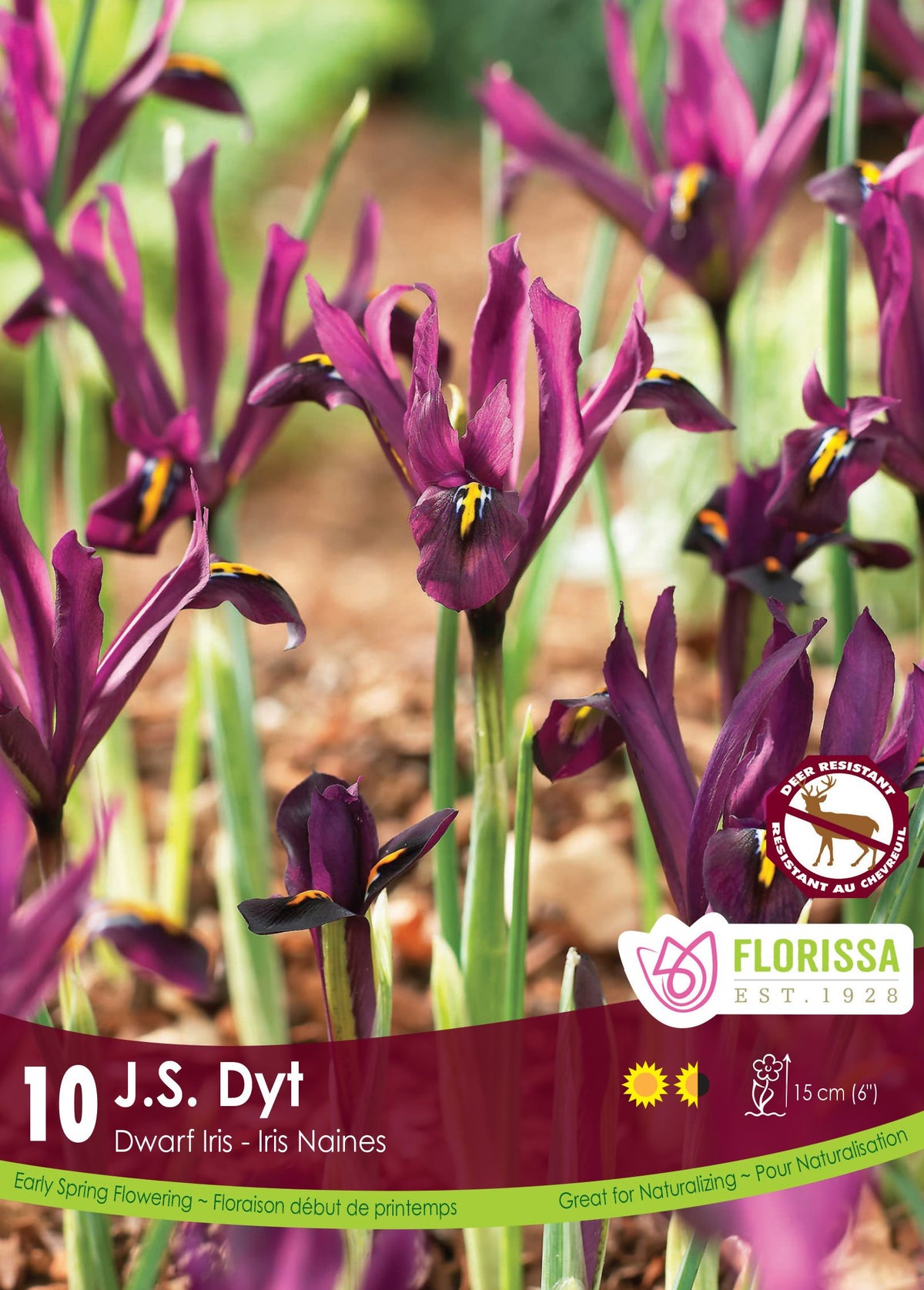
‘J.S. Dijt’ Dwarf Iris (Iris reticulata ‘J.S. Dijt’)

Product code : 146 490 01

‘J.S. Dijt’ Dwarf Iris produces a solitary flower displaying intense violet-purple with a yellow band and bright-blue splashes from late winter to early spring. The package contains 10 bulbs reaching 10 to 15 cm (4 to 6 in.). Plant them in fall in full sun or light partial shade and freely drained soil. Grouping them creates a clear colour accent in rock gardens, low borders, open woodland, and containers. Allow foliage to yellow completely after flowering so every bulb rebuilds its reserves. This Zone 5 perennial can return for several seasons where the site remains drained during dormancy. Irises are ornamental and should not be eaten. Store unplanted bulbs beyond the reach of children and pets.
7 99 $
Pay in 4 interest-free payments with Sezzle
Detailed plant guide
Advice adapted to Canada
Secure payment
2026 preorder for fall bulbs Shipping expected in October 2026.
Share
Quantity
10 bulbs
Exposure
Full sun to light partial shade
Life cycle
Spring-flowering bulbous perennial
Hardiness
Zones 5 to 9

Discover the plant

Common name‘J.S. Dijt’ Dwarf Iris
FamilyIridaceae
GenusIris
Speciesreticulata
CultivarJ.S. Dijt
TypeOrnamental iris bulb
Botanical nameIris reticulata

‘J.S. Dijt’ Dwarf Iris (Iris reticulata ‘J.S. Dijt’) produces a solitary flower displaying intense violet-purple with a yellow band and bright-blue splashes from late winter to early spring. The 10 bulbs in the package reach 10 to 15 cm (4 to 6 in.). Narrow green to grey-green foliage accompanies the flowers without making the planting appear heavy. Hardy in Zones 5 to 9, this bulbous perennial suits rock gardens, low borders, open woodland, and containers. Its intense violet-purple with a yellow band and bright-blue splashes colouring provides a distinct accent in the spring garden. Group planting creates a fuller presentation during the first season. Freely drained soil supports repeat flowering over successive years.

Plant bulbs in fall with the pointed end up, 8 cm (3 in.) deep and 8 cm (3 in.) apart. Choose full sun or light partial shade and loose soil that drains quickly. Water deeply after planting to settle the soil, then maintain light moisture in spring when rainfall is insufficient. Avoid saturated hollows, especially during thaw and summer dormancy. A thin layer of mature compost supports growth without encouraging excessive foliage. In containers, use a deep pot with unobstructed drainage holes and protect it from repeated freeze-and-thaw cycles. Check moisture before watering again and keep dense mulch away from emerging shoots.

After flowering, remove spent stems when seed capsules are not wanted, but allow every leaf to yellow completely. Foliage captures light and rebuilds reserves required for the following display. Reduce watering afterward and mark the position so dormant bulbs are not disturbed. Offsets may be separated and replanted in fall when the clump becomes crowded. Watch for slugs, leaf spots, and signs of rot, then improve drainage before considering treatment. Irises are harmful if eaten, so store unplanted bulbs beyond the reach of children and pets and wear gloves if handling bulbs irritates sensitive skin. Wash hands after planting and discard damaged bulbs safely.

‘J.S. Dijt’ Dwarf Iris in bloom, showing a solitary flower displaying intense violet-purple with a yellow band and bright-blue splashes and narrow green to grey-green foliage. The group reaches 10 to 15 cm (4 to 6 in.) in a bright, freely drained spring border. The image highlights the intense violet-purple with a yellow band and bright-blue splashes palette, the characteristic iris flower shape, and the fuller effect created by planting all 10 bulbs together in one coherent group.

Sowing guide

It all startswith a seed.

Sowing depth

8 cm (3 in.) deep, pointed end up

Spacing / density

Space 8 cm (3 in.) apart

Sowing period

September until the ground freezes

Propagation

Divide offsets during dormancy

Growing method

Plant bulbs in fall with the pointed end up, 8 cm (3 in.) deep and 8 cm (3 in.) apart. Choose full sun or light partial shade and loose soil that drains quickly. Water deeply after planting to settle the soil, then maintain light moisture in spring when rainfall is insufficient. Avoid saturated hollows, especially during thaw and summer dormancy. A thin layer of mature compost supports growth without encouraging excessive foliage. In containers, use a deep pot with unobstructed drainage holes and protect it from repeated freeze-and-thaw cycles. Check moisture before watering again and keep dense mulch away from emerging shoots. After flowering, remove spent stems when seed capsules are not wanted, but allow every leaf to yellow completely. Foliage captures light and rebuilds reserves required for the following display. Reduce watering afterward and mark the position so dormant bulbs are not disturbed. Offsets may be separated and replanted in fall when the clump becomes crowded. Watch for slugs, leaf spots, and signs of rot, then improve drainage before considering treatment. Irises are harmful if eaten, so store unplanted bulbs beyond the reach of children and pets and wear gloves if handling bulbs irritates sensitive skin. Wash hands after planting and discard damaged bulbs safely.

Soil and care

The right care,at the right time.

Soil pH

Acid, neutral, or slightly alkaline

Minimum temperature

Zone 5 hardiness

Care level

Moderate

Watering

Water thoroughly after planting to settle soil around the bulbs. Normal precipitation is usually sufficient until spring. During active growth and flowering, water only when the top few centimetres of soil are dry. Always allow excess water to drain, then reduce watering as foliage yellows and dormancy begins. Check containers more often, but never leave the pot standing in water.

Soil type

Loose, moderately fertile, freely drained soil. Reliable winter and summer drainage is essential to limit bulb rot. Improve a broad area with mature compost when soil is poor. In heavy soil, plant on a slight mound or use a freely drained container. Avoid low spots where water remains after rain or thaw, and do not place bulbs beside plants that require constant summer irrigation. This drainage consistently protects the bulbs.

Fertilization

Add a modest amount of mature compost at planting when soil is poor. In early spring, a low-nitrogen bulb fertilizer can support flowering. Avoid excess nitrogen and fresh manure, which encourage leaves or damage roots. One moderate application is normally sufficient for established clumps growing in reasonably fertile garden soil. Apply fertilizer to moist soil, follow the package rate, and water lightly afterward when rain is not expected.

Moisture

Maintain moderate, even moisture through establishment, active growth, and flowering without leaving bulbs in saturated soil. Rapid drainage is essential for winter hardiness, especially in Zone 4. Reduce irrigation as foliage yellows. Light mulch conserves summer moisture, but keep it away from emerging shoots to preserve airflow and prevent crown rot after prolonged rain or repeated winter thaws in Quebec gardens.

Seasonal care

After flowering, remove spent stems when seed capsules are not wanted, but allow every leaf to yellow completely. Foliage captures light and rebuilds reserves required for the following display. Reduce watering afterward and mark the position so dormant bulbs are not disturbed. Offsets may be separated and replanted in fall when the clump becomes crowded. Watch for slugs, leaf spots, and signs of rot, then improve drainage before considering treatment. Irises are harmful if eaten, so store unplanted bulbs beyond the reach of children and pets and wear gloves if handling bulbs irritates sensitive skin. Wash hands after planting and discard damaged bulbs safely. In spring, gently clear emerging shoots if thick mulch covers them. During active growth, remove only diseased or badly damaged leaves. Once foliage is completely dry, it may be cut at soil level. If flowering declines after several years, divide the clump during dormancy and promptly replant firm bulbs in refreshed, freely drained soil. Inspect the site after heavy rain and correct any area where water remains. In containers, rotate the pot for even light, empty the saucer after watering, and protect bulbs from repeated freeze-and-thaw cycles. A light, low-nitrogen feeding at the start of growth is sufficient; excessive fertilizer encourages soft foliage instead of sturdy flowers. Keep neighbouring plants from shading the iris during spring, then allow their later foliage to conceal the dormant planting naturally.

Container growing

A garden,within reach.

Recommended pot size

35 to 10 cm (14 to 16 in) wide and at least 5 cm (3 in) deep for 20 bulbs
Choose a container at least 25 cm wide and deep with several drainage holes. Fill it with freely draining container mix, adding coarse material when needed. Plant all 10 bulbs approximately 8 cm deep with pointed ends up, spacing them 5 to 8 cm apart for a full group without pressing them together. Water deeply and let excess water escape. Maintain light moisture during rooting and spring growth, but never leave water in the saucer. Place the pot in full sun or light partial shade. In cold climates, protect the container from repeated freeze-and-thaw cycles while preserving the winter chilling bulbs require. After flowering, remove spent flowers and let the leaves yellow completely. Reduce watering at that stage. Repot when the group becomes crowded, discard soft bulbs, and promptly replant firm bulbs in fresh, freely draining mix. Check moisture more often during active growth because containers dry faster than beds. Rotate the pot occasionally for even light and raise it slightly when drainage slows. Keep emerging shoots free of fallen leaves, and move the display into view as buds colour. After dormancy begins, store the labelled pot where summer rain cannot keep the mix saturated.
‘J.S. Dijt’ Dwarf Iris in bloom, showing a solitary flower displaying intense violet-purple with a yellow band and bright-blue splashes and narrow green to grey-green foliage. The group reaches 10 to 15 cm (4 to 6 in.) in a bright, freely drained spring border. The image highlights the intense violet-purple with a yellow band and bright-blue splashes palette, the characteristic iris flower shape, and the fuller effect created by planting all 10 bulbs together in one coherent group.

Bloom and dimensions

Its place,in your garden.

Mature height

10 to 15 cm (4 to 6 in.)

Width / spread

5 to 10 cm (2 to 4 in.)

Flower color

Intense violet-purple with a yellow band and bright-blue splashes

Foliage color

Green to grey-green

Foliage type

Deciduous narrow strap-shaped foliage

Growth rate

Moderate

Growth habit

Low compact upright clump

Fragrance

No significant fragrance

Bloom period

‘J.S. Dijt’ Dwarf Iris flowers from late winter to early spring and produces a solitary flower displaying intense violet-purple with a yellow band and bright-blue splashes. Cool weather may extend the display. Remove spent stems when seed capsules are not wanted, but retain every green leaf. Foliage must yellow naturally so it can rebuild the bulb’s reserves for the following season. Reduce watering only as the leaves begin to fade and dormancy approaches.
‘J.S. Dijt’ Dwarf Iris in bloom, showing a solitary flower displaying intense violet-purple with a yellow band and bright-blue splashes and narrow green to grey-green foliage. The group reaches 10 to 15 cm (4 to 6 in.) in a bright, freely drained spring border. The image highlights the intense violet-purple with a yellow band and bright-blue splashes palette, the characteristic iris flower shape, and the fuller effect created by planting all 10 bulbs together in one coherent group.

Garden associations

In goodcompany.

Companion plants

Pair this ‘J.S. Dijt’ dwarf iris with low plants that enjoy spring light and freely drained soil. Crocuses, dwarf daffodils, small botanical tulips, and hardy primroses complement its flowers without hiding them. Later-emerging perennials can discreetly cover foliage while it yellows. Avoid vigorous ground covers and species requiring constantly wet soil. Leave enough open space for naturalizing and future division of crowded clumps. Choose neighbours with comparable light, drainage, and seasonal moisture needs. Respect their mature width so air can circulate and every ‘J.S. Dijt’ dwarf iris leaf receives light until it yellows completely.

Frequently asked questions

Your questions,answered.

When should these dwarf iris bulbs be planted?
Plant the bulbs in fall, ideally from September until the ground freezes. Planting reasonably early allows roots to develop before winter without encouraging excessive top growth. Choose full sun or light partial shade and soil that drains quickly. Set each bulb 8 cm (3 in.) deep with the pointed end up and leave 8 cm (3 in.) between bulbs. Water deeply after planting. If autumn remains unusually dry, check moisture once or twice before freeze-up, but avoid watering that leaves the soil saturated. Mark the location if later fall work could disturb the group. In mild autumn weather, wait until the soil has cooled before planting.
What light does this dwarf iris need?
Full sun encourages compact stems and abundant flowering. Light partial shade is also suitable, especially beneath deciduous trees that allow spring sunlight to reach the bulbs before the canopy expands. Avoid dense all-day shade because it can reduce flowering. The location should also provide air movement and quick drainage after rain. In a container, rotate the pot if stems lean toward the light. After flowering, leaves still require light until they yellow completely because they are rebuilding reserves. A marked decline over several years can indicate that neighbouring shrubs now cast too much shade or that the clump needs division.
How should dwarf iris bulbs be watered?
Water deeply after planting to settle soil around the bulbs. In spring, maintain light, even moisture during growth and flowering whenever rainfall is insufficient. Allow the surface to begin drying before watering again because standing water promotes bulb rot. Direct water toward the soil rather than the flowers. Gradually reduce watering when foliage yellows, then keep bulbs relatively dry during summer dormancy. Containers dry more quickly than garden beds, but their saucers should always be emptied. Check moisture instead of following a rigid calendar. During cool or rainy weather, lengthen the interval and verify that runoff has not created a wet pocket around the planting.
Can this dwarf iris grow in a container?
Yes. Choose a container at least 25 cm wide and deep with several drainage holes. Plant the package bulbs approximately 8 cm (3 in.) deep with their pointed ends up in a light container mix. Space them 8 cm (3 in.) apart for a full group without pressing them together. Water deeply, then maintain moderate moisture without leaving water in the saucer. In very cold climates, insulate the pot or move it to a cold, sheltered place to limit repeated freeze-and-thaw cycles. The bulbs still require winter chilling. Allow foliage to yellow completely before reducing summer watering, and repot crowded bulbs during dormancy in fresh, freely draining mix.
Is this dwarf iris safe for pets?
No, not if eaten. Bulbs and other iris parts may cause irritation or digestive upset in people and animals. Store unplanted bulbs beyond the reach of children, dogs, and cats, and collect any that are dug up. Wear gloves if your skin is sensitive and wash hands after planting. If ingestion or symptoms are suspected, contact a healthcare professional or veterinarian. This product is intended only for ornamental cultivation. Do not use it in cooking, and keep discarded bulbs, cut foliage, and spent flowers away from areas explored by pets. Mark the planting area when animals regularly dig in garden beds.

Wildlife and pets

Life,around your plants.

Reported toxicity

Yes

Supporting wildlife

The small spring flowers can provide nectar and pollen for bees and other insects active early in the season. Plant several bulbs together and avoid insecticides during bloom. Combine them with crocuses and other simple flowers to extend available resources. A succession of nearby spring flowers keeps resources available longer.