Early Sensation Fritillaria

Product code : VAN-146-419-01

Fritillaria Early Sensation raises a 90 cm (35 in) stem in mid-spring, crowned with gleaming lemon-yellow bells. Its glossy green foliage and columnar habit structure beds before summer perennials grow. The Van Noort 18/20 bulb is planted in the fall in full sun in fertile, fresh, and very well-drained soil. Hardy to zone 5, it can naturalize when left in place. Use it with white narcissus, purple tulips, and blue muscari for a contrasting scene suitable for Quebec gardens. Drainage remains a priority throughout dormancy. The foliage must yellow naturally before any cutting. A durable establishment reduces bulb handling. Spring growth benefits from a
12 99 $
Pay in 4 interest-free payments with Sezzle
Detailed plant guide
Advice adapted to Canada
Secure payment
Share
Quantity
1 bulb size 18/20
Exposure
Partial shade
Life cycle
Naturalizing bulbous perennial
Hardiness
Zone 5; zones 5 to 10 according to Van Noort

Discover the plant

Common nameFritillaria Early Sensation
FamilyLiliaceae
GenusFritillaria
TypeHardy ornamental bulb for autumn planting
Botanical nameFritillaria
Reproducible seedsYes

?? Fritillaria 'Early Sensation' (1 bulb) – Soft lemon yellow & ultra-early bloomer ? Offered by Van Noort

Fritillaria 'Early Sensation' stands out for its surprisingly early flowering and its pale lemon yellow , almost pearly color, which brightens the first days of spring.
Its delicate drooping bells , carried by a slender stem topped with fine foliage, give it a graceful and graphic appearance.
Perfect for naturalistic style gardens or bordering paths, this rare and refined variety attracts the eye while remaining discreet and bright .
It is suitable for both small spaces and light potted compositions.
An early fritillary , sweet and poetic, which opens the season with finesse. ??

?? Characteristics of Fritillaria 'Early Sensation'

?? Average height : 30 to 40 cm
?? Exposure : Sun to partial shade
?? Hardiness : Zone 4 and above
?? Attracts wildlife : Not very attractive, but can attract attention!
?? Water requirements : Moderate
?? Ideal soil : Light, rich, well-drained
?? Quantity : 1 bulb

?? Planting and growing Fritillaria 'Early Sensation'

?? When to plant? From September to November, for flowering from March
?? In open ground : Ideal for fine borders, rock gardens, or naturalizing in light meadows. Combine with crocuses or grape hyacinths for a soft spring carpet.
?? In pots : Very well suited to growing in low pots or balcony planters. Combine with pansies, violets, or pale gray foliage.
?? How to plant?
1?? Depth : 8 to 10 cm
2?? Spacing : 10 to 15 cm
3?? Watering : Light after planting, moderate during flowering

?? Care of Fritillaria 'Early Sensation'

?? Watering : Regular but not excessive, especially in light soil
?? Fertilizer : Light application at flowering time
?? Pruning : Allow the foliage to fade naturally
?? Wintering : No special care, hardy

?? Why choose Fritillaria 'Early Sensation'?

? Very early flowering , from the end of winter
? Bright and rare pale yellow color
? Perfect for small spaces , borders, pots
? Hardy bulb, easy to grow , with discreet charm

? Bring a soft, bright, and original touch to your garden with the Fritillaria 'Early Sensation', offered by Van Noort — a little spring wonder not to be missed. ?

?? Pair with crocuses, squills, blanda anemones or silver foliage for a fresh and poetic end-of-winter scene . ??

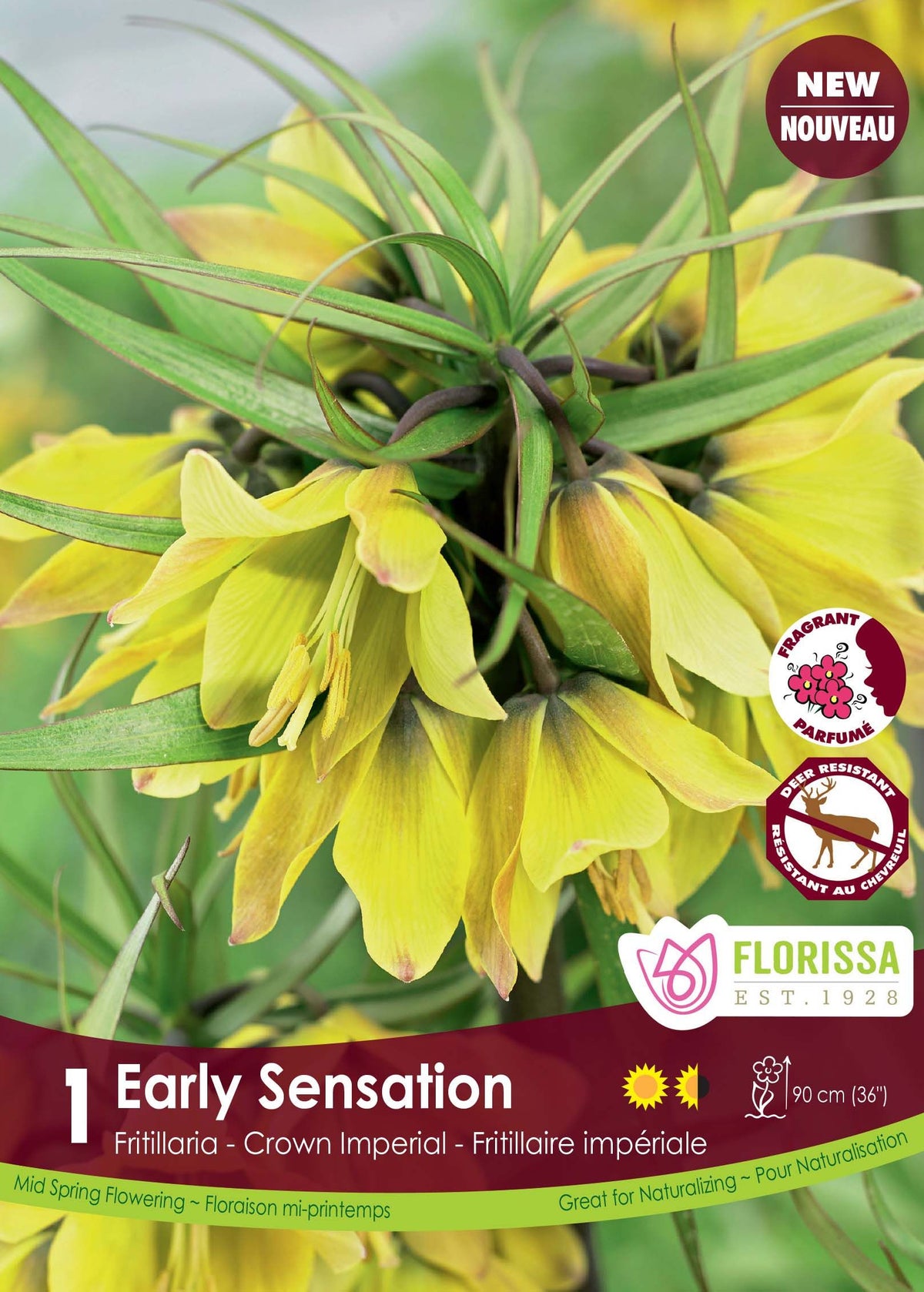
Fritillaire ‘Early Sensation’ ( Fritillaria ) : une couronne de clochettes jaunes sous des feuilles vertes. Le visuel Florissa présente la plante et son nom dans la partie inférieure de l’étiquette. La photographie occupe presque toute la surface, tandis que le bandeau du bas rassemble les indications du produit. Cette vue permet de reconnaître son apparence et de distinguer la variété présentée.

Planting guide

Plant well.Grow beautifully.

Planting depth

10 cm (4 in)

Best planting time

September to November before the ground freezes

Propagation

Division of bulblets in late summer

Growing method

In autumn, prepare a sunny or lightly shaded spot where rainwater drains quickly. Loosen fertile soil to a good depth and mix in mature compost and a little horticultural gravel if the soil texture is heavy. Wear gloves, place the 18/20 caliber bulb 10 cm (4 in) below the surface and leave 25 cm (10 in) around it. Water once if the soil is dry, then mark the spot. In spring, remove any debris hindering growth, maintain consistent moisture while the stem elongates, and apply a moderate dose of bulb fertilizer. Monitor for slugs and lily beetles as soon as they emerge. After flowering, remove seed pods only if seedlings are not desired, and allow all leaves to yellow. Divide only in late summer, when the clump is dormant. Drainage remains a priority throughout dormancy. Foliage must yellow naturally before any cutting. A permanent planting reduces bulb handling. Spring growth benefits from consistently moist soil. Drainage remains a priority throughout dormancy. Foliage must yellow naturally before any cutting. A permanent planting reduces bulb handling. Spring growth benefits from consistently moist soil. Drainage remains a priority throughout dormancy. Foliage must yellow naturally before any cutting. A permanent planting reduces handling.

Soil and care

The right care,at the right time.

Soil pH

Acid, neutral or alkaline if drainage is excellent

Minimum temperature

Zone 5 according to Van Noort; RHS H4

Care level

Easy

Watering

Water after planting only when the soil is dry. In spring, maintain regular moisture during emergence, elongation, and flowering, without ever saturating the root zone. Gradually reduce watering when the foliage yellows. During summer dormancy and winter, natural rainfall is usually sufficient; above all, avoid stagnant water around the bulb. Drainage remains a priority throughout dormancy. The foliage should yellow naturally before any pruning. Sustainable establishment reduces handling of the

Soil type

A fertile, humus-rich soil, cool during growth and very well-drained, is best. Loam, enriched sand, and calcareous soils can be suitable. Improve heavy textures with mature organic matter and gravel without creating a wet basin. Avoid saturated clays, depressions where snowmelt accumulates, and thick mulches that keep the bulb soggy. Drainage remains a priority throughout dormancy. Foliage should yellow naturally.

Fertilization

Incorporate mature compost into the surface during autumn preparation, but avoid placing it directly against the bulb. When growth begins, apply a moderate dose of balanced, slow-release fertilizer or a bulb-specific fertilizer. Avoid high-nitrogen feeds, which encourage soft stems. Stop fertilizing after flowering and allow the foliage to recharge the bulb’s reserves. Drainage remains a priority throughout dormancy. The foliage must yellow naturally before any cutting.

Seasonal care

In the fall, plant bulbs 10 cm (4 in) deep, mark their position, and correct any drainage problems before the cold rains. Apply light mulch only after the soil has cooled, without forming a compact, moist layer. In late winter, carefully remove debris so that shoots can emerge undamaged. In spring, water during dry periods, fertilize moderately at the start, and regularly inspect leaves for slugs, snails, or lily beetles. Stake only if the site is very windy. After flowering, remove spent flowers if you do not want seed pods, but keep the leaves. In early summer, wait for them to fully yellow before cutting. During dormancy, do not dig near the bulb. In late summer, divide bulbils only if the clump is crowded and replant them immediately. In winter, the most important protection remains soil that does not retain snowmelt. Drainage remains a priority throughout dormancy. Foliage must yellow naturally before any cutting. Sustainable establishment reduces bulb handling. Spring growth benefits from consistently cool soil. Drainage remains a priority throughout dormancy. Foliage must yellow naturally before any cutting. Sustainable establishment reduces bulb handling. Spring growth benefits from consistently cool soil. Drainage remains a priority throughout dormancy. Foliage must yellow naturally before any cutting. Sustainable establishment reduces bulb handling. Spring growth benefits from consistently cool soil.

Container growing

A garden,within reach.

Recommended pot size

Stable pot 35 to 40 cm (14 to 16 in.) for one bulb
Container gardening requires you to plan for the necessary volume for the roots and the plant's final height. Choose a stable pot with drainage holes and a substrate suitable for planting. Leave enough space to respect the recommended depth and spacing, rather than crowding the plants to immediately fill the pot. Place the container in the indicated exposure and regularly check the humidity, especially in hot or windy weather. A pot is more exposed to temperature variations than a plant in the ground. Therefore, plan from the outset for a wintering location compatible with the plant's needs and your region's climate. Plant the bulb in the fall, ideally before the ground freezes, 10 cm (4 in) deep and 25 cm (10 in) from neighboring plants. Choose sun or light partial shade and fertile, humus-rich soil that is fresh during growth but perfectly drained. Loams and enriched sandy soils are more suitable than saturated clays. Water after planting if the soil is dry, then let seasonal precipitation maintain regular moisture without waterlogging. A moderate addition of compost or bulb fertilizer at the start is sufficient. In Quebec, a location protected from strong winds helps the tall stem stay upright. In winter, protect the container according to the plant's needs: its roots are more exposed to cold than in the ground.
Fritillaire ‘Early Sensation’ ( Fritillaria ) : une couronne de clochettes jaunes sous des feuilles vertes. Le visuel Florissa présente la plante et son nom dans la partie inférieure de l’étiquette. La photographie occupe presque toute la surface, tandis que le bandeau du bas rassemble les indications du produit. Cette vue permet de reconnaître son apparence et de distinguer la variété présentée.

Bloom and dimensions

Its place,in your garden.

Mature height

90 cm (36 in)

Width / spread

Up to about 10 cm (4 in) according to RHS

Flower color

Lemon yellow to cream yellow

Foliage color

Bright green

Foliage type

Deciduous, glossy green, and ribbon-like

Growth rate

Moderate

Bloom period

In mid-spring, shiny lemon-yellow to cream-colored bells gather in a crown atop a 90 cm (35 in) stem. They hang beneath a tuft of green bracts and open progressively from bottom to top. This sequence gives the inflorescence a prolonged presence and a very recognizable imperial crown silhouette. Drainage remains a priority throughout dormancy. The foliage should yellow naturally before any cutting. A lasting establishment reduces
Fritillaire ‘Early Sensation’ ( Fritillaria ) : une couronne de clochettes jaunes sous des feuilles vertes. Le visuel Florissa présente la plante et son nom dans la partie inférieure de l’étiquette. La photographie occupe presque toute la surface, tandis que le bandeau du bas rassemble les indications du produit. Cette vue permet de reconnaître son apparence et de distinguer la variété présentée.

Garden associations

In goodcompany.

Companion plants

Combine Early Sensation with white daffodils, purple tulips, blue grape hyacinths, squills, silver brunneras, lungworts, and small spurges. Their low-lying blooms or foliage enhance the yellow crown without obscuring the stem. Leave an airy zone around the bulb and prioritize neighbors with moderate root systems. Avoid invasive ground covers that retain moisture or make division difficult. Drainage remains a priority throughout dormancy. The foliage should yellow naturally before any cutting. Long-term planting reduces bulb handling. Spring growth benefits from consistently moist soil. Drainage remains a priority throughout

Plants to avoid

Avoid invasive ground covers, soggy soil, and highly competitive roots.

Frequently asked questions

Your questions,answered.

When to plant Fritillaria Early Sensation?
Plant Early Sensation in the fall, from September to November, before the ground freezes. Choose a permanent location immediately in sun or light partial shade, as an established fritillary prefers to remain undisturbed. Dig 10 cm (4 in.) deep into fertile, very well-drained soil, then keep 25 cm (10 in.) between bulbs. Wear gloves and handle the bulb with care. Water only if the soil is dry at planting time. Then mark the position to avoid damaging it during dormancy. In cold Quebec regions, a light mulch applied after the soil cools limits variations without trapping too much water. Drainage remains a priority throughout dormancy. The foliage should yellow naturally before
Why do bell flowers open from the bottom up?
The progressive opening from bottom to top is a characteristic described by the RHS for Early Sensation. The first florets mature at the base of the crown, and then the following ones take over, giving the inflorescence a visible evolution. This sequence does not indicate a lack of water or disease. Instead, observe the firmness of the stem, the green color of the foliage, and the absence of lesions to judge overall health. Avoid handling or straightening the drooping flowers, as their pedicels can break. Place the bulb near a pathway or slightly above eye level to admire the creamy yellow interior without touching the florets. Drainage remains a priority throughout dormancy. The foliage must yellow naturally before any cutting. A
How to protect the bulb from rot?
Prevention starts with site selection. Avoid hollows, compacted clay, and areas where snowmelt lingers for several days. Loosen the soil and incorporate mature compost and horticultural grit if the texture is heavy. Plant 10 cm (4 in) deep without forming a watering basin. Use a thin mulch that doesn't stay soggy directly over the bulb. During growth, water enough to keep the soil moist, but always allow excess water to drain away. Reduce watering after the foliage yellows. In pots, empty the saucer and regularly check that the drainage holes are not blocked. Drainage remains a priority throughout dormancy. The foliage must yellow naturally before any cutting. A lasting establishment
Can Early Sensation grow in containers?
Yes, but choose a heavy container 35 to 40 cm (14 to 16 in.) in diameter and depth to stabilize the 90 cm (35 in.) stem. Large drainage holes are essential. Use a mix based on loam, compost, and gravel, then plant a single bulb 10 cm (4 in.) deep. Place the pot in the sun or in light shade and turn it occasionally for straight growth. Water when the surface begins to dry and always empty the saucer. After flowering, keep the leaves until they yellow. For winter, allow dormancy to proceed in the cold while insulating the pot sides against extreme freeze-thaw cycles. Drainage remains a priority throughout dormancy. The foliage must yellow
Is the Early Sensation fritillary edible?
No. The RHS specifies that ornamental fritillary bulbs should not be eaten and recommends wearing gloves when handling them. Keep the bulbs out of reach of children and animals before planting, then wash hands and tools after work. Do not use any part in a recipe, herbal tea, or medicinal preparation. Clearly label the planting if it is next to a vegetable garden. If a person or animal ingests a part, contact the poison control center, a doctor, or a veterinarian quickly and provide the exact name of the product. Normal garden observation does not require excessive caution. Drainage remains a priority throughout dormancy. The foliage must yellow naturally before

Wildlife and pets

Life,around your plants.

Supporting wildlife

Van Noort describes Early Sensation as pollinator-friendly and deer-resistant. Its spring bells can host various insects when temperatures allow for their activity. However, supplement the planting with simple flowers that precede and follow its blooming to ensure a continuous supply of pollen and nectar. Drainage remains a priority throughout