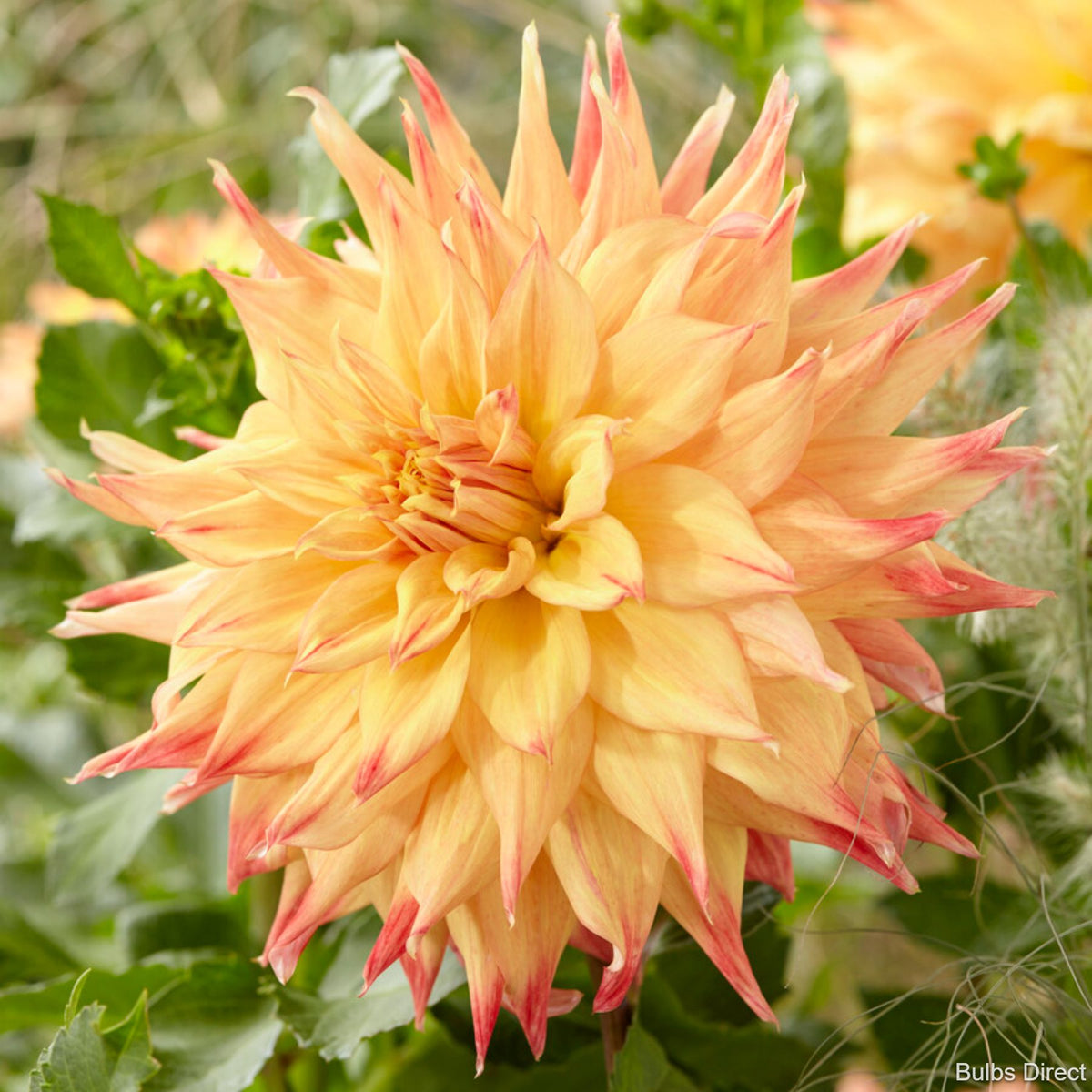
'Eva Luna' semi-cactus giant dahlia

Dahlia × pinnata

Eva Luna grows 39 to 43 in (100 to 110 cm) tall and produces semi-cactus flowers about 6 in (15 cm) in diameter. Their golden yellow heart turns apricot, then the narrow petals show red tips that evolve into pink. This transition evokes a sunset and renews interest at each stage of opening. The stems are suitable for bouquets; early staking and frost-free wintering preserve the tuber. Successive buds show different proportions, which renews the plant from mid-summer until frost. Fertile soil, deep watering without saturation, and a moderate fertilizer richer in potassium support the stems. The pointed form combines easily with round flowers, grasses, and dark foliage.
7 99 $
Pay in 4 interest-free payments with Sezzle
Detailed plant guide
Advice adapted to Canada
Secure payment
Share
Quantity
1 tuber
Exposure
Sun
Life cycle
Tender perennial
Hardiness
Zone 8

Discover the plant

Common nameGiant Dahlia 'Eva Luna'
FamilyAsteraceae
GenusDahlia
TypeTuber
Botanical nameDahlia × pinnata

Giant Dahlia 'Eva Luna' (1 tuber) – An explosion of vibrant colors! ????

The giant Dahlia 'Eva Luna' is a dazzling variety that immediately catches the eye with its XXL 25 cm (10") flowers in bright orange and intense red hues. Its tapered petals, typical of cactus dahlias, create a spectacular effect in beds, borders and bouquets . Easy to grow, it flowers generously from June until the first frosts , offering a luminous spectacle all summer long.


?? Characteristics of the variety

?? Height : 90 cm (36")
?? Flower size : 25 cm (10")
?? Exposure : Full sun
?? Hardiness : Not hardy (dig up the tubers before winter)
?? Deer Resistance : Low (can be nibbled!)
?? Water requirements : Medium (moist but well-drained soil)
?? Ideal soil : Loamy or sandy, acidic to neutral pH
?? Quantity : 1 tuber


?? Planting and growing Dahlia 'Eva Luna'

?? When to plant?
??? From March to May , after the last frosts.

?? Where to plant it?
?? In open ground : Ideal for flower beds and borders .
?? In a pot : Choose a large container with good drainage.

?? How to plant?
1?? Soak the tuber in water a few hours before planting.
2?? Plant 4 cm deep , spacing the plants 50 cm apart.
3?? Stake tall stems , as they can reach 90 cm in height .
4?? Water regularly , but avoid overwatering to prevent rot.

?? Tip : Pair it with yellow and purple dahlias for a vibrant and vibrant contrast !


?? Care of Dahlia 'Eva Luna'

?? Watering : Keep the soil moist but well drained , especially in dry periods.
?? Fertilizer : Add a high potassium fertilizer every two weeks to maximize flowering.
?? Pruning : Cut off faded flowers to encourage new growth.
?? Wintering :
?? Dig up the tubers in the fall , let them dry and store them in a cool, dry place.


?? Why choose Dahlia 'Eva Luna'?

? Giant and abundant flowering
? Perfect for a spectacular and colorful garden
? Ideal for floral arrangements and XXL bouquets
? Easy to grow and maintain

? Make your garden shine with the Dahlia 'Eva Luna', a true floral flame! ?

?? Pair it with other giant dahlias for an even more impressive effect! ??

Dahlia géant semi-cactus ‘Eva Luna’ ( Dahlia ) : une grande fleur de dahlia jaune doré, aux pétales effilés marqués de rose aux pointes, devant du feuillage vert. Cette photographie montre le sujet de près et permet d’en observer les formes, les couleurs et la disposition. Le cadrage attire l’attention sur les éléments visibles au premier plan. Cette vue complète la présentation du produit en donnant un aperçu de son apparence à cette étape, dans la scène photographiée.

Planting guide

Plant well.Grow beautifully.

Planting depth

10 cm (4 in)

Best planting time

May to early June in Quebec, when the ground has warmed

Propagation

Division of tubers with at least one viable bud

Growing method

After the last frost, place the Eva Luna tuber horizontally about 10 cm (4 in) deep in fertile, humus-rich, warm, and well-drained soil. Orient the eye upwards and allow 45 to 50 cm (18 to 20 in) around the crown. Choose full sun and a location protected from prevailing winds. Install a sturdy stake before growth begins to avoid damaging the roots later. Water lightly before sprouting, then deeply at the base when the surface begins to dry. Pinch shoots at 20 to 30 cm (8 to 12 in) to encourage flowering on multiple branches. Incorporate mature compost, then moderately use a fertilizer higher in potassium during bud formation. To obtain a few particularly impressive flower heads about 15 cm (6 in) in diameter, keep one vigorous stem and selectively remove some lateral buds; leave other branches intact to maintain a long season. Gradually tie up the stems without constricting them. Remove faded flowers before seed formation, monitor for slugs, aphids, earwigs, and spider mites, and water in the morning so that the foliage dries quickly. After the first frost, lift the crown, dry it, label it, and store it in a cool, dry, and frost-free place.

Soil and care

The right care,at the right time.

Soil pH

Slightly acidic to neutral

Minimum temperature

5 °C (41 °F)

Care level

Moderate

Watering

Water regularly to keep the soil moist without overwatering. An organic mulch helps retain moisture and reduces watering needs during hot spells. Before watering, check the moisture below the surface with your finger rather than following a fixed schedule. Recent rain, wind, and container growing can quickly change watering requirements.

Soil type

Rich, loose, and perfectly drained soil enriched with compost or organic matter. Narrow, partially curled petals emanate from a golden-yellow to apricot heart; their red tips gradually soften to pink, creating a sunset effect. Plant it about 10 cm (4 in) deep, with the eye facing up, in a location receiving at least six hours of sun, then reserve 45 to 50 cm (18 to 20 in) around the crown. Mature compost and a moderate fertilizer richer in potassium support the buds.

Fertilization

For the 'Eva Luna' giant semi-cactus dahlia, use compost at planting, followed by a potassium-rich fertilizer during the flowering period. This selection requires a sunny, warm, and sheltered location, as well as fertile soil that drains excess water quickly. In spring, plant the tuber horizontally after the last frost; growth will accelerate once nights become mild. Water deeply to maintain consistent moisture without soaking the crown.

Seasonal care

In the spring, inspect the Eva Luna tuber and replant only the firm parts with a viable eye. Wait until the risk of frost has passed and the soil has dried out. Install a sturdy stake, enrich the area with mature compost, and place the crown about 10 cm (4 in) deep. During emergence, water sparingly to prevent rot. When stems reach 20 to 30 cm (8 to 12 in), pinch the tips to encourage multiple branches. In early summer, tie up new shoots, gently weed, and maintain regular moisture with deep watering at the base. From bud formation, fertilize moderately with a formula lower in nitrogen and higher in potassium. Choose a few stems to disbud only if very large exhibition flowers are desired. In July, August, and September, harvest nearly open flower heads, remove faded flowers, check ties, and monitor for pests and diseases. Promptly remove damaged tissues and ensure good air circulation between leaves. After the first frost, cut back stems, carefully lift the crown, let its surface dry, then label Eva Luna. Store the tuber in a slightly insulating, cool, dry, dark, and frost-free environment. Check it monthly, remove soft parts, and prevent extreme drying until spring. Keep ties loose.

Container growing

A garden,within reach.

Recommended pot size

Pot at least 40 cm (16 in) in diameter and depth
For the giant semi-cactus dahlia 'Eva Luna', container cultivation requires providing sufficient volume for the roots and the plant's final height. Choose a stable pot with drainage holes and a suitable potting substrate. Leave enough space to respect the recommended planting depth and spacing, rather than overcrowding the plants to fill the pot immediately. Place the container in the indicated exposure and check moisture levels regularly, especially during hot or windy weather. A pot is more exposed to temperature fluctuations than planting in open ground. Therefore, plan ahead for a winter storage location compatible with the plant's needs and your region's climate. Plant in spring once all risk of frost has passed and the soil has sufficiently warmed. Choose a sunny spot, sheltered from strong winds, in fertile, well-drained soil. Position the tuberous roots with their neck and buds facing upward, being careful not to break the fragile attachments. Install a stake at planting time if support will be needed, to avoid damaging the roots later. Water sparingly at the start, then adjust watering according to foliage growth.
Dahlia géant semi-cactus ‘Eva Luna’ ( Dahlia ) : une grande fleur de dahlia jaune doré, aux pétales effilés marqués de rose aux pointes, devant du feuillage vert. Cette photographie montre le sujet de près et permet d’en observer les formes, les couleurs et la disposition. Le cadrage attire l’attention sur les éléments visibles au premier plan. Cette vue complète la présentation du produit en donnant un aperçu de son apparence à cette étape, dans la scène photographiée.

Bloom and dimensions

Its place,in your garden.

Mature height

110 cm (43 in)

Width / spread

20 in (50 cm)

Flower color

Golden yellow to apricot, red tips evolving to pink

Foliage color

Dark green

Foliage type

Obsolete

Growth rate

Quick

Bloom period

A spectacular display of large, soft pink cactus-like flowers from July until the first frosts. The semi-cactus giant dahlia ‘Eva Luna’ (Dahlia ‘Eva Luna’) produces bright flowers whose color changes as they open. Mature compost and a moderate, potassium-rich fertilizer support the buds. Harvest almost open stems early in the morning, protect delicate tips, and regularly remove spent flowers.

Harvest

July to October. Pick the flowers early in the morning when they are fully open to ensure excellent vase life. Continue to remove spent flowers to prolong blooming.
Dahlia géant semi-cactus ‘Eva Luna’ ( Dahlia ) : une grande fleur de dahlia jaune doré, aux pétales effilés marqués de rose aux pointes, devant du feuillage vert. Cette photographie montre le sujet de près et permet d’en observer les formes, les couleurs et la disposition. Le cadrage attire l’attention sur les éléments visibles au premier plan. Cette vue complète la présentation du produit en donnant un aperçu de son apparence à cette étape, dans la scène photographiée.

Garden associations

In goodcompany.

Companion plants

To accompany the ‘Eva Luna’ giant semi-cactus dahlia, you could consider cosmos, zinnias, or ornamental salvias. Choose companion varieties based on their height, flowering period, and the colours you wish to combine. Most importantly, ensure that their sun exposure and water requirements are suitable for the same location. Leave enough space so that leaves don't obscure young shoots and to allow easy access to each plant during maintenance. These pairings are for creating the garden's aesthetic; they do not guarantee protection against pests or diseases. Adjust the layout after observing one growing season.

Frequently asked questions

Your questions,answered.

'Eva Luna' semi-cactus giant dahlia: why does the color of 'Eva Luna' change?
For the 'Eva Luna' giant semi-cactus dahlia, Eva Luna combines several colored zones, and their balance evolves as the bloom opens. The center appears golden yellow to apricot, while the red petal tips soften gradually toward pink. Light, temperature, and the age of the flower head can alter the apparent intensity. Therefore, the cultivar should not be described as simply pink. Photographing several stages best illustrates its sunset palette and helps in choosing appropriate companions. Compare the flowers under neutral light rather than in the bright midday sun, which can wash out the tones. Buds and mature flower heads can thus seem to belong to different palettes despite coming from the same plant.
Giant semi-cactus dahlia 'Eva Luna': how to plant the 'Eva Luna' tuber?
For Dahlia giant semi-cactus 'Eva Luna', after the last frost, lay the tuber about 10 cm (4 in) deep in warmed, fertile, humus-rich, and well-drained soil. Point the eye upward, provide at least six hours of sun, and keep 45 to 50 cm (18 to 20 in) around the crown. Install the stake immediately. Water sparingly before emergence, then deeply when the surface begins to dry. Pinch the shoots at about 20 to 30 cm (8 to 12 in). Incorporate mature compost and then fertilize moderately with a formula higher in potassium.
'Eva Luna' giant semi-cactus dahlia: is 'Eva Luna' a cactus or semi-cactus dahlia?
For the giant semi-cactus dahlia 'Eva Luna', specialized registries and growers classify it as semi-cactus. Its petals are narrow, pointed, and partially rolled, but they do not all exhibit the pronounced rolling expected of a strict cactus form over the majority of their length. Commercial labels may use "giant cactus" as a broad category. The horticultural data sheet specifies semi-cactus to correctly describe the visible structure, without changing the Van Noort commercial product name. Both terms may therefore appear in trade, but semi-cactus is the more informative choice for this data sheet. The flowers remain double, and their central disc is not easily accessible.
'Eva Luna' giant semi-cactus dahlia: how to cut 'Eva Luna' for bouquets?
For the 'Eva Luna' giant semi-cactus dahlia, harvest early in the morning when the flowers are almost open, as dahlias do not progress much after cutting. Choose firm stems, cut above a node, and protect the delicate tips. Remove any leaves that would sit in the water, recut the bases, and use a clean vase. The 15 cm (6 in) flower heads pair well with chocolate cosmos, white gaura, blue sage, and bronze foliage that echoes their warm palette. Keep the vase away from direct sunlight and ripe fruit, and change the water frequently. Stems harvested at different stages may show more yellow or pink, which enriches a monochrome bouquet.
'Eva Luna' giant semi-cactus dahlia: how to overwinter 'Eva Luna' in Quebec?
For giant semi-cactus dahlia 'Eva Luna', after the first frost has blackened the foliage, cut back the stems and carefully lift the crown without breaking the neck. Let the surface dry under cover, then clearly label it Eva Luna. Store the tuber in a slightly insulating medium, in a cool, dry, dark, and frost-free place. Inspect it monthly, remove any soft parts, and prevent extreme drying until safe conditions return in the spring. In the spring, only restart the crown's growth when the risk of frost diminishes. To divide it, each section must retain a portion of the neck bearing a viable eye; an isolated tuberous root without an eye will not form a new shoot.

Wildlife and pets

Life,around your plants.

Supporting wildlife

For the giant semi-cactus dahlia 'Eva Luna', the central florets can provide pollen to visiting insects. This variety requires a sunny, warm, and sheltered position, as well as fertile soil that drains excess water quickly. In spring, the tuber should be planted horizontally after the last frost, and growth will accelerate once the nights become mild.