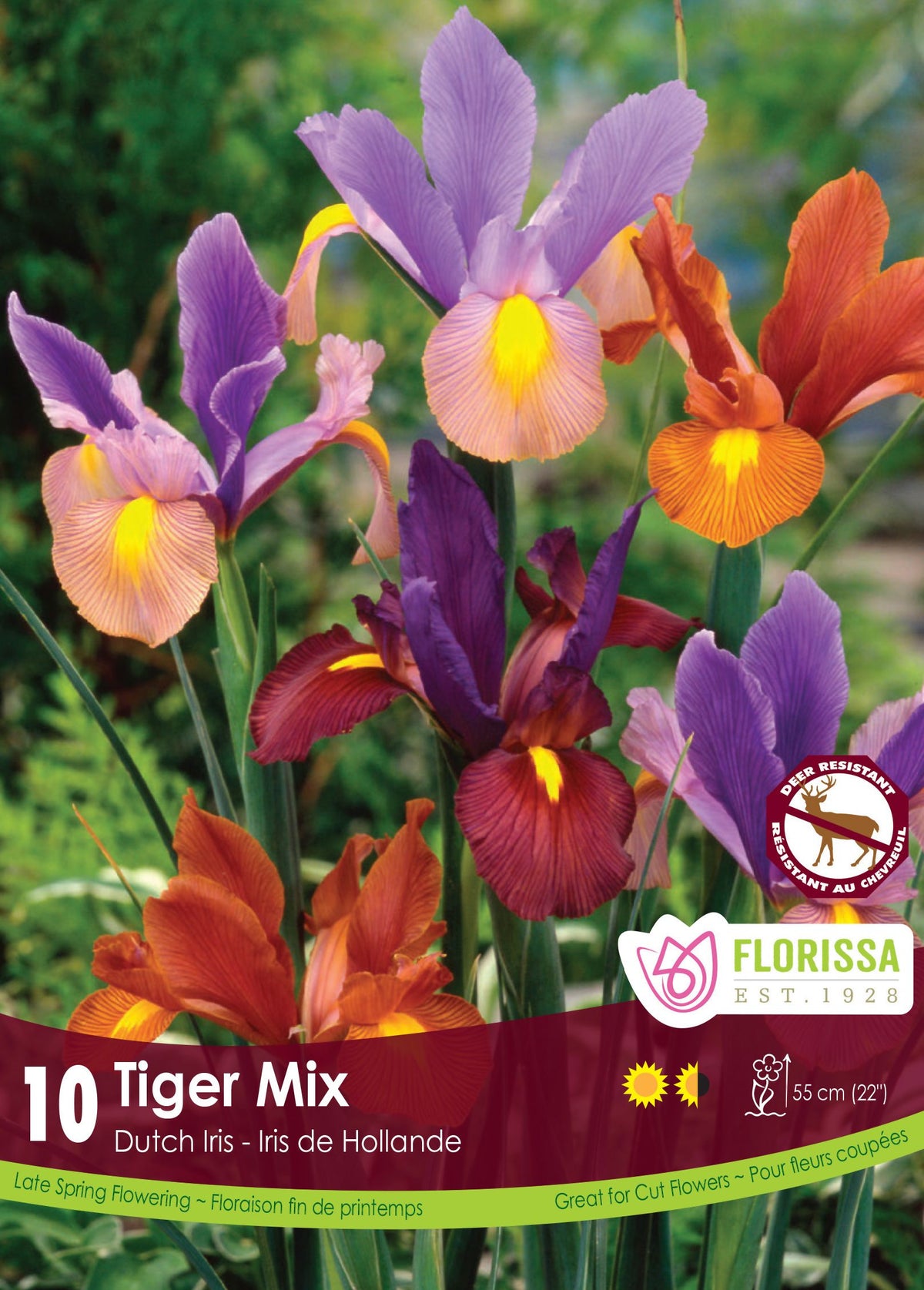
Dutch iris mix (Iris × hollandica ‘Tiger Mix’)

Iris × hollandica ‘Tiger Mix’

Dutch iris ‘Tiger Mix’ includes 10 bulbs producing bold bicoloured flowers in blue, purple, burgundy, orange and yellow. Reaching 50 to 60 cm (20 to 24 in), this graphic mixture suits beds, containers and cut bouquets.
7 99 $
Pay in 4 interest-free payments with Sezzle
Detailed plant guide
Advice adapted to Canada
Secure payment
2026 preorder for fall bulbs Shipping expected in October 2026.
Share
Exposure Full sun to partial shade
Hardiness Zones 5 to 9
Difficulty level Easy

Discover the plant

Family Iridaceae
Type Mixed flowering bulbs
Cycle Bulbous perennial

Dutch iris mix (Iris × hollandica ‘Tiger Mix’) combines upright, slender bulbous irises reaching approximately 50 to 60 cm (20 to 24 in) tall. Their narrow green foliage surrounds sturdy flowering stems that produce a spectacular display in late spring. The mixture is distinguished by contrasting bicoloured flowers in shades of blue, purple, burgundy, red, orange and yellow, often marked with golden areas or darker patterns. This warm, graphic palette brings strong character to plantings from May to June. The bulbs are generally hardy in Zones 5 to 9 when winter drainage is excellent, allowing them to return in suitable garden conditions while maintaining their distinctive vertical form.

This mixture prefers full sun but tolerates light partial shade in a bright location. Light, fertile and sharply drained soil is essential because standing moisture around the bulbs can contribute to deterioration. In Quebec, plant them from September to December before the ground freezes, 100 to 120 mm deep and 8 to 10 cm (3 to 4 in) apart. Water lightly after planting, then moderately when active growth resumes in spring. Following flowering, reduce watering and allow the foliage to yellow naturally so it can replenish the bulbs’ stored energy. Winter mulch may be useful near the colder limit of their hardiness, particularly where repeated freeze-thaw cycles occur.

This selection is especially effective in contrasting beds, dynamic borders, contemporary gardens, containers and cutting gardens. Planted in groups, the bulbs create a succession of rich colours and a strongly structured vertical effect. They pair well with dark tulips, purple ornamental alliums, white daffodils and grey or silver foliage that highlights their vivid colouring. The long stems are also suitable for bold, colourful bouquets. The flowers may be visited by bees and other pollinating insects during bloom. Irises are not edible and may be harmful if ingested, particularly by pets, so bulbs and other plant material should be kept out of reach. This product is offered by Van Noort.

Dutch iris mix (<em>Iris × hollandica</em> ‘Tiger Mix’)

Planting guide

From planting to establishment.

Spacing / density Space 8 to 10 cm (3 to 4 in) apart
Best planting time September to December, before the ground freezes
Propagation Division of bulb offsets
Growing method
Plant the bulbs from September to December in loose, fertile and sharply drained soil. Set them 100 to 120 mm deep with the pointed end upward, leaving 8 to 10 cm (3 to 4 in) between each bulb. Water lightly after planting, then moderately as growth resumes in spring. Grow in full sun or light partial shade. After flowering, remove faded blooms if desired, then allow the foliage to yellow naturally before cutting it back so the bulbs can replenish their stored energy.

Soil and care

The right conditions.

Exposure Full sun to partial shade
Soil pH Acidic to neutral
Hardiness zone Zones 5 to 9
Minimum temperature Approximately -29 °C
Watering
Low to moderate; moderate during active spring growth
Soil type
Light, fertile and sharply drained soil
Fertilization
Light application of balanced fertilizer in spring and after flowering
Seasonal care
In fall, plant the bulbs before the ground freezes in loose, sharply drained soil, then water lightly to settle the soil around them. In spring, maintain moderate moisture while leaves and flowering stems develop. A light application of balanced fertilizer can support active growth. During bloom, harvest stems for bouquets or remove faded flowers. After flowering, gradually reduce watering and retain the foliage while it remains green. Wait until it has completely yellowed before removing it. In colder Zone 5 locations, applying mulch after the ground freezes can help moderate repeated freeze-thaw cycles and provide additional winter protection for the bulbs.

Container growing

A controlled environment.

Recommended pot size
Pot at least 25 to 30 cm (10 to 12 in) in diameter
Dutch iris mix (<em>Iris × hollandica</em> ‘Tiger Mix’)

Bloom and dimensions

The complete profile.

Flower color Blue, purple, burgundy, red, orange and yellow
Foliage color Green
Foliage type Deciduous
Growth rate Moderate
Bloom period
May to June
Maximum height 60 cm (24 in)
Maximum width 15 cm (6 in)
Dutch iris mix (<em>Iris × hollandica</em> ‘Tiger Mix’)

Garden associations

What to plant with it.

Good companions
Dark tulips, purple ornamental alliums, white daffodils and silver foliage
Avoid planting with
Plants requiring constantly moist or waterlogged soil
Beds, borders, containers, contemporary gardens and cut flowers

Frequently asked questions

Everything toknow.

‘Tiger Mix’ combines bicoloured irises in shades that include blue, purple, burgundy, red, orange and yellow. Many flowers feature golden or darker markings that strengthen their contrasting appearance. The exact proportion of colours can vary within each bulb assortment.
Plant the bulbs from September to December before the ground freezes. Set them 100 to 120 mm deep in light, sharply drained soil. Fall planting allows roots to begin establishing before active spring growth resumes and helps prepare the bulbs for flowering.
The irises in this mixture generally reach 50 to 60 cm (20 to 24 in) tall. Their habit remains narrow and upright, allowing them to add structure to beds without taking up much space and making them useful for cut flowers.
Yes. Choose a pot at least 25 to 30 cm (10 to 12 in) in diameter with several drainage holes and use a light potting mix. Group several bulbs for stronger colour impact, water moderately and protect the container from severe winter freezing in Quebec.
No. Irises can cause irritation and digestive upset when ingested, with the underground parts presenting particular concern. Keep bulbs and plant debris away from dogs and cats, and prevent pets from digging in areas where the bulbs have recently been planted.

Its strengths, naturally.

Not recommended for pets

Pets

Pollinators
Attracts or supports pollinating insects

Pollinators

Deer
Less attractive or generally tolerated by deer

Deer