Galanthus Polar Bear

Galanthus elwesii

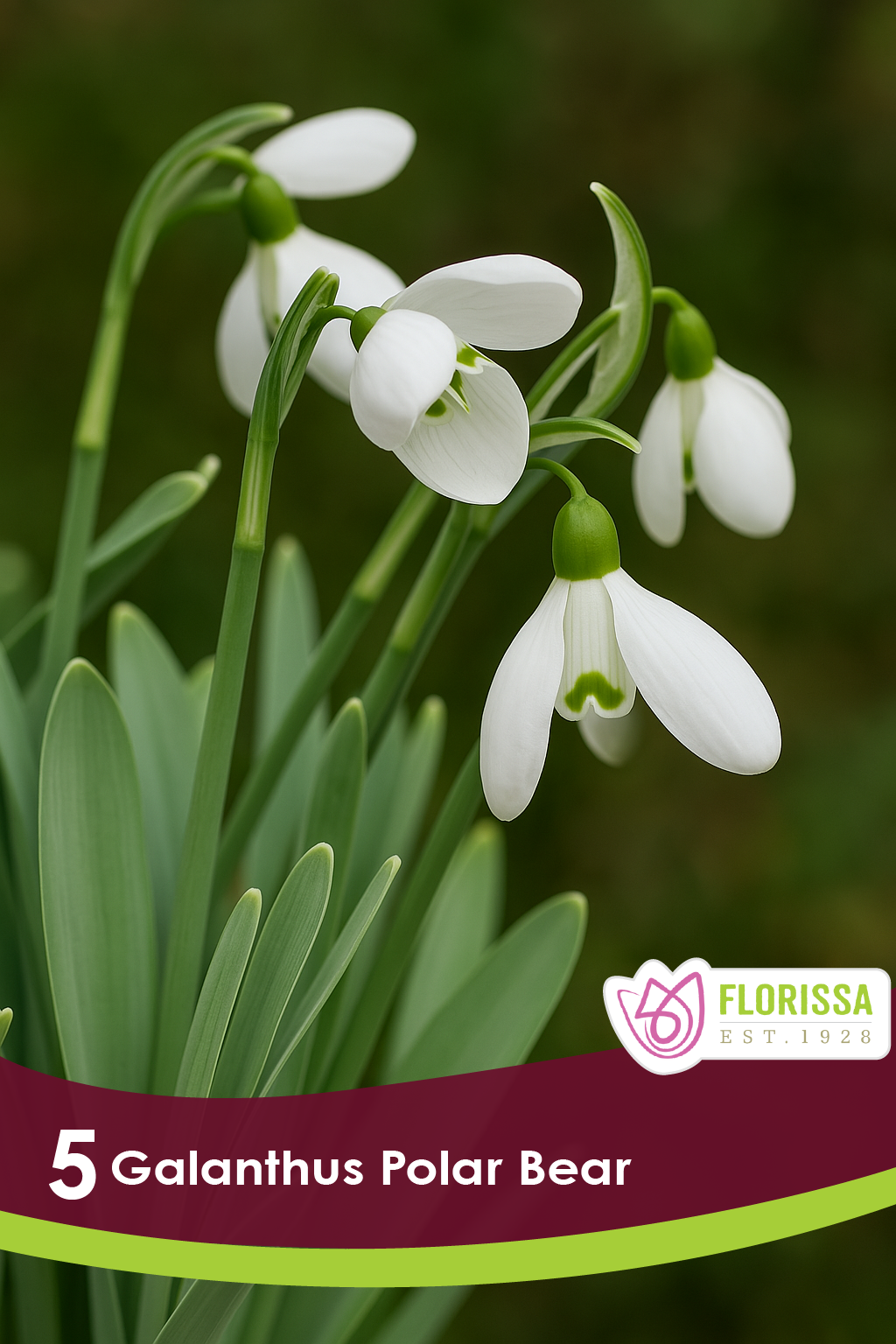
Galanthus elwesii ‘Polar Bear’ is a giant snowdrop approximately 15 cm (6 in) tall. Its large white flower faces outwards and consists of three broad, cup-shaped outer tepals, as well as three inner segments marked with green at the base and a small inverted V at the top. The relatively broad leaves are grayish-green. It blooms in spring. Plant Van Noort bulbs in autumn in humus-rich, cool but well-drained soil, in spring sun or partial shade. This H5 cultivar is suitable for light woodlands, cool borders, shallow containers, and naturalized groupings. Allow its foliage to yellow naturally after flowering.
13 99 $
Pay in 4 interest-free payments with Sezzle
Detailed plant guide
Advice adapted to Canada
Secure payment
Share
Quantity
5 bulbs
Exposure
Half sun
Life cycle
Naturalizing bulbous perennial

Discover the plant

Common nameGiant Snowdrop
FamilyAmaryllidaceae
GenusSnowdrop
Specieselwesii
CultivarOurs polaire
TypeHardy ornamental bulb for autumn planting
Botanical nameGalanthus elwesii
Reproducible seedsYes

?? Galanthus 'Polar Bear' (5 bulbs) – Immaculate flowering & winter elegance ? Offered by Van Noort

Galanthus 'Polar Bear' is a refined snowdrop variety with a graceful habit and strikingly pure white flowers .
Its pearly outer petals frame a soft green heart, creating a soft contrast that brightens borders, rockeries or light undergrowth from the end of winter.
Its early flowering, sometimes as early as February, heralds renewal and attracts the first pollinators.
Very hardy, this small bulbous plant naturalizes easily in natural or poetic gardens.
An exceptional snowdrop, with a slender silhouette, luminous blooms and a soothing presence. ??

?? Characteristics of Galanthus 'Polar Bear'

?? Average height : 10 to 15 cm
?? Exposure : Partial shade to mild sun
?? Hardiness : Zone 3 and above
?? Attracts wildlife : Yes, early pollinators
?? Water requirements : Moderate
?? Ideal soil : Humiferous, light, fresh but well-drained
?? Quantity : 5 bulbs

?? Planting and growing Galanthus 'Polar Bear'

?? When to plant? From September to November, for flowering in February-March
?? In open ground : Ideal in light undergrowth , light borders , fresh rockeries or spring meadows
?? In a pot : Perfect in a winter pot or window box , combined with evergreen foliage
?? How to plant?
1?? Depth : 5 to 7 cm
2?? Spacing : 5 to 8 cm
3?? Watering : Light after planting, keep cool until flowering

??Care of Galanthus 'Polar Bear'

?? Watering : Moderate in case of winter drought
?? Fertilizer : A little compost in the fall
?? Pruning : Allow the foliage to fade naturally
?? Wintering : No care required, very hardy

?? Why choose Galanthus 'Polar Bear'?

? Pure white flowering , very early
? Ideal for naturalizing in undergrowth , poetic borders or winter pots
? Very hardy , easy to achieve, flowering faithfully every year
? Brings light, grace and softness from the end of winter

? Bring February light into your garden with Galanthus 'Polar Bear', offered by Van Noort — a small , white wonder, discreet and full of promise. ?

?? Pair with pastel crocuses , white muscari , hellebores or epimediums for a soothing and elegant winter scene. ??

Perce-neige géant ( Galanthus elwesii ‘Polar Bear’) : des perce-neige blancs à marques vertes sur un fond sombre. Le visuel Florissa présente la plante et son nom dans la partie inférieure de l’étiquette. La photographie occupe presque toute la surface, tandis que le bandeau du bas rassemble les indications du produit. Cette vue permet de reconnaître son apparence et de distinguer la variété présentée.

Planting guide

Plant well.Grow beautifully.

Planting depth

8 cm (3 in)

Best planting time

September to November before the ground freezes

Propagation

Division of bulbils at the end of summer

Growing method

In the fall, prepare a sunny or lightly shaded location where rainwater drains quickly. Loosen fertile soil to a good depth and mix in mature compost, as well as a little horticultural gravel if the soil texture is heavy. Wear gloves, place the bulb 8 cm (3 in) below the surface, and leave 5 cm (2 in) around it. Water once if the soil is dry, then mark the location. In spring, remove any debris that hinders growth, maintain consistent moisture while the stem elongates, and apply a bulb fertilizer at a moderate dose. Monitor for narcissus fly as soon as it emerges. After flowering, remove seed pods only if seedlings are not desired, and allow all leaves to yellow. Divide only in late summer, when the clump is dormant. Drainage remains a priority throughout dormancy. Foliage must yellow naturally before any cutting. Sustainable establishment reduces bulb handling. Spring growth benefits from consistently moist soil. Drainage remains a priority throughout dormancy. Foliage must yellow naturally before any cutting. Sustainable establishment reduces bulb handling. Spring growth benefits from consistently moist soil. Drainage remains a priority throughout dormancy. Foliage must yellow naturally before any cutting. Sustainable establishment reduces bulb handling.

Soil and care

The right care,at the right time.

Soil pH

Acidic, neutral or alkaline

Minimum temperature

RHS H5; do not convert directly to zone

Care level

Easy

Watering

Water after planting only when the soil is dry. In spring, maintain regular moisture during emergence, elongation, and flowering, without ever saturating the root zone. Gradually reduce watering when the foliage yellows. During summer dormancy and winter, natural rainfall is usually sufficient; above all, avoid stagnant water around the bulb. Drainage remains a priority throughout dormancy. The foliage must yellow naturally before any cutting. Sustainable establishment reduces handling of the

Soil type

Grow 'Polar Bear' in humus-rich soil that is cool but well-drained and doesn't dry out completely in summer. Loamy, clayey, chalky, or sandy soil is suitable when it contains mature compost and drains excess water well. Spring sun or partial shade under deciduous shrubs encourages flowering. Avoid constantly saturated soils and locations dried out by very competitive roots.

Fertilization

Incorporate mature compost into the surface during autumn preparation, but avoid placing it directly against the bulb. At the start of growth, distribute a moderate dose of balanced slow-release fertilizer or bulb fertilizer. Avoid nitrogen-rich fertilizers that encourage tender stems. Stop fertilizing after flowering and allow the foliage to recharge the reserves. Drainage remains a priority throughout dormancy. The foliage must yellow naturally before any cutting.

Seasonal care

In the fall, plant the bulb 8 cm (3 in) deep, mark its position, and correct any drainage problems before the cold rains. Apply a light mulch only after the soil cools, without forming a compact, moist layer. In late winter, gently clear away debris so the shoot can emerge undamaged. In spring, water during dry periods, fertilize moderately at the start, and regularly inspect the leaves for narcissus fly. Stake only if the site is very windy. After flowering, remove spent blooms if you don't want seed pods, but keep the leaves. In early summer, wait for them to turn completely yellow before cutting. During dormancy, do not dig near the bulb. In late summer, divide bulbils only if the clump is tight, and replant them immediately. In winter, the most important protection remains soil that does not retain snowmelt. Drainage remains a priority throughout dormancy. The foliage must yellow naturally before any cutting. Sustainable establishment reduces bulb handling. Spring growth benefits from regularly cool soil. Drainage remains a priority throughout dormancy. The foliage must yellow naturally before any cutting. Sustainable establishment reduces bulb handling. Spring growth benefits from regularly cool soil. Drainage remains a priority throughout dormancy. The foliage must yellow naturally before any cutting. Sustainable establishment reduces bulb handling. Spring growth benefits from regularly cool soil.

Container growing

A garden,within reach.

Recommended pot size

Stable pot 35 to 40 cm (14 to 16 in.) for one bulb
Container gardening requires planning for the volume needed for the roots and the final height of the plant. Choose a stable pot with drainage holes and a substrate suitable for planting. Leave enough space to respect the recommended depth and spacing, rather than crowding the plants to fill the pot immediately. Place the container in the recommended exposure and regularly check the moisture level, especially in hot or windy weather. A pot is more exposed to temperature variations than an in-ground planting. Therefore, plan for a wintering location compatible with the plant's needs and your region's climate right from the start. Plant these bulbs in the fall in loose soil that drains excess water well. Choose a location that matches their exposure, where young shoots can receive light in the spring. Distribute the bulbs in small groups rather than a too-tight line, then respect the depth appropriate to their size. Water after planting if the soil is dry to encourage contact with the roots. Keep a discreet marker to find the groups during their dormant period. In an already planted flowerbed, work carefully between the roots of perennials and avoid cutting them unnecessarily. In winter, protect the container according to the plant's needs: its roots are more exposed to cold than in the ground.
Perce-neige géant ( Galanthus elwesii ‘Polar Bear’) : des perce-neige blancs à marques vertes sur un fond sombre. Le visuel Florissa présente la plante et son nom dans la partie inférieure de l’étiquette. La photographie occupe presque toute la surface, tandis que le bandeau du bas rassemble les indications du produit. Cette vue permet de reconnaître son apparence et de distinguer la variété présentée.

Bloom and dimensions

Its place,in your garden.

Mature height

Approx. 6 in (15 cm)

Width / spread

Less than 10 cm (4 in)

Flower color

White, green basal spot and small inverted green V on the inner segments

Foliage color

Greyish-green to glaucous

Foliage type

Deciduous, relatively broad, greyish-green to glaucous

Growth rate

Moderate

Bloom period

In spring, each stem, about 15 cm (6 in.) tall, bears a large, outward-facing white flower. Three broad, cup-shaped outer tepals surround three inner segments that have a green blotch at the base and a small, inverted green V near the tip. The relatively broad, grayish-green leaves stay low beneath the flower, emphasizing its generous form. Place bulbs near a pathway to observe these markings without touching the fragile bell.
Perce-neige géant ( Galanthus elwesii ‘Polar Bear’) : des perce-neige blancs à marques vertes sur un fond sombre. Le visuel Florissa présente la plante et son nom dans la partie inférieure de l’étiquette. La photographie occupe presque toute la surface, tandis que le bandeau du bas rassemble les indications du produit. Cette vue permet de reconnaître son apparence et de distinguer la variété présentée.

Garden associations

In goodcompany.

Companion plants

Pair elwesii ‘Polar Bear’ with white daffodils, purple crocuses, blue muscari, scillas, silver brunnera, lungworts, and small euphorbias. Their low-lying blooms or foliage enhance the white and green flower without obscuring the stem. Leave an open area around the bulb and favor neighbors with moderate root systems. Avoid invasive groundcovers that retain moisture or make division difficult. Drainage remains a priority throughout dormancy. The foliage should yellow naturally before any cutting. A lasting planting reduces bulb handling. Spring growth benefits from consistently cool soil. Drainage remains a priority throughout

Plants to avoid

Avoid invasive groundcovers, soggy soil, and highly competitive roots.

Frequently asked questions

Your questions,answered.

When to plant Elwes's snowdrop ‘Polar Bear’?
Plant 'Polar Bear' elwesii in the fall, from September to November, before the ground freezes. Immediately choose a permanent location in full sun or light partial shade, as an established snowdrop prefers to remain undisturbed. Dig 3 inches (8 cm) deep into fertile, humus-rich soil that is cool but well-drained, then keep 2 inches (5 cm) between bulbs. Wear gloves and handle the bulb carefully. Water only if the soil is dry at the time of planting. Then mark the position to avoid damaging it during dormancy. In cold Quebec regions, a light mulch applied after the soil cools limits variations without trapping too much water. Drainage remains a priority throughout dormancy. The foliage must yellow naturally before
How to recognize the Galanthus Polar Bear flower?
'Polar Bear' is recognized by its large white flower, which is more outward-facing than strongly pendulous. The three outer tepals are broad and cup-shaped. The three inner segments bear two types of green markings: a spot at the base and a small inverted V near the apex. This combination, described by the RHS, distinguishes the cultivar from many other snowdrops. Observe the flower from a path or a slight incline without straightening it by hand. The relatively broad, grey-green leaves also confirm its belonging to Galanthus elwesii. The size of approximately 15 cm (6 in) remains compact, even if the flower appears large in relation to the plant.
How do I protect the bulb from rot?
Prevention begins with site selection. Avoid hollows, compacted clay soils, and areas where snowmelt lingers for several days. Loosen the soil and incorporate mature compost and horticultural gravel if the texture is heavy. Plant at 8 cm (3 in) without creating a watering basin. Use a thin mulch that doesn't stay soggy directly over the bulb. During growth, water enough to keep the soil fresh, but always allow excess water to drain. Reduce watering after the foliage yellows. In pots, empty the saucer and regularly check that the drainage holes are not blocked. Drainage remains a priority throughout dormancy. The foliage should yellow naturally before any pruning. For a lasting planting
Can elwesii 'Polar Bear' be grown in a container?
Yes, but choose a heavy container 35 to 40 cm (14 to 16 in.) in diameter and depth to stabilize the 15 cm (6 in.) stem. Large drainage holes are essential. Use a loam, compost, and gravel-based mix, then plant a single bulb 8 cm (3 in.) deep. Place the pot in sun or light shade and turn it occasionally for straight growth. Water when the surface begins to dry and always empty the saucer. After flowering, keep the leaves until they yellow. For winter, allow dormancy to proceed in the cold while insulating the pot sides against extreme freeze-thaw cycles. Drainage remains a priority throughout dormancy. The foliage must yellow
Is the snowdrop elwesii ‘Polar Bear’ edible?
No. The RHS specifies that ornamental snowdrop bulbs should not be eaten and recommends wearing gloves while handling them. Keep the bulbs out of reach of children and animals before planting, then wash your hands and tools after the work. Do not use any part in a recipe, herbal tea, or medicinal preparation. Clearly label the planting if it is next to a vegetable garden. If a person or animal ingests any part, quickly contact the poison control center, a doctor, or a veterinarian and provide the exact name of the product. Normal observation in the garden does not require excessive caution. Drainage remains a priority throughout dormancy. The foliage must yellow naturally before

Wildlife and pets

Life,around your plants.

Supporting wildlife

Van Noort describes *elwesii* ‘Polar Bear’ as pollinator-friendly and deer-resistant. Its spring blooms can host various insects when temperatures allow for their activity. However, supplement the planting with single flowers that precede and follow its bloom to ensure a continuous supply of pollen and nectar. Drainage remains a priority throughout