


Fall vegetable bulb
Spanish Roja garlic (Allium sativum ‘Spanish Roja’)
Product code :
- Quantity
- 3 bulbs
- Exposure
- Full sun to partial shade
- Life cycle
- Annual in vegetable production
- Hardiness
- Zones 2 to 10
Discover the plant
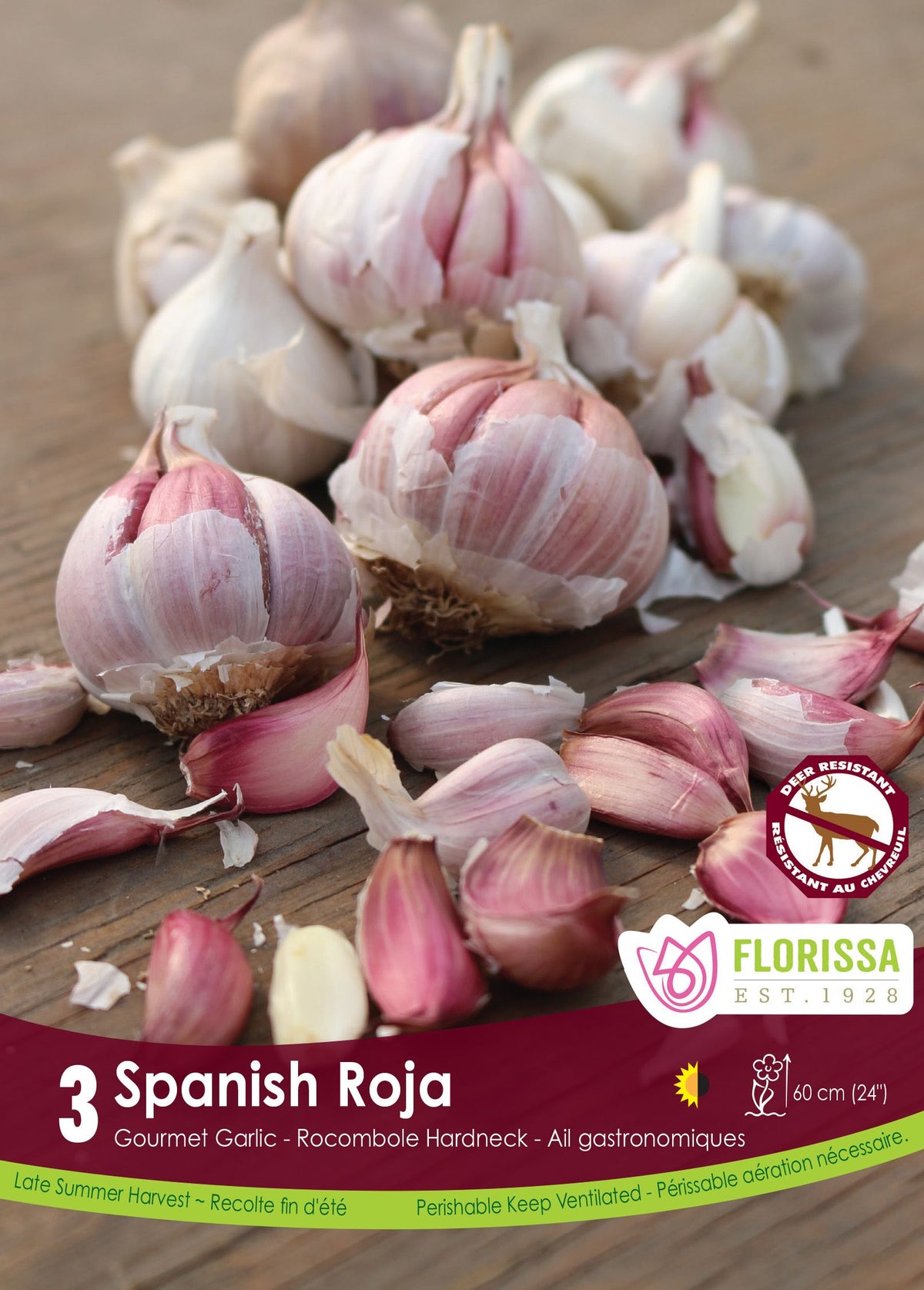
Spanish Roja garlic (Allium sativum var. ophioscorodon ‘Spanish Roja’) is a hardneck garlic in the Rocambole group, originating from the Republic of Georgia and sold here as a package of three bulbs for planting. Symmetrical bulbs carry purple wrappers with satiny gold and silver tones. They generally contain eight to nine plump cloves arranged in one ring around a firm central stalk. In spring, narrow upright green foliage surrounds a scape that curls before straightening. Plants reach approximately 60 cm (24 in) tall. Suited to Zones 2 to 10 and grown as an annual vegetable crop, Spanish Roja offers a strong, lingering flavour without the excessive heat found in some hardneck garlics.
Plant cloves in fall in full sun or bright partial shade, using loose, fertile, organic-rich soil with excellent drainage. Separate the three bulbs only one or two days before planting to protect each clove’s basal plate. Set cloves pointed end up 8 cm (3 in) deep, spacing plants 15 cm (6 in) apart and rows approximately 30 cm (12 in) apart. After the soil cools, apply clean straw mulch. In spring, maintain even moisture without saturation, weed early, and fertilize moderately. Harvest scapes at their first curl, then stop watering about two weeks before lifting the main bulbs. Avoid late nitrogen, standing water, and damage to shallow roots while bulbs are actively enlarging.
Lift bulbs when lower leaves have browned while four or five upper leaves remain green. Use a garden fork instead of pulling the stems, then cure whole plants for two to four weeks in a shaded, dry, exceptionally well-ventilated place. Once necks and wrappers are dry, brush away loose soil and store bulbs in an airy container in a cool, dark location. Spanish Roja is valued raw for a strong flavour without overwhelming heat and roasted for its softer character. Cloves suit sauces, marinades, roasted vegetables, and breads, while young scapes are excellent in pesto, stir-fries, or on the grill. Reserve only firm, healthy cloves for future planting.

Planting guide
Plant well.Grow beautifully.
Planting depth
Spacing / density
Best planting time
Propagation
Growing method
Soil and care
The right care,at the right time.
Soil pH
Minimum temperature
Care level
Watering
Soil type
Fertilization
Moisture
Seasonal care
Container growing
A garden,within reach.
Recommended pot size

Bloom and dimensions
Its place,in your garden.
Mature height
Width / spread
Flower color
Foliage color
Foliage type
Growth rate
Growth habit
Fragrance
Bloom period
Fruiting
Harvest
Garden associations
In goodcompany.
Companion plants
Plants to avoid
Recipe idea
From the gardento your plate.
Frequently asked questions
Your questions,answered.
When should Spanish Roja garlic be planted?
Why choose Spanish Roja garlic?
When should Spanish Roja garlic bulbs be harvested?
Does Spanish Roja garlic store well?
Should Spanish Roja garlic scapes be cut?
Wildlife and pets