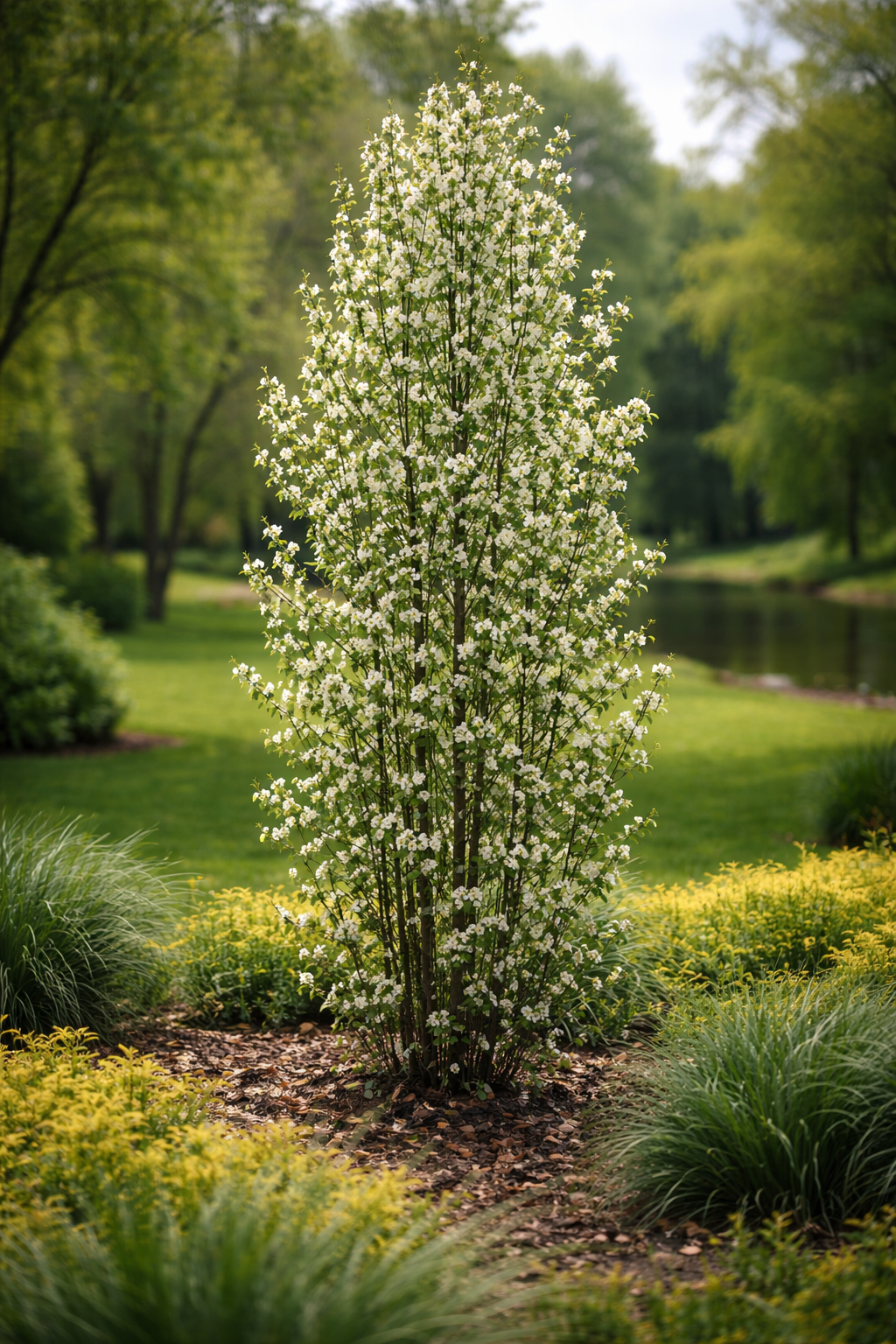
Standing Ovation™ serviceberry (Amelanchier alnifolia ‘Obelisk’)

Narrow multi-stemmed Standing Ovation™ serviceberry covered with white flowers among almost-round leaves. This view shows <em>Amelanchier alnifolia</em> ‘Obelisk’, a Zone 2 shrub reaching approximately 4.3 to 4.6 m high by 1.2 m wide (14 to 15 ft × 4 ft), with edible purple-black fruit and vivid red-orange foliage in fall.
PÉPINIÈRE.CA

Standing Ovation™ serviceberry (<em>Amelanchier alnifolia</em> ‘Obelisk’)

BACK-IN-STOCK ALERT

Don’t miss its return.

Leave your email and receive an alert when this product is available again.

An alert for this product only. No newsletter signup. Privacy

Narrow vertical shrub with flowers, edible fruit, and fall colour

Pépinière.ca

Sold as 7 gallons

Title

Available in store only

Pay in 4 interest-free payments withSezzle

Delivery and pickup: view conditions

Product information
Advice adapted to Canada
Secure payment
Share
Common nameStanding Ovation™ serviceberry; Obelisk Saskatoon serviceberry
FamilyRosaceae
GenusAmelanchier
Speciesalnifolia
CultivarObelisk
Plant typeFruit shrub
Botanical nameAmelanchier alnifolia ‘Obelisk’
Fruit tree typeOrnamental shrub with secondary edible fruit

Standing Ovation™ serviceberry (Amelanchier alnifolia ‘Obelisk’) is a narrow upright selection ideal where available width is limited. Multiple stems form a uniform oval column approximately 4.3 to 4.6 m high and only 1.2 m wide (14 to 15 ft × 4 ft). In spring, abundant white flowers cover the branches before or as almost-round leaves emerge. Edible purple-black fruit may follow in June, but production is generally lighter than on cultivars selected primarily for harvest. Dark-green foliage turns red and orange in fall. Hardy to Zone 2, this shrub retains a structured outline in winter and provides four-season vertical interest.

Plant Standing Ovation™ in full sun or partial shade and cool, fertile, well-drained soil. Full sun encourages dense growth, abundant bloom, and brighter fall colour. Dig a hole as deep as the root ball and twice as wide, set the root flare level with the soil, and water slowly. For a narrow hedge, space shrubs 1 to 1.2 m (3 to 4 ft) apart; as distinct specimens, allow approximately 1.5 m (5 ft). Spread 5 to 8 cm (2 to 3 in) of mulch without touching the stems. Maintain even moisture through the first two seasons, then irrigate during prolonged dry periods.

Use Standing Ovation™ as a vertical accent, narrow screen, naturally formal hedge, or focal point in a small garden. Its uniform habit suits positions near a patio, along an entrance, or between areas where a wider shrub would be intrusive. Prune lightly, mainly removing dead, broken, crossing, or diseased wood and suckers that widen the base beyond the planned space. Flowers support pollinators, while fruit can feed birds or be harvested when purple-black and soft. Watch for rust, leaf spots, powdery mildew, and fire blight. Good air circulation and irrigation directed toward the soil help prevent problems.

In the garden

Exposure
Sun
Hardiness
Zone 2

Planting guide

Planting & establishment

Spacing / density

Space shrubs 1 to 1.2 m (3 to 4 ft) apart for a continuous narrow hedge. As distinct accents, allow approximately 1.5 m (5 ft) between centres. Keep at least 60 cm (2 ft) from a wall or fence to support air circulation and maintenance access.

Minimum temperature

Approximately -40 °C (-40 °F), Zone 2

Planting period

In spring after the soil thaws, or in early fall at least six weeks before persistent frost

Propagation

Cuttings or tissue culture to preserve the ‘Obelisk’ cultivar faithfully; seed does not reproduce Standing Ovation™ identically

Soil and care

Soil & care

Soil pH

Slightly acidic to neutral, ideally approximately 5.5 to 7.5

Moisture

Moderate and even; cool soil without stagnant water

Minimum temperature

Approximately -40 °C (-40 °F), Zone 2

Care level

Low to moderate

Drought tolerance

Yes

Watering

Moderate watering

Soil type

Slightly acidic to neutral, well drained

Fertilization

Fertilizer is generally unnecessary in fertile soil. In spring, spread a thin layer of mature compost over the root zone without touching the trunk. When a soil test identifies a deficiency, apply a balanced slow-release fertilizer according to its label. Avoid excess nitrogen because it encourages tender shoots, may reduce fruiting, and can increase susceptibility to fire blight. For best results, inspect soil, foliage, and growth regularly.

Seasonal care

In spring, inspect bark and remove dead, crossing, or damaged branches before budbreak. White clusters appear early; avoid broad-spectrum insecticides during bloom to protect bees and butterflies. After flowering, prune only lightly because buds form on the previous season’s wood. In early summer, monitor ripening fruit and harvest when it becomes purple-black. Irrigate during dry periods to limit premature fruit drop. In summer, watch for rust, powdery mildew, leaf spots, or fire blight; remove affected shoots with disinfected tools and avoid wetting foliage. In fall, enjoy orange-red colour, renew mulch without piling it against the trunk, and water until freeze-up when soil remains dry. In winter, protect the trunk from rodents and avoid piling salt-laden snow over the root zone. For best results, inspect soil, foliage, and growth regularly. This attention supports a healthy, productive, lasting tree. For best results, inspect soil, foliage, and growth regularly. This attention supports a healthy, productive, lasting tree. For best results, inspect soil, foliage, and growth regularly. This attention supports a healthy, productive, lasting tree. For best results, inspect soil, foliage, and growth regularly. This attention supports a healthy, productive, lasting tree. For best results, inspect soil, foliage, and growth regularly. This attention supports a healthy, productive, lasting tree. For best results, inspect soil, foliage, and growth regularly. This attention supports a healthy, productive, lasting tree.

Container growing

Container growing

Recommended pot size

At least 75 to 100 L (20 to 25 US gal) for temporary culture
Container culture is best limited to young trees for a temporary period. Use a stable pot holding at least 75 to 100 L (20 to 25 US gal) with numerous holes and a structured well-drained mix. Water regularly, protect the root ball from freeze-thaw cycles, and transplant into the ground before roots become strongly circling.
Amélanchier Standing Ovation™ ‘Obelisk’ (Amelanchier alnifolia)

Size, flowering & harvest

Mature height

3 to 4 m (10 to 13 feet)

Width / spread

2 m (6.5 ft)

Flower color

White

Foliage color

Dark green in summer, red and orange in fall

Foliage type

Deciduous; simple, oval, finely toothed, glossy leaves

Growth rate

Moderate

Growth habit

Narrow, upright, multi-stemmed, uniform, and nearly columnar

Fragrance

Light floral fragrance

Edible parts

Ripe purple-black fruit, fresh or cooked; remove stems before preparation

Bloom period

Numerous five-petalled white flowers open in slightly drooping clusters in early spring, before or as leaves unfold. Light fragrance and nectar attract bees, butterflies, and other pollinators. Bloom is generally more abundant in full sun. Protect flowers from insecticide sprays to support pollination and good fruit set. The white display contrasts with bronze-purple emerging foliage. For best results, inspect soil, foliage, and growth regularly.

Fruiting

Edible purple-black fruit may follow the flowers and ripen in June or early summer. Production is generally secondary and can be light compared with cultivars selected for orchards. Birds take ripe fruit quickly. Harvest only when berries are fully dark and soft, then eat them fresh or cooked. For best results, inspect soil, foliage, and growth regularly. For best results, inspect soil, foliage, and growth regularly.

Harvest

Harvest fruit in June or early summer when it becomes purple-black, soft, and easy to detach. Quantity varies with bloom, pollination, exposure, and shrub age. Pick by hand, chill promptly, and leave part of the crop for birds. This selection is primarily ornamental, so a light harvest is normal.
Narrow multi-stemmed Standing Ovation™ serviceberry covered with white flowers among almost-round leaves. This view shows Amelanchier alnifolia ‘Obelisk’, a Zone 2 shrub reaching approximately 4.3 to 4.6 m high by 1.2 m wide (14 to 15 ft × 4 ft), with edible purple-black fruit and vivid red-orange foliage in fall.

Garden associations

Companion plants & uses

Companion plants

Pair Standing Ovation™ with dwarf conifers, compact hydrangeas, viburnums, spireas, hardy geraniums, columbines, asters, and sedges. Choose low or moderately broad plants that do not obscure its vertical outline. Keep the root flare visible and maintain access for watering, inspection, and stem pruning. For best results, inspect soil, foliage, and growth regularly. This attention supports a healthy, structured, lasting shrub. For best results, inspect soil, foliage, and growth regularly. This attention supports a healthy, structured, lasting shrub. For best results, inspect soil, foliage, and growth regularly.

Plants to avoid

Avoid stagnant water, severe compaction, dense shade, and repeated pruning that cuts every shoot. Rust, leaf spots, powdery mildew, and fire blight can occur. Irrigate at soil level, maintain good air circulation, and remove affected shoots promptly with clean tools. Repeated road-salt deposits can damage roots and foliage. For best results, inspect soil, foliage, and growth regularly. This attention supports a healthy, structured, lasting shrub. For best results, inspect soil, foliage, and growth regularly. This attention supports a healthy, structured, lasting shrub.

Garden use

Create a narrow screen by planting Standing Ovation™ every 1 to 1.2 m (3 to 4 ft) along a patio or boundary. Keep approximately 60 cm (2 ft) from a wall so you can move behind the row and inspect stems. Beneath it, add low perennials suited to sun or partial shade, such as hardy geraniums, columbines, asters, and sedges, without covering the root flare. White flowers brighten spring, dark leaves create a calm summer background, and red-orange colour becomes a fall focal point. Avoid shearing the entire surface; instead remove misplaced stems and excess suckers. For best results, inspect soil, foliage, and growth regularly. This attention supports a healthy, structured, lasting shrub. For best results, inspect soil, foliage, and growth regularly. This attention supports a healthy, structured, lasting shrub. For best results, inspect soil, foliage, and growth regularly. This attention supports a healthy, structured, lasting shrub. For best results, inspect soil, foliage, and growth regularly. This attention supports a healthy, structured, lasting shrub. For best results, inspect soil, foliage, and growth regularly. This attention supports a healthy, structured, lasting shrub. For best results, inspect soil, foliage, and growth regularly.

Recipe idea

From garden to table

For a simple compote, combine 500 ml (2 cups) of washed serviceberries with 30 to 45 ml (2 to 3 tbsp) maple syrup and 15 ml (1 tbsp) lemon juice. Simmer gently for 10 to 15 minutes, stirring until fruit bursts. Serve over yogurt, pancakes, or ice cream, or freeze in small portions.

Frequently asked questions

Frequently asked questions

How large does Standing Ovation™ serviceberry grow?
Standing Ovation™ generally reaches approximately 4.3 to 4.6 m high and only 1.2 m wide (14 to 15 ft × 4 ft). Multiple stems form a uniform oval column that maintains a narrow footprint. For a continuous hedge or screen, space shrubs 1 to 1.2 m (3 to 4 ft) apart. As distinct accents, allow approximately 1.5 m (5 ft). Keep at least 60 cm (2 ft) from a wall or fence to support air circulation, watering, and pruning access. Avoid overhead wires because the shrub becomes relatively tall. For best results, inspect soil, foliage, and growth regularly. This attention supports a healthy, structured, lasting shrub.
Is Standing Ovation™ serviceberry fruit edible?
Yes. Edible purple-black fruit may ripen in June or early summer after the white flowers. Eat it when fully dark, soft, and easy to detach. Its flavour resembles other serviceberries, and it can be enjoyed fresh or cooked. Standing Ovation™ was selected primarily for its narrow uniform habit, so its crop is often lighter and less consistent than that of fruit cultivars. Full sun, pollinator activity, and even moisture during bloom and fruit enlargement support fruiting. Birds may take berries before full maturity, especially when only a few clusters are present. For best results, inspect soil, foliage, and growth regularly.
Does Standing Ovation™ work for a narrow hedge?
Yes. Its mature width of approximately 1.2 m (4 ft) and upright multi-stemmed habit make it an excellent narrow screen. Space plants 1 to 1.2 m (3 to 4 ft) apart so crowns meet without becoming overly crowded. Maintain access on at least one side for watering and removal of damaged wood. Avoid shearing the entire surface like a cedar hedge; instead select stems that extend beyond the natural profile. A sunny exposure produces denser growth. Allow for its height of 4.3 to 4.6 m (14 to 15 ft) near wires or windows. For best results, inspect soil, foliage, and growth regularly.
When and how should Standing Ovation™ be pruned?
Prune lightly after flowering or during dormancy. First remove dead, broken, crossing, or diseased stems, then suckers that widen the base beyond the planned space. Retain well-spaced vertical stems that form the natural column. Avoid shortening every branch to the same height because this creates a dense surface, reduces bloom, and distorts the oval top. To renew an older shrub, cut one or two ageing stems at ground level and allow a well-placed young shoot to replace them. Do not remove more than one-quarter of the total mass in a single year. For best results, inspect soil, foliage, and growth regularly.
Why is Standing Ovation™ widening at the base?
Like other alder-leaved serviceberries, Standing Ovation™ can produce suckers from roots or the base. They are normal, but some extend beyond the narrow column. To maintain the planned width, cut unwanted suckers at ground level while young. Do not pull them forcefully because this may damage main roots. Retain several well-positioned vertical shoots to replace older stems gradually. Excess nitrogen or severe pruning can stimulate more shoots. Use moderate fertilization, keep the root flare visible, and avoid injuring roots during bed maintenance. Regular observation makes small corrections easier than removing established stems later. For best results, inspect soil, foliage, and growth regularly.

Wildlife and pets

Wildlife & precautions

Attracts birds

Yes

Native plant

Yes

Supporting wildlife

Flowers provide nectar and pollen for bees, butterflies, and other insects. Fruit feeds songbirds, grouse, and small mammals. Foliage hosts certain caterpillars, including viceroy and red-spotted purple butterflies. Leave part of the crop on the tree and avoid broad-spectrum insecticides during bloom. For best results, inspect soil, foliage, and growth regularly.

Complete your purchase

Click a product to build your selection.

Your selection

Total