Biologiquement vôtre

Organic 'Chioggia' beet

Beta vulgaris

Organic 'Chioggia' beet is an open-pollinated heirloom recognized for concentric raspberry-pink and creamy-white rings inside each root. Its slightly flattened round shape has tender texture and mild lightly sweet flavour that is often less earthy than classic red beets. Young green leaves with pink-striped stalks are edible as well. Sliced raw, pickled, or gently cooked, the roots create a striking feature in salads, carpaccio, and vegetable plates. Direct sow in fertile drained soil, thin to approximately 7 to 10 cm, and maintain even moisture. Long cooking can soften the internal pattern, so choose preparation methods according to whether colour or tenderness is your main goal.
Sold as Approximately 100 seeds
4 49 $

Available

Pay in 4 interest-free payments withSezzle

Delivery and pickup: view conditions

Product information
Advice adapted to Canada
Secure payment
Share

Discover the plant

Common nameChioggia beet, candy-striped beet
FamilyAmaranthaceae
GenusBeta
Speciesvulgaris
CultivarChioggia
TypeRound-rooted candy-striped heirloom beet
Botanical nameBeta vulgaris
Reproducible seedsYes
Heirloom varietyYes

Organic 'Chioggia' beet (Beta vulgaris) is an open-pollinated heirloom famous for slightly flattened round roots whose flesh reveals concentric raspberry-pink and creamy-white rings. Tender texture and mild lightly sweet flavour, less earthy than many red beets, suit salads, carpaccio, pickles, roasted vegetables, and cooked dishes. Young green leaves with pink-striped stalks are also edible. This striking beet creates a naturally decorative pattern in every slice. To display the rings more clearly, serve roots raw, pickled, or gently cooked because long cooking can soften the contrast between colours. Several modest sowings provide fresh roots and greens through the cool season.

Direct sow from early spring through midsummer as soon as the soil can be worked. Place seed clusters approximately 1 to 2 cm deep in fertile loose moisture-retentive well-drained soil. Keep the surface moist during emergence, which often takes 7 to 14 days. Each cluster may produce several seedlings: wait for the first true leaves, then thin with scissors to leave approximately 7 to 10 cm between plants. Sun and cool temperatures support clearer internal colour, while light protection during intense heat helps the ground retain moisture. Succession sowings two or three weeks apart spread the harvest.

Water regularly to maintain tender roots and limit cracking, then apply light mulch after plants establish. Weed shallowly and avoid excessive nitrogen. Harvest young leaves moderately so enough foliage remains to feed the root. Begin checking around 55 days and generally lift beets at 3 to 7 cm diameter. Loosen soil before pulling. Trim tops while leaving a small crown, cool leaves and roots separately, then store only firm intact beets cold under humid conditions. Use cut or lightly marked roots first, and discard any beet that becomes slimy, mouldy, deeply decayed, or abnormal smelling.

In the garden

Exposure
Grow 'Chioggia' in full sun for rapid root development or bright partial shade where summer heat dries soil severely. Aim for at least four to six hours of direct light. Dense shade delays maturity and produces more foliage at the expense of root size.
Life cycle
Biennial, generally harvested in the first year

Sowing guide

Sowing & germination

Sowing depth

2 to 3 cm (3/4 to 1 in)

Spacing / density

Thin to approximately 7 to 10 cm (3 to 4 in)

Germination temperature

10 to 30 °C (50 to 86 °F)

Germination time

Approximately 7 to 14 days in evenly moist soil; cool soil slows emergence.

Sowing period

May to July, adjusted to local frost dates and soil temperature Adjust these dates to your local frost dates and soil conditions; Canadian growing seasons vary by region.

Propagation

Direct sowing

Growing method

Beet seeding: 'Chioggia' beet. Direct-sow 'Chioggia' two to four weeks before last frost as soon as soil can be worked. Use restrained fertility; excess nitrogen can favour leaves over roots. 'Chioggia' beet produces the expected harvest form: slightly flattened round root with pale red skin and raspberry-pink and creamy-white ringed flesh. Protect the developing crop from soil splash and rough handling. Keep the row moist through emergence, then thin each seed cluster carefully as several seedlings may appear together. Choose the position for the planting from its light needs, drainage, and mature size rather than convenience alone. Mark the row and remove weeds shallowly to protect the swelling root. Space the root crop thin to approximately 7 to 10 cm (3 to 4 in) to preserve access for watering, inspection, and harvest. Thin for the harvest size you want, using clean scissors where pulling would disturb neighbours. Because its habit is upright rosette above a swollen root, this beet needs enough room for routine care and neighbouring plants. Plan a later small sowing only if enough cool weather remains before hard freezing. Check root shoulders before lifting the row, and loosen the soil beside mature roots rather than pulling against resistance. Lift the crop when sample roots show the diameter and tenderness desired. Trim tops with a short stem remaining, shade both portions, refrigerate them separately, and continue checking later roots rather than treating one calendar date as a guarantee.

Soil and care

Soil & care

Soil pH

Approximately 6.0 to 8.0

Minimum temperature

-5 °C (23 °F)

Care level

Easy to moderate: direct sowing, thinning, steady moisture, and monitoring leaf miners and leaf spots determine root quality.

Watering

For 'Chioggia' beet, reliable moisture supports both the leafy top and the swelling slightly flattened round root with pale red skin and raspberry-pink and creamy-white ringed flesh. Before 'Chioggia' beet emerges, use a gentle flow; as roots lengthen, water more deeply and let excess leave the bed. Below 'Chioggia' beet, check moisture before irrigating so the centre of the root zone does not stay saturated. Mulch 'Chioggia' beet lightly only after establishment, limiting abrupt wet-dry cycles that can cause cracking or uneven texture. A 'Chioggia' beet container must drain freely and needs daily checks in warm wind while the edible root enlarges.

Soil type

'Chioggia' beet forms best in friable soil that lets its slightly flattened round root with pale red skin and raspberry-pink and creamy-white ringed flesh enlarge without standing water. Well before sowing 'Chioggia' beet, work in mature compost, remove stones and undecomposed debris, and avoid fresh manure near its roots. For 'Chioggia' beet, the stated soil reaction is approximately 6.0 to 8.0; confirm it with a test before amending. Level the 'Chioggia' beet seedbed carefully so moisture and emergence stay uniform across the row. For potted 'Chioggia' beet, use the recommended depth, light vegetable mix, and clear drainage holes.

Fertilization

For 'Chioggia', excess nitrogen can favour leaves over root development. Let a soil test guide any corrective amendment. 'Chioggia' beet develops best in loose, evenly fertile soil. Keep dry fertilizer outside the immediate stem area. For Chioggia beet, unneeded mineral additions can upset the root-zone balance. Record plant response before repeating the treatment. Feed 'Chioggia' modestly before the root begins swelling. Read the root zone before reaching for fertilizer. For 'Chioggia' beet, its leaf growth should remain steady rather than overly lush.

Moisture

Beet prefers steady root-zone moisture with good airflow among tops. Avoid saturated soil and evening irrigation on foliage. Water at soil level in the morning, space plants correctly, and remove heavily spotted leaves to reduce conditions favouring foliar disease.

Seasonal care

Seasonal care for 'Chioggia' beet. Plan 'Chioggia' beet from local frost and soil conditions rather than a fixed calendar: use the local frost-relative window and current soil conditions for this crop. Sow 2 to 3 cm deep at 10 to 30 °C (50 to 86 °F); the working germination range is 7 to 14 days, with moisture held steady rather than saturated. Direct-sow into deep, loose, stone-free soil; transplanting or hard clods can distort the slightly flattened round root with pale red skin and raspberry-pink and creamy-white ringed flesh. Keep the surface continuously damp until seedlings are established, using a gentle flow that does not wash seed from the row. Thin seedlings early to the stated spacing by cutting extras rather than tugging against neighbouring roots, and keep the shoulders lightly covered. Maintain even moisture without saturation; long dry spells followed by heavy watering can produce cracking, coarse texture, or irregular growth. If potted, follow this provision for 'Chioggia' beet: at least 25 to 30 cm (10 to 12 in) deep. Recheck root-zone moisture whenever heat or wind increases evaporation. Leaf miners, foliar spotting, and rough root growth deserve regular checks as the crop develops. Treat the supplied harvest guidance—the expected root-development interval—as a starting point, then lift one sample to assess diameter, colour, and tenderness before clearing the row. For succession, make smaller sowings while enough cool-season time remains before local heat or hard freezing. At harvest, loosen the surrounding soil, trim foliage as appropriate, cool the crop promptly, and discard roots showing rot or serious damage.

Container growing

Container growing

Recommended pot size

At least 25 to 30 cm (10 to 12 in) deep
Growing 'Chioggia' beet in containers. For 'Chioggia', choose a container matching this guide: at least 25 to 30 cm (10 to 12 in) deep. Keep several drainage holes unobstructed. Thin seedlings with scissors to protect the roots that remain. Place 'Chioggia' before late-season crowding develops, keeping its mature habit in mind: upright rosette above a swollen root. Water the full container depth as the surface begins drying, avoiding cycles between drought and saturation. At final planting, follow this layout for the crop: thin to approximately 7 to 10 cm (3 to 4 in). Mark positions before roots are placed. Place the pot in sun or bright partial shade where heavy rain cannot leave it standing in water. Leave enough access around this beet to inspect and cleanly harvest slightly flattened round root with pale red skin and raspberry-pink and creamy-white ringed flesh. Avoid repeated nitrogen feeding and never place concentrated fertilizer against young roots. Choose the position for the root crop from its light needs, drainage, and mature size rather than convenience alone. For the planting, keep foliage open to light, remove weeds shallowly, and cover exposed root shoulders with a little clean mix when needed. Sample one root first, loosen the surrounding mix, and lift the remainder without scraping neighbouring roots. Sample the crop before lifting the whole container. Loosen mix beside the developing roots, harvest without twisting neighbouring roots, trim tops promptly, and refrigerate sound roots separately from foliage.
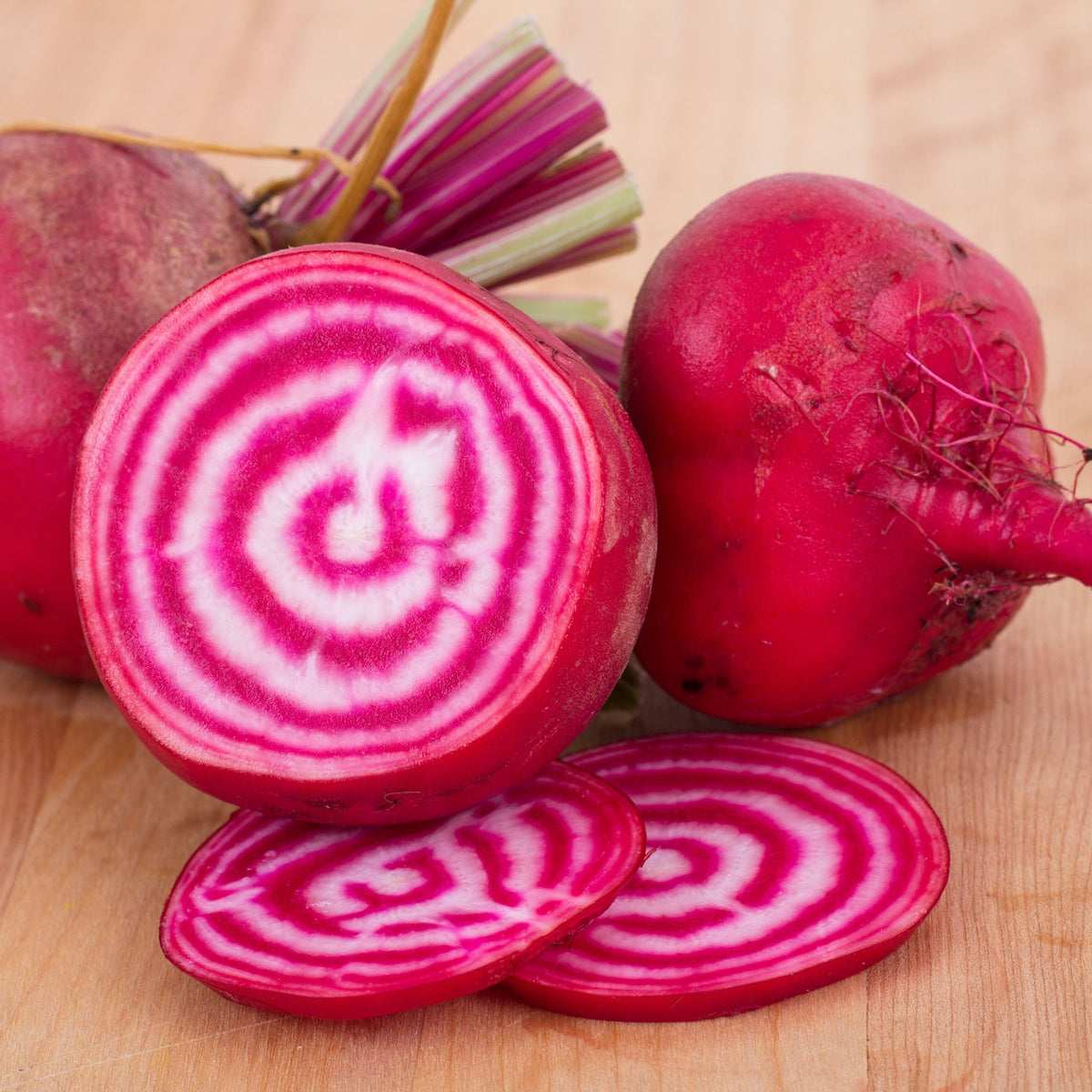
Whole and sliced organic 'Chioggia' beets showing pale red skin, concentric raspberry-pink and creamy-white rings, and edible green leaves with pink-striped stalks in a sunny harvest scene. The image highlights the slightly flattened round shape, smooth skin, regular rings, and delicate colour contrast that distinguish this heirloom variety when freshly cut for serving.

Bloom and dimensions

Size, flowering & harvest

Mature height

30 to 45 cm (12 to 18 in)

Width / spread

10 to 15 cm (4 to 6 in)

Flower color

Inconspicuous green

Foliage color

Green with pink-striped stalks

Foliage type

Green leaves with pink-striped edible stalks when young

Growth rate

Fast to moderate

Growth habit

Upright rosette above a swollen root

Bloom period

'Chioggia' flowers only after shifting away from harvest growth. Keep the root zone evenly moist during bloom. As 'Chioggia' beet bolts, leaf or root harvest quality changes. Good light and airflow help reproductive growth continue. For Chioggia beet, its seed stalk becomes taller and less harvest-focused. Correct heat or cold stress before adding fertilizer. For 'Chioggia', leave selected blooms only when seed or insects matter. Do not treat every fallen blossom as disease. Lengthening days or stress can hasten 'Chioggia' beet's bolting. Remove Chioggia beet before seed disperses if volunteers are unwanted.

Fruiting

The main harvest is a slightly flattened round root with pale red skin and pink-and-white ringed flesh. Each sown cluster may produce several seedlings, but every retained plant forms one root. Begin checking around 55 days and generally harvest at 3 to 7 cm diameter. Cool temperatures support clearer internal colour. In the second year, pollinated flowers produce dry fruits grouped in corky structures containing the seeds. Root size and tenderness depend strongly on spacing, moisture, and temperature.

Harvest

Harvest roots generally around 55 days after sowing depending on desired diameter while they remain firm tender and not woody. Loosen soil before lifting. For greens cut only several young outer stalks at a time and retain enough foliage for root growth. After harvest trim tops while leaving a small crown, rinse or brush, dry the surface, and refrigerate promptly. Discard any slimy mouldy or abnormal-smelling root.
Whole and sliced organic 'Chioggia' beets showing pale red skin, concentric raspberry-pink and creamy-white rings, and edible green leaves with pink-striped stalks in a sunny harvest scene. The image highlights the slightly flattened round shape, smooth skin, regular rings, and delicate colour contrast that distinguish this heirloom variety when freshly cut for serving.

Garden associations

Companion plants & uses

Companion plants

Grow 'Chioggia' near lettuce, radishes, or spinach when those crops will be harvested early enough to avoid competing with developing roots. Their fast growth can use space around young beets. Place taller vegetables to the north so they do not reduce sunlight. Low herbs and flowers may edge the bed, but no companion combination guarantees protection from leaf miners, slugs, or disease. Rely instead on crop rotation, adequate spacing, regular weeding, and easy access for watering and inspection. Keep chard and other beets in the rotation plan because they belong to the same crop group.

Plants to avoid

Pole Bean, Mustard

Garden use

Slice roots raw to reveal their rings in salads and carpaccio, or prepare them as pickles with a tested recipe. Gentle steaming or brief roasting generally retains more contrast than long cooking. Beets can also enrich soup, purée, and vegetable sides. Young green leaves and pink-striped stalks may be eaten raw when tender or cooked briefly like chard. Separate greens after harvest and use them before the roots because they have a shorter storage life. Use damaged roots promptly and discard any tissue that becomes slimy or mouldy.

Recipe idea

From garden to table

Edible parts

Roots, young leaves, and stalks
'Chioggia' beet in the kitchen. Roasted 'Chioggia' beets with sautéed tops — Separate the greens from 600 g beets and wash both parts thoroughly. Wrap similarly sized roots in foil with 15 mL water and roast at 200°C until tender when pierced, generally 35–60 minutes. Let them cool just enough to peel, then cut into wedges. To show the concentric rings, avoid prolonged boiling and toss the cooked roots gently with 15 mL olive oil, 15 mL white-wine vinegar, black pepper, and a small pinch of salt. Slice the washed stems finely and sauté them first in 10 mL oil; add the chopped leaves and cook just until wilted. Arrange the greens on a platter, top with beet wedges, and finish with orange segments and toasted hazelnuts. Serve warm or at room temperature. Keep muddy roots separate from cleaned leaves and ready-to-eat garnishes. Discard slimy tops or roots with deep rot. Refrigerate leftovers promptly in a covered container; the vinegar dressing adds flavour but does not make the dish shelf-stable.
Whole and sliced organic 'Chioggia' beets showing pale red skin, concentric raspberry-pink and creamy-white rings, and edible green leaves with pink-striped stalks in a sunny harvest scene. The image highlights the slightly flattened round shape, smooth skin, regular rings, and delicate colour contrast that distinguish this heirloom variety when freshly cut for serving.

Frequently asked questions

Frequently asked questions

When and how should Chioggia beet be sown?
Direct-sow Chioggia beet 2 to 3 cm (¾ to 1 in) deep in prepared soil. Seed can germinate across approximately 10 to 30 °C (50 to 86 °F), with emergence expected in 7 to 14 days. Keep the seedbed evenly moist so the surface does not crust. Beet seed units can produce closely spaced seedlings, so thin carefully to about 7 to 10 cm apart once they are established; crowded plants cannot develop uniform roots. Use the removed young leaves if they are clean and suitable for the kitchen. A container should be at least 25 to 30 cm deep. The crop is biennial but is normally harvested for its roots, young leaves, and stalks in the first year. Maintain steady moisture as the slightly flattened, ringed roots enlarge, and avoid injuring neighbouring roots during thinning.
Why do several seedlings emerge from one beet cluster?
Chioggia beet seed is usually a corky cluster that can contain more than one viable seed, so a small group of seedlings at one spot is expected. Wait until true leaves are visible, then preserve the strongest rosette and sever the others at the soil line. Scissors are safer than pulling because the keeper's young root must remain undisturbed to form a clean, slightly flattened round beet. Thin the row to about 7–10 cm between plants, water afterward, and keep light reaching every rosette. The removed seedlings may be used as greens only if they are clean, healthy, and sufficiently developed; otherwise compost sound material. Do not apply extra nitrogen as a substitute for spacing, since it may encourage tops without solving root competition. When assessing germination, one planted cluster can legitimately yield several shoots and should not be counted as several sowing points.
When is 'Chioggia' beet ready to harvest?
Chioggia is ready when the exposed shoulder shows the root size and texture you want; the available product facts do not give a verified number of days to maturity. Brush soil gently away from one shoulder without cutting the skin, then lift a sample root if you are unsure. Smaller roots are usually chosen for tenderness, while roots left too long or grown through stress can become coarse. Harvest from moist, workable soil so roots lift without snapping, but avoid digging when the bed is waterlogged. The slightly flattened root has pale red skin and raspberry-pink and creamy-white rings inside, though the internal pattern is confirmed only after cutting. Young leaves and stalks are also edible. Record the sowing and sample dates for your conditions instead of adding an unsupported fixed deadline to future harvests.
Can beet tops be harvested without harming the roots?
Yes, with restraint. Chioggia's young leaves and stalks are edible, but the striped root develops from energy captured by the whole rosette. Once plants are well established, take a single tender outer leaf from selected beets rather than stripping every plant. Leave the centre and most mature foliage untouched, and rotate which rosettes supply greens. When roots are the priority, stop leaf picking as the shoulders begin to swell. Use clean scissors and select only leaves free of mines, spots, rot, or soil contamination. Refrigerate culinary tops promptly; they lose quality sooner than harvested roots. A plant recovering from heat, drought, insect damage, or disease should not be cut again until new leaves expand. Severe or repeated defoliation can delay the ringed beet and reduce its final diameter.
How should beet roots and tops be stored after harvest?
Separate Chioggia tops from the roots soon after lifting so the leaves do not continue drawing moisture from the beet. Cut the foliage while leaving a short stem, taking care not to slice the root crown or skin. Store sound roots and tops separately. Chill clean, dry young leaves and stalks in a ventilated refrigerator container and use them promptly, since they are more perishable than roots. Brush loose soil from roots without scrubbing or washing them before longer storage; wash just before preparation. Keep roots cold and humid in a perforated or otherwise suitable container that prevents condensation from pooling. Label the batch with its harvest date and inspect it regularly. Remove any soft, mouldy, split, or rotting beet immediately so deterioration does not spread to neighbouring roots.

Wildlife and pets

Wildlife & precautions

Supporting wildlife

Chioggia beet is grown for roots and greens during its vegetative stage. A beet retained through its reproductive cycle produces a taller flower stalk, but beet pollination is primarily wind-driven. For a garden intended to support flower-visiting insects, include other flowering plants rather than depending on the beet crop alone.

Seed-starting essentials

Click a product to build your selection.

Your selection

Total