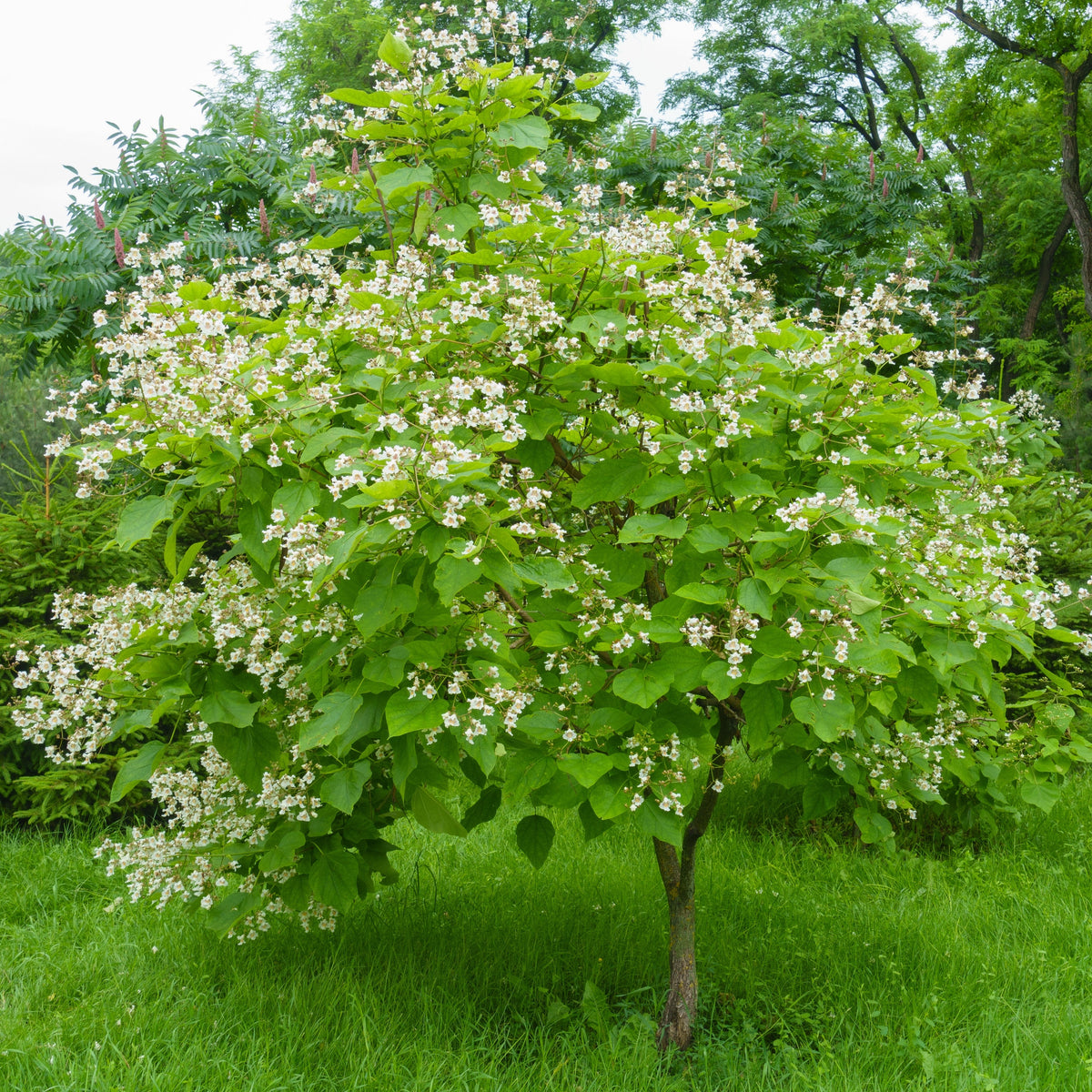
Globe catalpa ‘Nana’ (Catalpa bignonioides ‘Nana’)

Globe catalpa ‘Nana’ grafted on a standard, showing a compact naturally rounded crown of large mid-green heart-shaped leaves. This view shows <em>Catalpa bignonioides</em> ‘Nana’, a Zone 5 deciduous tree whose crown reaches approximately 1.5 to 2.5 m high and wide (5 to 8 ft); total height varies with the graft position.
PÉPINIÈRE.CA

Globe catalpa ‘Nana’ (<em>Catalpa bignonioides</em> ‘Nana’)

BACK-IN-STOCK ALERT

Don’t miss its return.

Leave your email and receive an alert when this product is available again.

An alert for this product only. No newsletter signup. Privacy

Small standard tree with a rounded leafy crown

Pépinière.ca

Sold as 150 cm; 175 cm; 40 mm

Title

Sold out

Pay in 4 interest-free payments withSezzle

Delivery and pickup: view conditions

Product information
Advice adapted to Canada
Secure payment
Share
Common nameGlobe catalpa ‘Nana’; umbrella catalpa; dwarf catalpa
FamilyBignoniaceae
GenusCatalpa
Speciesbignonioides
CultivarNana
Plant typeTREE
Botanical nameCatalpa bignonioides ‘Nana’

Globe catalpa ‘Nana’ (Catalpa bignonioides ‘Nana’) is a small deciduous tree grafted on a standard and valued for its naturally dense, rounded crown. Large, mid-green, broadly heart-shaped leaves create bold texture and welcome summer shade. Unlike the straight species, this dwarf cultivar rarely flowers and generally does not produce long seed pods; its dependable appeal comes from foliage and an even outline. The crown reaches approximately 1.5 to 2.5 m high and wide (5 to 8 ft). Total tree height depends on the graft position because the clear trunk essentially retains the height selected at the nursery.

Plant ‘Nana’ in full sun in a position sheltered from strong wind, which can tear the large leaves. It prefers fertile, moist to moderately moist, well-drained soil but accepts clay, loam, or sand and acidic, neutral, or alkaline pH. Hardy to Zone 5, it suits protected cold-climate sites. Water deeply during establishment and dry periods, then maintain 5 to 8 cm (2 to 3 in) of mulch away from the trunk. Set the root flare at soil level and keep the graft union fully exposed. Avoid standing water, compaction, and piles of salt-laden snow around the trunk or root zone.

Use globe catalpa as a compact specimen, formal accent, entrance tree, courtyard feature, small shade tree, or repeated avenue planting. Its spherical crown suits urban gardens and spaces where a controlled outline is desirable. Light pruning is sufficient: remove dead, damaged, or crossing wood and any vigorous shoot emerging below the graft. Avoid routinely cutting the crown back because repeated heading stimulates weak, coarse shoots. Watch for Verticillium wilt, leaf spots, and catalpa sphinx caterpillars. With drained soil and consistent moisture, ‘Nana’ maintains a crisp architectural silhouette for many years while providing bold foliage without the flower and pod litter associated with the straight species.

In the garden

Exposure
Sun
Hardiness
Zone 5

Planting guide

Planting & establishment

Spacing / density

Allow approximately 2.5 to 3 m (8 to 10 ft) between trunks so crowns measuring 1.5 to 2.5 m (5 to 8 ft) can develop without overlapping. Keep the tree away from walls, wires, signs, and narrow walkways. Clear-trunk height depends on the graft position and changes very little.

Minimum temperature

Approximately -29 °C (-20 °F), Zone 5

Planting period

In spring after the soil thaws, or in early fall at least six weeks before persistent frost

Propagation

Winter grafting onto a <em>Catalpa bignonioides</em> standard

Growing method

Choose a sunny, sheltered position. Dig a hole two to three times wider than the root ball without making it deeper. Set the root flare at soil level and keep the graft union above ground. Backfill with loosened soil, water slowly, and add 5 to 8 cm (2 to 3 in) of mulch without touching the trunk. Stake only if the root ball or standard moves, then remove ties once the tree stands independently. Water regularly during establishment. Promptly remove every shoot emerging from the trunk or roots below the graft because it belongs to the rootstock and can overtake the ‘Nana’ crown.

Soil and care

Soil & care

Soil pH

Acidic, neutral, or alkaline, approximately 5.5 to 8.0

Moisture

Moist soil with dependable drainage; avoid standing water

Minimum temperature

Approximately -29 °C (-20 °F), Zone 5

Care level

Easy

Watering

Moderate watering

Soil type

Neutral, rich and well-drained

Fertilization

In fertile soil, a thin spring compost layer and organic mulch are often sufficient. When a soil test or weak growth indicates a need, apply balanced slow-release fertilizer according to the label. Avoid excessive nitrogen because it produces long tender shoots, distorts the crown, and delays hardening before winter. For best results, inspect soil moisture, the graft union, and foliage response regularly.

Seasonal care

In spring, inspect the root flare, graft union, and remaining ties. Remove rootstock shoots and renew mulch without covering the trunk. In summer, water during dry periods and inspect large leaves after strong wind. Defoliation by catalpa sphinx caterpillars looks dramatic but is rarely fatal on a vigorous tree; avoid unnecessary treatments. In fall, clear leaves from walkways and stop fertilizing early enough for shoots to harden. During dormancy, remove dead, broken, or crossing wood without cutting the whole crown back. In winter, protect the standard from rodents, impacts, and salt-laden snow. For best results, inspect soil moisture, the graft union, and foliage response regularly. This attention preserves the compact tree’s natural crown and lasting vigour. For best results, inspect soil moisture, the graft union, and foliage response regularly. This attention preserves the compact tree’s natural crown and lasting vigour. For best results, inspect soil moisture, the graft union, and foliage response regularly. This attention preserves the compact tree’s natural crown and lasting vigour. For best results, inspect soil moisture, the graft union, and foliage response regularly. This attention preserves the compact tree’s natural crown and lasting vigour. For best results, inspect soil moisture, the graft union, and foliage response regularly. This attention preserves the compact tree’s natural crown and lasting vigour. For best results, inspect soil moisture, the graft union, and foliage response regularly.

Container growing

Container growing

Recommended pot size

At least 75 to 100 L (20 to 26 US gal) for a young tree; planting in the ground is recommended
Permanent container culture is practical only in a very large insulated planter with open drainage holes and a stable base. Provide at least 75 to 100 L (20 to 26 US gal) for a young specimen, then increase volume as the root ball expands. Water more often than in the ground, protect roots from repeated freezing and thawing, and keep the graft union exposed. Planting in the ground remains preferable for durable growth.
Catalpa boule ‘Nana’ (Catalpa bignonioides)

Size, flowering & harvest

Mature height

4 to 5 m (13 to 16 feet)

Width / spread

4 m (13 feet)

Flower color

White marked with yellow and purple; bloom is rare

Foliage color

Mid-green from spring through summer, then yellow in fall

Foliage type

Deciduous; large simple heart-shaped leaves

Growth rate

Moderate

Growth habit

Dense, rounded, spreading crown on a clear standard

Fragrance

No notable ornamental fragrance

Bloom period

‘Nana’ rarely flowers. Do not rely on the large white panicles of the straight species for its ornamental display. In the uncommon event that flowers appear, they are tubular, white, and marked with yellow and purple. The rounded crown, large heart-shaped leaves, and summer shade remain the dependable characteristics of this cultivar. For best results, inspect soil moisture, the graft union, and foliage response regularly.

Fruiting

This cultivar generally produces few or no fruits because it rarely flowers. The long narrow pods typical of <em>Catalpa bignonioides</em> are therefore not a dependable feature of ‘Nana’. An occasional pod may appear after a rare pollinated bloom, but the rounded crown and foliage remain the principal ornamental attractions. For best results, inspect soil moisture, the graft union, and foliage response regularly.
Catalpa boule ‘Nana’ (Catalpa bignonioides)

Garden associations

Companion plants & uses

Companion plants

Pair globe catalpa with hardy geraniums, coral bells, sedges, hostas, ferns, or spring bulbs suited to the available light. Position them beyond the root flare and keep the trunk visible so rootstock shoots are easy to detect. Flexible grasses and narrow conifers contrast effectively with the round crown and large leaves. For best results, inspect soil moisture, the graft union, and foliage response regularly. This attention preserves the compact tree’s natural crown and lasting vigour. For best results, inspect soil moisture, the graft union, and foliage response regularly.

Plants to avoid

Avoid standing water, compaction, extended drought, strong wind, trunk injury, and burial of the graft union. Watch for Verticillium wilt, leaf spots, mildew, dying twigs, and catalpa sphinx caterpillars. Remove shoots below the graft as soon as they appear using a clean tool. For best results, inspect soil moisture, the graft union, and foliage response regularly. This attention preserves the compact tree’s natural crown and lasting vigour. For best results, inspect soil moisture, the graft union, and foliage response regularly.

Garden use

Frame an entrance with two globe catalpas planted at equal distance, or use one specimen to shade a bench in a small courtyard. The dense crown creates a crisp focal point above low perennials. Position hardy geraniums, coral bells, sedges, or spring bulbs beyond the root flare to preserve access to the trunk and graft union. Repeat the rounded form with clipped borders or contrast it with flexible grasses. Allow 2.5 to 3 m (8 to 10 ft) between trunks in a repeated planting. Avoid narrow walkways because leaves are large and branches spread. A permeable mulched surface protects roots from urban heat. For best results, inspect soil moisture, the graft union, and foliage response regularly. This attention preserves the compact tree’s natural crown and lasting vigour. For best results, inspect soil moisture, the graft union, and foliage response regularly. This attention preserves the compact tree’s natural crown and lasting vigour. For best results, inspect soil moisture, the graft union, and foliage response regularly. This attention preserves the compact tree’s natural crown and lasting vigour. For best results, inspect soil moisture, the graft union, and foliage response regularly. This attention preserves the compact tree’s natural crown and lasting vigour.

Frequently asked questions

Frequently asked questions

Does globe catalpa ‘Nana’ produce flowers and pods?
‘Nana’ rarely flowers, unlike the straight species with its large white panicles, so this cultivar should not be selected for bloom. Because pods develop after pollinated flowers, they are generally absent as well. An occasional bloom or pod remains possible on a mature specimen but is not guaranteed. Dependable interest comes from the dense naturally rounded crown and large green heart-shaped leaves. The usual absence of pods also reduces long hanging debris. For a flowering effect, add perennials or spring bulbs beneath the crown but beyond the root flare, where planting will not injure the trunk or graft union. For best results, inspect soil moisture, the graft union, and foliage response regularly.
How tall does a globe catalpa grafted on a standard become?
The ‘Nana’ crown reaches approximately 1.5 to 2.5 m high and wide (5 to 8 ft). Total tree height, however, depends on graft height. The clear trunk changes very little; most future growth occurs within the crown. A tree grafted at 150 cm will therefore not finish at exactly the same total height as one grafted at 175 cm. Check the selected nursery format and roughly add clear-trunk height to the mature crown height. Allow enough clearance for spreading branches, overhead wires, walls, vehicles, and walkways before choosing the final planting position. For best results, inspect soil moisture, the graft union, and foliage response regularly.
Should globe catalpa be pruned every year?
Severe annual pruning is unnecessary because ‘Nana’ naturally develops a rounded crown. During dormancy, remove only dead, broken, diseased, or crossing wood, then eliminate every shoot growing from the trunk or below the graft union. These shoots belong to the rootstock and can become more vigorous than the selected crown. Avoid cutting every branch back to the same length because this practice stimulates clusters of weak, coarse shoots. When shape correction is truly needed, make a few targeted cuts with clean tools. Correct placement, adequate clearance, regular watering, and protection from wind reduce pruning needs more effectively than repeated intervention.
Where should globe catalpa ‘Nana’ be planted?
Choose a full-sun position sheltered from strong wind that can tear the large leaves. Soil may be clay, loam, sand, or chalk, but it should remain fertile, moist, and well drained. Keep the root flare at soil level and the graft union exposed. Allow approximately 2.5 to 3 m (8 to 10 ft) between trunks when several trees are repeated. Keep the crown clear of wires, walls, signs, vehicles, and narrow walkways. A courtyard, entrance, small lawn, or avenue can work well as long as roots receive a permeable, uncompacted soil area and consistent moisture during establishment. For best results, inspect soil moisture, the graft union, and foliage response regularly.
Why are shoots growing below the graft union?
Shoots emerging from the trunk or roots below the graft belong to the Catalpa bignonioides rootstock, not to the dwarf ‘Nana’ cultivar. They can grow quickly, develop a different form, and eventually overtake the rounded crown. Remove them promptly with a clean cut at their point of origin without leaving a stub or injuring the trunk. Inspect several times during the growing season, especially after stress, pruning, or physical damage. Never bury the graft union with soil or mulch. A shoot arising above the graft normally belongs to ‘Nana’ and should be evaluated differently before it is removed. For best results, inspect soil moisture, the graft union, and foliage response regularly.

Wildlife and pets

Wildlife & precautions

Attracts birds

Yes

Supporting wildlife

Although ‘Nana’ rarely flowers, its foliage can host catalpa sphinx caterpillars, which form part of the food chain for birds and bats. A dense crown also offers temporary perching structure. Tolerate some chewed leaves when the tree remains vigorous and avoid broad-spectrum insecticides. For best results, inspect soil moisture, the graft union, and foliage response regularly.

Complete your purchase

Click a product to build your selection.

Your selection

Total