Sale
Sold out

Bare seeds
Euphorbiaceae
Ornamental flowers seeds
Gibsonii castor bean (Ricinus communis)
Product code : 61-6730-010
Gibsonii castor bean is a fast-growing tropical annual valued for large dark-red palmate leaves and decorative red seed capsules. W.H. Perron lists an approximate height of 150 cm and a 90 cm spread. The packet contains approximately 7 bare seeds. Sow indoors 2 to 3 weeks before outdoor planting in individual containers and maintain 21 to 22°C. Germination takes 6 to 12 days. Transplant 7 to 10 days after the last ground frost in full sun and rich, moist, well-drained soil. Every part of the plant is highly poisonous, especially the ricin-containing seeds. Keep seed and plants out of reach of children and animals, wear gloves, and never eat, crush, or chew the seeds. Remove developing capsules before maturity when preventing seed access is necessary.
- Quantity
- Approximately 7 bare seeds
- Exposure
- Full sun
- Life cycle
- Annual
Discover the plant
Common nameGibsonii castor bean
FamilyEuphorbiaceae
GenusRicinus
Speciescommunis
CultivarGibsonii
TypeBare seeds
Botanical nameRicinus communis
Gibsonii castor bean (Ricinus communis) is a fast-growing tropical annual valued for dramatic foliage. W.H. Perron lists an approximate height of 150 cm and a spread of 90 cm. Large dark-red palmate leaves, coloured stems, and red seed capsules give sunny garden beds an exotic silhouette. Plants may be used individually as focal points or repeated as a seasonal screen. They are frost tender and are grown as annuals in Canadian climates with cold winters. Their architectural shape remains prominent throughout the warm outdoor growing season for maximum visual impact.
The W.H. Perron packet, product code 61-6730-010, contains approximately 7 bare seeds. Sow indoors 2 to 3 weeks before outdoor planting in individual containers, using one or two seeds per container. Maintain 21 to 22°C and even moisture without saturation. Germination takes 6 to 12 days. Harden young plants gradually, then transplant 7 to 10 days after the last ground frost in full sun and rich, moist, well-drained soil. Allow about 90 cm for the mature spread and stake plants where strong wind could bend the tall stems.
Warning: every part of castor bean is highly poisonous, especially the seeds, which contain ricin. Never eat, crush, or chew the seeds. Keep the packet, seedlings, and plants out of reach of children and animals. Wear gloves while sowing, handling plants, or removing capsules, then wash hands and clean tools. Select a location inaccessible to young children and pets. If ingestion or a concerning exposure occurs, immediately contact a poison centre, physician, veterinarian, or emergency service. Keep the original packet available to identify the plant and product accurately during an emergency.

Sowing guide
It all startswith a seed.
Sowing depth
One or two seeds per individual container, covered with approximately 2 to 3 cm of mix
Spacing / density
Allow approximately 90 cm between plants based on mature spread
Germination temperature
21 to 22°C
Germination time
6 to 12 days
Sowing period
Indoors, 2 to 3 weeks before outdoor planting; transplant 7 to 10 days after the last ground frost
Propagation
Seed
Growing method
Keep Gibsonii castor bean seeds securely stored in their labelled packet, out of reach of children and animals. Wear gloves and prepare a washable work surface. Two to three weeks before outdoor planting, fill individual containers with clean, well-drained seed-starting mix. Sow one or two seeds per container, cover with approximately 2 to 3 cm of mix, and maintain 21 to 22°C. Keep the medium evenly moist but never saturated. Germination takes 6 to 12 days. Never taste, crush, or chew the seeds. After emergence, place seedlings in abundant light and remove the weaker plant without unnecessarily handling any remaining seed. Harden young plants gradually for about one week. Transplant 7 to 10 days after the last ground frost when nights have warmed. Choose full sun and rich, moist, loose, well-drained soil. Space plants approximately 90 cm apart. Water at soil level to maintain consistent moisture, then feed moderately during active growth. Stake stems where wind exposure could bend them. Remove capsules before maturity if seeds could become accessible. Wear gloves for every handling task, wash hands, and clean tools. At the end of the season, dispose of plants and every seed carefully without leaving material in an accessible area.
Soil and care
The right care,at the right time.
Soil pH
Rich, fertile, well-drained soil; exact pH not published
Minimum temperature
Frost tender; transplant only after all frost risk
Care level
Moderate because of toxicity precautions
Watering
Keep the seed-starting mix evenly moist during germination without saturating it. After transplanting, water deeply at soil level to moisten the entire root zone. Check the soil before each application and water when the surface begins to dry. Gibsonii castor bean grows rapidly and has low tolerance for extended drought, especially before establishment. Reduce frequency after substantial rain, however, and never leave a container or garden bed in standing water.
Soil type
Gibsonii castor bean prefers rich, fertile, loose, well-drained soil that retains consistent moisture without remaining waterlogged. Incorporate mature compost before planting where soil is poor. Avoid low spots where water accumulates and heavily compacted ground. A location sheltered from strong wind also helps the 150 cm stems remain upright. W.H. Perron does not publish an exact soil pH for this product.
Fertilization
Enrich the soil with mature compost before planting. Once active growth resumes, use a balanced fertilizer strictly according to its label rate. Regular nutrition supports large leaves and rapid growth, but excessive nitrogen can produce softer stems that are more vulnerable to wind. In containers, feed at a measured rate and occasionally water with clear water to limit salt accumulation. Stop fertilizing when growth slows near the end of the season.
Moisture
Consistent moisture without saturation; low drought tolerance before establishment
Seasonal care
In spring, keep Gibsonii castor bean seeds securely stored and sow indoors only 2 to 3 weeks before outdoor planting. Use individual containers, gloves, and a washable surface. Maintain 21 to 22°C and consistent moisture until germination, which takes 6 to 12 days. Then provide abundant light and rotate containers to keep stems upright. Harden plants gradually and transplant 7 to 10 days after the last ground frost. During summer, keep soil moist without saturation, feed moderately, and monitor stem stability. A stake may be useful in a windy location. Inspect foliage during hot, dry weather because spider mites may appear on stressed plants. Remove damaged leaves while wearing gloves. As soon as capsules develop, determine whether they can remain without creating an access risk. Remove them before maturity whenever a child, animal, or visitor could reach the seeds. Never leave capsules or seed on the ground. In autumn, before frost, remove the plant carefully while wearing gloves. Collect every seed, place debris in a closed container according to local disposal guidance, and do not add it to accessible compost. Wash hands, clean tools, and return unused seed to secure labelled storage away from food. Clean pots and stakes before storing them, and inspect the former planting area again carefully after wind or rain and before winter cleanup ends.
Container growing
A garden,within reach.
Recommended pot size
Large stable 45 to 60 cm container with drainage, positioned out of reach
Gibsonii castor bean can grow in a large, stable container when positioned in an area inaccessible to children and animals. Choose a pot at least 45 to 60 cm wide, heavy enough to support an approximately 150 cm plant, with several drainage holes. Fill it with rich, well-drained potting mix. Sow in a small individual container indoors, then transplant the intact root ball after hardening and all frost risk. Place the pot in full sun, sheltered from strong wind, and install a sturdy stake at planting time. Check moisture daily during hot periods, but water only when the surface begins to dry. Irrigate until excess drains, then empty the saucer. Feed with a balanced product according to its label without exceeding the rate. Wear gloves while watering near foliage, staking, pruning, or removing capsules. Never place the pot on a patio, entrance, or play area where seed could be touched. Remove capsules before maturity and immediately collect any fallen seed. At the end of the season, dispose of the plant and mix safely; do not reuse that mix for edible container crops. Clean the saucer, stake, and tools before storing them.

Bloom and dimensions
Its place,in your garden.
Mature height
150 cm (59.1 in)
Width / spread
90 cm (35.4 in)
Foliage color
Dark red to purple
Foliage type
Large glossy palmate leaves
Growth rate
Rapid
Growth habit
Tall, upright, branching, and tropical
Fragrance
No particular fragrance confirmed
Bloom period
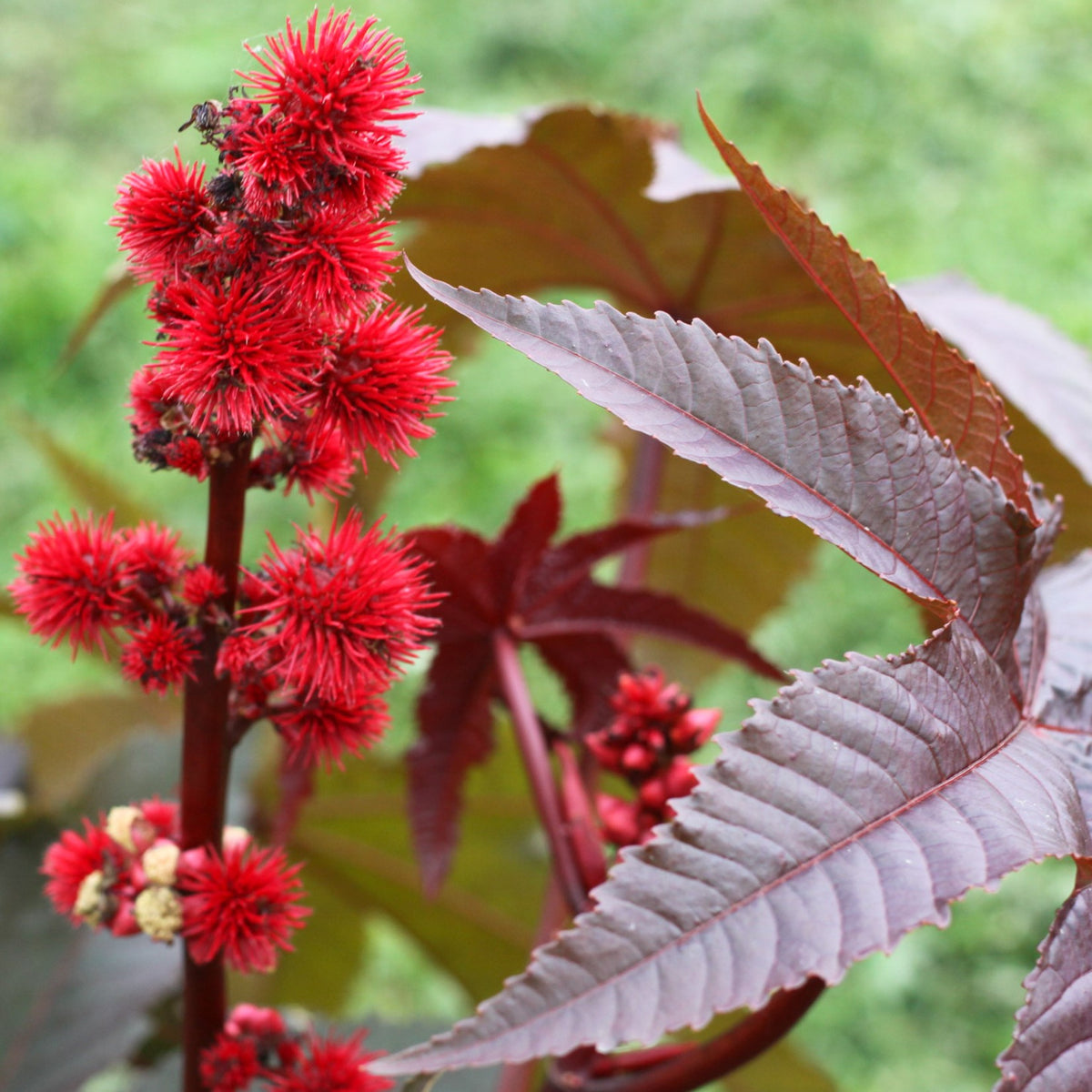
Gibsonii castor bean is grown primarily for foliage. During summer, it forms spikes of small petal-free flowers followed by decorative red spiny capsules. Male and female flowers occur on the same spike. Production varies with sowing date, warmth, and the length of the season. Remove capsules before maturity whenever the highly poisonous seeds could become accessible to children, animals, or visitors. Wear gloves and place removed material directly in a closed container.
Fruiting
After flowering, the plant produces round, red, densely spined capsules. Each capsule may contain mottled seeds that are highly poisonous. Their value is ornamental only; they are never edible. Remove capsules with gloves before maturity whenever a person or animal could reach them. Place removed capsules directly in a closed container, collect every fallen seed, and clean tools after the work is complete.
Days to maturity
8 to 12 weeks
Garden associations
In goodcompany.
Companion plants
Combine Gibsonii castor bean with full-sun annuals that prefer rich, well-drained soil only in an area inaccessible to children and animals. Silver, green, or chartreuse foliage highlights its large dark-red leaves. Position lower companions in front without blocking access for staking, watering, or capsule removal. Avoid edible plants, vegetable beds, culinary herbs, and dense groundcovers that could conceal fallen seeds. Keep the surface around the plant visible and easy to inspect so every capsule or seed can be collected promptly.
Frequently asked questions
Your questions,answered.
What is in a Gibsonii castor bean packet?
The W.H. Perron packet, product code 61-6730-010, contains approximately 7 bare Gibsonii castor bean seeds. “Bare” means the seeds are sold without a listed coating; the official page does not present them as organic, treated, or primed. Keep the packet closed, clearly labelled, and securely stored away from food, children, and animals. Ricinus communis seeds contain ricin and are highly poisonous when chewed, crushed, or swallowed. Never use them for jewellery, crafts, home remedies, or food. Wear gloves while sowing, wash hands thoroughly, and clean the work surface and tools after handling. Keep the original label with every container throughout the growing season.
How should castor bean be sown carefully?
Keep the seeds securely stored until sowing and prepare a washable surface out of reach of children and animals. Wear gloves. Sow indoors 2 to 3 weeks before outdoor planting, using one or two seeds per individual container, then cover with approximately 2 to 3 cm of mix. Maintain 21 to 22°C and even moisture without saturation; germination takes 6 to 12 days. Never file, crush, chew, or taste the seeds. After emergence, provide abundant light, harden plants gradually, and transplant 7 to 10 days after the last ground frost into a secure full-sun location. Wash hands and clean all tools and surfaces immediately after sowing.
What size and appearance should be expected?
W.H. Perron lists an approximate height of 150 cm and a spread of 90 cm for Gibsonii castor bean. The plant rapidly develops an upright, branching habit, large dark-red palmate leaves, and coloured stems. Small petal-free flowers appear on spikes, followed by red spiny capsules when conditions permit. Its tropical appearance suits a full-sun focal point or seasonal screen. Allow the full mature space at planting time and provide a stake in windy locations. Capsules and seeds are highly poisonous; remove them before maturity whenever they could become accessible and always wear gloves. Collect every fallen seed immediately and keep the planting area visible.
What care supports healthy growth?
Grow Gibsonii castor bean in full sun and rich, fertile, moist, well-drained soil. Water deeply at soil level when the surface begins to dry without allowing standing water. Incorporate mature compost before planting and then use a balanced fertilizer according to its label. Stake stems in a wind-exposed location. The plant generally has few problems, but spider mites may appear during hot, dry periods. Inspect leaf undersides and correct water stress first. Wear gloves for every maintenance task. Remove capsules before maturity whenever the seeds could be reached, then place debris directly in a closed container. Collect fallen material promptly and wash hands after completing the work.
Why is castor bean highly poisonous?
Every part of Ricinus communis is poisonous, but the seeds are especially dangerous because they contain ricin. Chewing or crushing can release this toxin. Ingestion may cause nausea, vomiting, abdominal pain, diarrhoea, severe weakness, and potentially life-threatening complications. Contact with the plant may also irritate the skin of sensitive people. Do not induce vomiting or attempt a home remedy. Following ingestion, a chewed seed, or any concerning exposure, immediately contact a poison centre, emergency medical service, or veterinarian. Keep the packet available so the botanical name and product code can be provided. Never wait for symptoms before seeking expert guidance about a suspected exposure.
Wildlife and pets
Life,around your plants.
Supporting wildlife
No particular wildlife value is confirmed for Gibsonii. The priority is preventing access to seed and capsules because every part is poisonous to people and animals. Do not use this plant to attract wildlife. Remove capsules before maturity whenever pets or wild animals could reach the seeds, and collect any fallen seed immediately while wearing gloves.
For a great start to your seeds
The right extras.Right here.
Seed Starting Soil
Shop the collectionSeed starting supplies
Shop the collection