Sale
Sold out

Seeds
Ranunculaceae
Organic seeds
Love-in-a-mist organic
Nigella damascena
Product code : TOURNE-0103
Love-in-a-mist produces sky-blue flowers held in feathery foliage, followed by inflated pods that remain decorative long after bloom. This organic, open-pollinated annual is easy to direct sow in spring and reaches about 20 to 50 cm tall. It suits borders, naturalized beds, and fresh or dried arrangements. Each packet contains approximately 150 seeds. Repeat sowings every two to four weeks to extend the flowering season. This is an ornamental species and should not be confused with culinary black cumin, Nigella sativa. The airy plants combine especially well with other cottage-garden annuals and remain attractive as their unusual pods develop.
- Quantity
- 150 seeds
- Exposure
- Full sun
- Life cycle
- Annual
Discover the plant
Common nameLove-in-a-mist
FamilyRanunculaceae
GenusNigella
Speciesdamascena
CultivarLove-in-a-Mist
TypeSeeds
Botanical nameNigella damascena
Reproducible seedsYes
Love-in-a-mist organic (Nigella damascena) is an organic, open-pollinated annual valued for sky-blue flowers framed by finely divided, lace-like foliage. After bloom, inflated purple-striped seed pods extend its ornamental season and add distinctive texture to fresh or dried arrangements. Easy to grow, this cool-season flower suits borders, naturalized beds, pollinator gardens, and cutting patches. Each packet contains approximately 150 seeds. Ferme Tourne-Sol lists about 70 days to maturity, a useful guide that may shift with sowing time, local temperatures, and the conditions in each Canadian home garden and growing season.
For best results, direct sow in spring as soon as the soil can be worked because love-in-a-mist prefers minimal root disturbance. Cover seeds with about 3 mm of soil and keep the surface evenly moist until germination, usually within 7 to 14 days. Thin seedlings to 15 or 20 cm apart. Choose full sun and ordinary, loose, well-drained soil. Repeat sowings every two to four weeks to extend the display. Plants tolerate cool conditions and light frost, but flowering may slow during intense summer heat. Avoid waterlogged soil and heavy feeding, which can produce soft growth rather than sturdy flowering stems.
Reaching 20 to 50 cm tall, love-in-a-mist develops branching stems that mingle naturally with other annual flowers. Cut stems as buds begin to open for fresh arrangements, or leave the pods to mature for their sculptural shape before harvesting and drying them. Plants may self-sow when ripe capsules remain in the garden. This ornamental species should not be confused with culinary black cumin, Nigella sativa. As a precaution, the seeds and other parts of Nigella damascena are not recommended for eating. Its best uses are ornamental: blue summer flowers, airy texture, pollinator interest, and decorative seed pods.

Sowing guide
It all startswith a seed.
Sowing depth
3 mm (1/8 in)
Spacing / density
15 to 20 cm (6 to 8 in) between plants
Germination temperature
13 to 18°C
Germination time
7 to 14 days; sometimes slower in cold soil
Sowing period
Spring, as soon as soil can be worked; repeat every 2 to 4 weeks
Propagation
Direct sowing
Growing method
Direct sow love-in-a-mist in its final location in spring as soon as the soil can be worked. This cool-season annual tolerates light frost and does not need summer heat to begin growing. Make a shallow furrow, scatter the seeds, and cover them with about 3 mm of fine soil. Keep the seedbed evenly moist until emergence, usually within 7 to 14 days. Once seedlings are large enough to handle, thin them to 15 or 20 cm apart. Love-in-a-mist prefers minimal root disturbance, so direct sowing is easier than transplanting. Choose a sunny site with loose, well-drained soil. Avoid nitrogen-rich fertilizer, which can encourage soft foliage at the expense of sturdy flower stems. Repeat sowings every two to four weeks for a longer sequence of blooms and pods. During dry weather, water slowly at soil level, then let the surface dry slightly. After flowering, cut closed pods for arrangements or leave a few to ripen if self-sowing is welcome. Label the sowing clearly so this ornamental species is never confused with culinary black cumin. If heavy rain crusts the surface before emergence, loosen it gently without uncovering the seeds. Remove faded plants only after deciding whether decorative pods or natural reseeding are wanted.
Soil and care
The right care,at the right time.
Care level
Easy
Watering
Keep the surface evenly moist during germination without saturating it. Once plants are established, water when the top few centimetres of soil begin to dry. A slow, deep soaking encourages deeper roots and better resilience during warm days. Direct water at soil level to protect blooms and reduce splashing. Container-grown plants require more frequent moisture checks. Avoid frequent shallow splashes once roots are established because they encourage surface rooting and less resilient growth.
Soil type
Love-in-a-mist grows in ordinary, loose, well-drained soil. Moderate fertility is enough; overly rich compost or nitrogen fertilizer can produce abundant foliage and fewer sturdy stems. Loosen the surface before sowing and remove large clods. In heavy soil, incorporate mature organic matter to improve structure without creating a constantly wet seedbed. A slightly firm seedbed helps the small seeds maintain contact with moisture while still allowing young roots to penetrate easily.
Fertilization
This annual generally performs well in soil of average fertility. A light addition of mature compost before sowing is enough in most gardens. Avoid nitrogen-rich fertilizer, which encourages soft foliage and can reduce stem quality. In containers, apply a half-strength balanced feed only if growth becomes pale or noticeably slows. Healthy green plants with steady flowering usually need no additional feeding during their short seasonal cycle.
Seasonal care
In spring, prepare a fine, well-drained surface and direct sow as soon as the soil can be worked. Maintain moisture until emergence and thin early to leave 15 to 20 cm between plants. Repeat small sowings every two to four weeks if you want a longer sequence of flowers and pods. During growth, hand-weed carefully to avoid disturbing shallow roots. Water deeply in dry weather, especially while buds form, but always allow excess water to drain. Staking is rarely needed in a sheltered site; in a windy location, grow plants in a group so neighbouring stems support one another. Cut flowering stems when the first buds begin to open. For dried arrangements, wait until pods are fully formed but still green and firm. Leave a few capsules to ripen only where self-sowing is welcome. At the end of the season, remove plants or keep their dry silhouettes temporarily for structure and seed-eating birds. Watch young sowings after pounding rain because a surface crust can interfere with emergence. Loosen only the soil between rows and avoid touching the roots. As temperatures rise, a very thin mulch can stabilize moisture, but keep plant crowns uncovered. Label the planting if other Nigella species grow nearby. Harvested seed should be stored only for future sowing and never used as a spice. Before winter, clean containers, discard any diseased plants, and store thoroughly dry seed in a dated envelope. Review which sowing dates produced the longest display, then use those notes to plan next season.
Container growing
A garden,within reach.
Recommended pot size
10 to 15 L (2.5 to 4 gal) or larger, with drainage
Love-in-a-mist can grow in a container when the pot is wide enough for several plants without crowding them. Choose a container holding at least 10 to 15 L with effective drainage holes and fill it with a light potting mix. Sow directly in the pot because young roots dislike disturbance. Cover seeds with 3 mm of mix and keep the surface moist until emergence. Thin seedlings to about 15 cm apart for stronger stems and good air movement. Place the container in full sun. During hot or windy weather, check moisture daily and water until excess drains away. Do not leave the pot standing in a water-filled saucer. Only light feeding is needed; too much nitrogen encourages foliage instead of flowers. To extend the display, sow a second small group two or three weeks after the first. After bloom, keep the pods for their decorative shape or cut and dry them for arrangements. Rotate the container a quarter turn each week when light comes mainly from one direction. Remove collapsed stems after heavy rain, and keep only as many ripening pods as desired. A surface layer of fine gravel can reduce splashing without holding excess moisture against the stems.

Bloom and dimensions
Its place,in your garden.
Mature height
20 to 50 cm
Width / spread
15 to 25 cm
Flower color
Sky blue
Foliage color
Medium green
Foliage type
Herbaceous, finely divided
Growth rate
Fast
Growth habit
Upright, branching, and airy
Bloom period
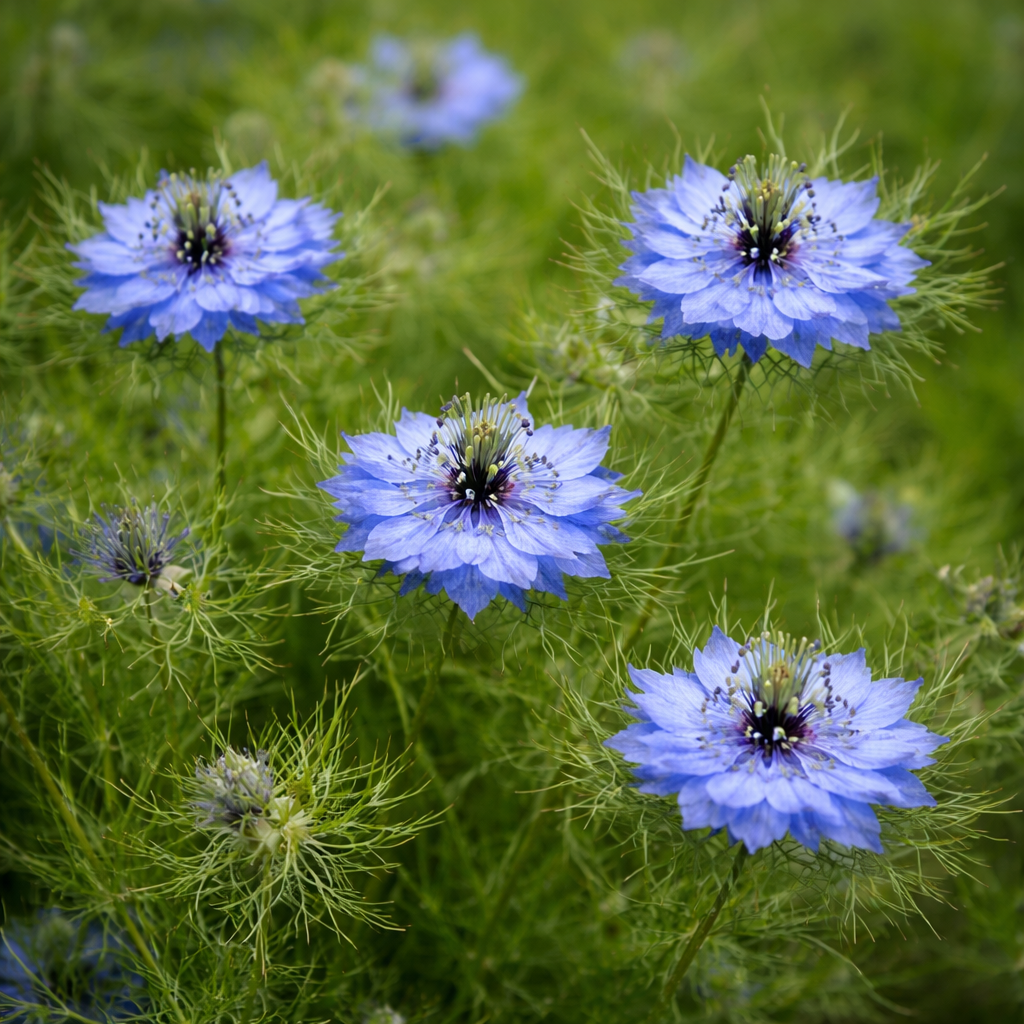
Flowers appear about 70 days after sowing under suitable conditions. They are typically sky blue, with five petal-like sepals surrounded by very fine bracts. Exact timing changes with weather and staggered sowings. Cut stems as the first buds begin to open for fresh arrangements. Allowing some flowers to mature produces the characteristic ornamental pods. Staggered sowings are the simplest way to maintain blooms over a longer period.
Days to maturity
70 days
Garden associations
In goodcompany.
Companion plants
Pair love-in-a-mist with cool-season annuals and flowers that share its need for sun and drainage. Cosmos, cornflowers, poppies, calendulas, and zinnias provide colour contrast and useful bouquet stems. Position taller species behind it so light still reaches its fine foliage. These combinations are ornamental rather than protective, so always leave enough room for air movement and access to water. Staggering love-in-a-mist among these companions extends the textural effect and prevents the border from peaking all at once. This keeps maintenance simple.
Frequently asked questions
Your questions,answered.
How and when should love-in-a-mist be sown?
Direct sow in spring as soon as the soil can be worked. Love-in-a-mist tolerates cool conditions and light frost, and its roots prefer not to be transplanted. Cover seeds with about 3 mm of fine soil, then keep the surface moist without saturating it. Germination usually occurs within 7 to 14 days but may take longer in cold soil. Thin seedlings to leave 15 to 20 cm between plants. Repeat sowings every two to four weeks for a longer succession of flowers and decorative pods. Label the row so the seedlings and species remain easy to identify, especially when other annual flowers are sown nearby.
Is love-in-a-mist edible?
No. This page concerns Nigella damascena, an ornamental species grown for flowers and decorative pods. It should not be confused with Nigella sativa, or black cumin, whose seeds are used in cooking. University horticultural sources do not consider love-in-a-mist edible, and its seeds contain the alkaloid damascenine. As a precaution, do not eat the seeds or other plant parts. Use it in beds, fresh bouquets, and dried arrangements, and wash your hands after handling if your skin is sensitive. Keep the packet and any harvested seed away from children and pets, and label saved seed clearly for propagation only.
When does love-in-a-mist flower?
Ferme Tourne-Sol lists approximately 70 days to maturity. Depending on sowing date and weather, flowers generally appear from late spring through midsummer. The plant prefers cool conditions, and intense heat can shorten or slow the display. For a longer succession, make small sowings every two to four weeks instead of one large sowing. Cut some stems as the first buds open for bouquets, then allow others to develop their inflated ornamental pods. Individual plants have a relatively short flowering window, which is why staggered sowings provide a more reliable continuous display. Watch developing buds regularly and harvest promptly for the longest vase life.
Can love-in-a-mist be grown in a container?
Yes. Choose a wide container holding at least 10 to 15 L with drainage holes and fill it with a light potting mix. Sow directly in the container to avoid disturbing the roots. Cover seeds with 3 mm of mix, maintain moisture until emergence, then thin seedlings to about 15 cm apart. Place the pot in full sun and water deeply when the surface begins to dry. During hot or windy weather, check moisture daily. Only light feeding is needed because excess nitrogen favours foliage instead of flowers and sturdy stems. Several plants grouped in one wide pot create a more natural display and help neighbouring stems support one another.
Are these seeds organic and open-pollinated?
Yes. Ferme Tourne-Sol presents this love-in-a-mist seed lot as organic and open-pollinated. Leave a few pods to mature fully, cut them as they brown, and dry them in an airy place before removing the seeds. Store seed in a clearly labelled envelope in a cool, dry, dark location. Self-sowing is also possible when ripe pods remain in place. Harvested seed is intended only for propagation; it is not recommended for eating and must not be confused with culinary seed from Nigella sativa. Always label the envelope with the botanical species and harvest year so it cannot be mistaken for a culinary seed.
Wildlife and pets
Life,around your plants.
Reported toxicity
Yes
Supporting wildlife
Open flowers provide pollen and nectar for visiting insects, including bees. After bloom, ripe pods may also offer seed to birds when left standing in the garden. Activity varies with weather, region, and the diversity of flowers growing around the planting. Local plant diversity strongly influences which species will appear and how often they visit.
For a great start to your seeds
The right extras.Right here.
Seed Starting Soil
Shop the collectionSeed starting supplies
Shop the collection