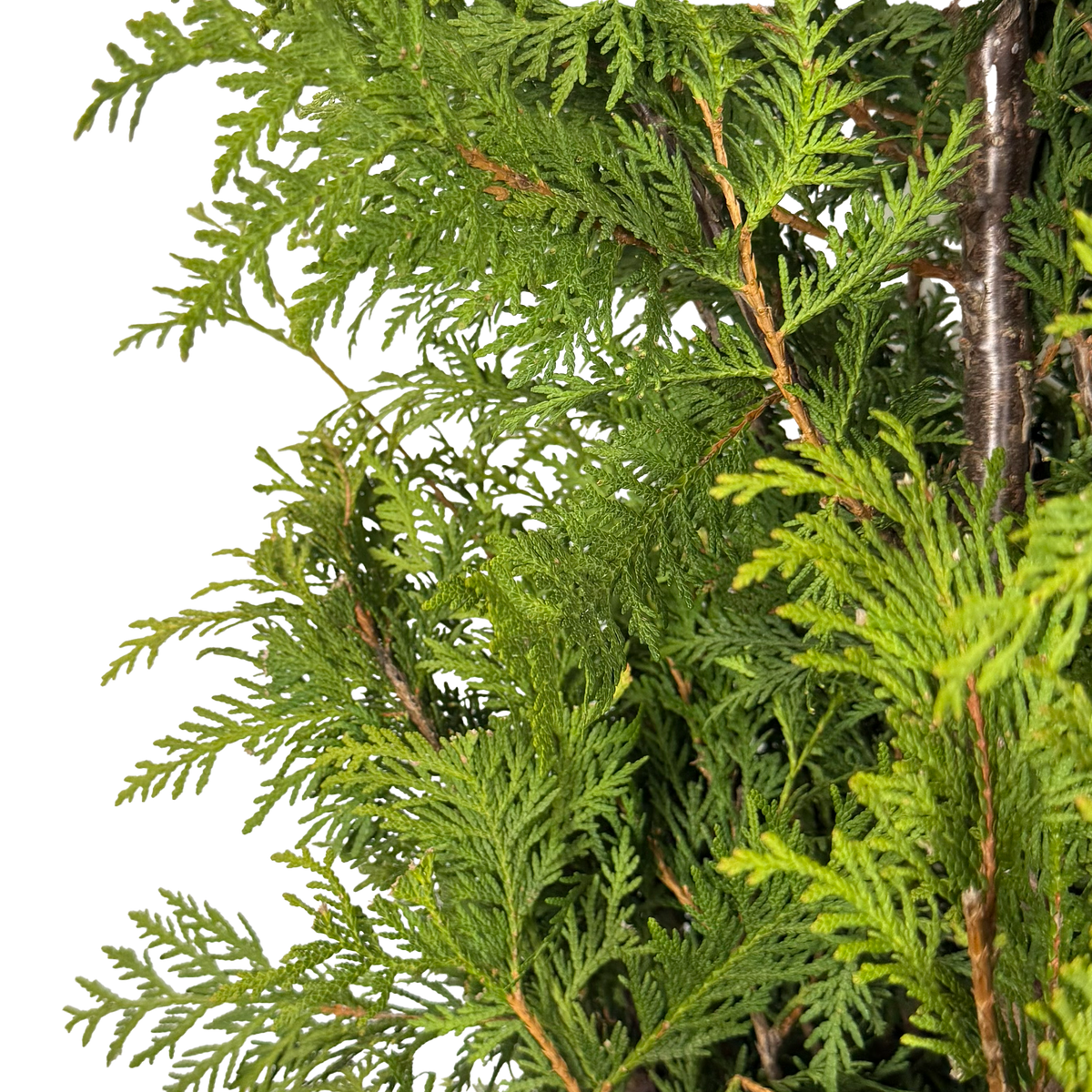
Thuja occidentalis 'Nigra'

Thuja occidentalis 'Nigra'
PÉPINIÈRE.CA

Thuja occidentalis 'Nigra'

BACK-IN-STOCK ALERT

Don’t miss its return.

Leave your email and receive an alert when this product is available again.

An alert for this product only. No newsletter signup. Privacy

Shrubs

Pépinière.ca

Sold as Trees and shrubs

Height

Available in store only

Pay in 4 interest-free payments withSezzle

Delivery and pickup: view conditions

Product information
Advice adapted to Canada
Secure payment
Share
Common nameBlack cedar
FamilyCupressaceae
GenusThuja
Speciesoccidentalis
CultivarNigra
Plant typeConiferous
Botanical nameThuja occidentalis 'Nigra'

Black cedar (Thuja occidentalis 'Nigra') is an evergreen conifer with a narrow, dense and regular pyramidal habit, especially valued for deep green foliage that maintains good colour through winter. Flattened sprays carry tightly arranged scale-like leaves, giving the plant a uniform texture and strongly structured silhouette. Small brown cones may appear toward the end of the growing season. With a moderate to moderately fast growth rate, this cultivar can reach approximately 8 m (26 ft) tall and 2 m (7 ft) wide at maturity. Hardy to Zone 3, it performs well in cold climates and provides consistent ornamental structure throughout the year.

Black cedar grows in sun to partial shade, generally developing its densest growth where light is abundant. It prefers moist to moderately moist, fertile and well-drained soil, although it adapts to several soil textures when moisture remains reasonably consistent. Deep watering is especially important during the first growing seasons and for newly planted hedges. Organic mulch helps conserve moisture and protect the shallow root system. A conifer fertilizer can be applied in spring when soil conditions or growth indicate a need. In Quebec, adequate watering before freeze-up and protection from de-icing salts can help maintain healthier winter foliage, particularly in exposed residential settings where drying winds and salt spray may otherwise create stress.

Because of its upright growth and dense evergreen foliage, this cedar is particularly well suited to privacy hedges, screening, rows and year-round structural plantings. It can also serve as a vertical accent where a full hedge is not required. Its dark green mass provides an effective backdrop for flowering shrubs, perennials and ornamental grasses. The persistent branches offer cover for some birds and small animals, especially during winter. For a uniform hedge, spacing should reflect the mature width and desired speed of closure. When trimming, maintaining a slightly broader base than top allows more light to reach lower branches, helping preserve foliage density from ground level upward as the hedge matures.

In the garden

Exposure
Sun
Hardiness
Zone 3

Planting guide

Planting & establishment

Spacing / density

For hedging, generally space plants about 75 cm to 1 m (30 to 39 in) apart depending on starting size and desired speed of canopy closure.

Minimum temperature

Approximately −40 °C

Planting period

Spring or early autumn, when soil is cool and roots can establish before periods of intense heat or winter freezing.

Propagation

Vegetative propagation is used to preserve the habit, density and foliage colour characteristic of the 'Nigra' cultivar.

Soil and care

Soil & care

Soil pH

Slightly acidic to slightly alkaline

Moisture

Consistent to moderate soil moisture without prolonged drought or constant saturation; mulch helps stabilize conditions around the shallow root system.

Minimum temperature

Approximately −40 °C

Care level

Easy

Watering

Regular watering

Soil type

Acidic to slightly acidic, moist to well-drained

Fertilization

Apply conifer fertilizer in spring only when needed, particularly where soil is poor or annual growth appears insufficient.

Seasonal care

In spring, inspect plants after snowmelt and remove broken, dried or severely damaged shoots. Check soil moisture and renew mulch when needed without piling it against the trunks. Conifer fertilizer can be applied when annual growth is weak or soil fertility is inadequate. In early summer, trim lightly to maintain an even hedge, keeping the base slightly broader than the top so sunlight continues reaching the lower foliage. Avoid deep cuts into old brown wood. During hot weather, water deeply rather than applying frequent shallow irrigation. In autumn, continue watering when rainfall is insufficient until freezing weather approaches. During winter, minimize exposure to de-icing salts and monitor heavy snow or ice accumulation that could spread or bend branches away from the hedge’s intended form.

Container growing

Container growing

Recommended pot size

Very large container at least 60 cm (24 in) wide, stable, deep and well drained, suitable mainly for young specimens.
Container culture is possible for young specimens or temporary screening, but it becomes less practical as 'Nigra' gains height. Choose a very large, stable container with numerous drainage holes and use a structured growing medium that holds even moisture without remaining waterlogged. Position the pot in sun to partial shade and monitor watering carefully during summer because evergreen foliage continues losing moisture during hot and windy conditions. In Quebec, above-ground roots are far more exposed to winter cold, so the container requires substantial protection. For long-term cultivation, a hedge plant or specimen intended to reach several metres in height should be transplanted into the ground before the root system becomes severely restricted by the available container volume.
Thuja occidentalis 'Nigra'

Size, flowering & harvest

Mature height

6 to 8 m (20 to 26 feet)

Width / spread

2 m (6.5 ft)

Foliage color

Dark green, generally maintaining good colour through winter.

Foliage type

Evergreen, scale-like and dense, borne on flattened sprays that create a uniform surface when maintained as a hedge.

Growth rate

Moderate to moderately fast

Growth habit

Narrow, dense and upright pyramidal habit with regular branching well suited to hedges and structured screens.

Fragrance

The foliage releases a characteristic resinous aroma when crushed, typical of northern white cedar.

Bloom period

Discreet spring reproductive structures with little ornamental importance, associated with the conifer’s natural cone production.

Fruiting

Small, discreet brown cones appearing toward the end of the season with limited ornamental significance.

Harvest

FALSE
Thuja occidentalis 'Nigra'

Garden associations

Companion plants & uses

Companion plants

Hydrangeas, spireas, ornamental grasses and durable perennials can be planted in front of a 'Nigra' hedge to create colour and texture contrast.

Plants to avoid

Avoid highly competitive plants placed directly in the root zone and sites subject to repeated accumulation or spray from de-icing salts.

Garden use

Thuja occidentalis 'Nigra' is especially useful for creating a dense cedar hedge around a yard, along a property line or where an undesirable view needs screening. Planted at regular intervals, it gradually forms an evergreen barrier whose height can be managed with light annual trimming. Its dark green foliage also provides an effective backdrop for hydrangeas, spireas, ornamental grasses and colourful perennials, provided those plants receive adequate moisture and root space. For hedging, generally allow 75 cm to 1 m (30 to 39 in) between plants depending on their starting size and the desired speed of closure. Avoid locations repeatedly exposed to de-icing salt spray. Maintaining the hedge slightly broader at the base than at the top helps preserve dense green foliage down to ground level.

Frequently asked questions

Frequently asked questions

How far apart should 'Nigra' cedars be planted for a hedge?
For a dense hedge, spacing of approximately 75 cm to 1 m (30 to 39 in) between plants generally works well, depending on starting size and how quickly screening is desired. Closer spacing creates privacy sooner but also increases competition for water and nutrients. Consistent spacing is important for developing a uniform long-term hedge.
How large does Thuja occidentalis 'Nigra' become?
An untrimmed specimen can reach approximately 8 m (26 ft) tall and 2 m (7 ft) wide. In hedges, both height and width are commonly controlled through regular trimming. It is better to begin shaping while plants are still young rather than waiting until they greatly exceed the desired dimensions, because severe cuts into old bare wood recover poorly.
When should a 'Nigra' cedar hedge be trimmed?
Light trimming can be done in early summer after the main spring flush, with an additional light correction later if needed without pruning too late before winter. Cuts should remain mainly within green foliage and avoid old brown wood. Keeping the hedge slightly wider at the base than the top helps sunlight reach lower branches and reduces thinning near ground level.
Is Thuja 'Nigra' drought tolerant?
No. Although an established plant can tolerate short drier periods, Thuja occidentalis performs best where soil moisture remains relatively consistent. Young plants and newly installed hedges are particularly sensitive to inadequate water. During prolonged drought, deep irrigation is recommended so moisture reaches the active root zone instead of merely wetting the soil surface.
Is Thuja 'Nigra' deer resistant?
No. Northern white cedar can be browsed by deer, especially during winter when other food sources become limited. Damage often affects accessible lower branches and can create a noticeable browse line along a hedge. In areas with heavy deer pressure, seasonal physical protection remains the most dependable way to protect young plants and preserve lower foliage.

Wildlife and pets

Wildlife & precautions

Attracts birds

Yes

Native plant

Yes

Reported toxicity

Yes

Supporting wildlife

Dense evergreen branching provides useful cover for some birds and small animals, especially in winter, and can offer shelter within mature, well-developed hedges.

Complete your purchase

Click a product to build your selection.

Your selection

Total