Hardneck garlic for planting and harvest

Purple Stripe garlic (Allium sativum var. ophioscorodon ‘Purple Stripe’)

Product code : 340 185 01

Purple Stripe is a hardy hardneck garlic valued for purple-streaked wrappers, firm cloves, and a rich flavour that remains balanced when cooked. This Van Noort package contains exactly 3 No1 bulbs to separate into cloves immediately before planting. Set them in fall, in full sun and fertile, freely draining soil. Plants reach approximately 45 cm (18 in), produce edible garlic scapes in early summer, and are harvested as lower leaves yellow. Zone 3 hardiness, good storage after curing, and broad culinary versatility make this garlic particularly suitable for Canadian vegetable gardens. The purple-striped wrappers also make cured bulbs attractive for kitchen storage and gifting.
7 49 $
Pay in 4 interest-free payments with Sezzle
Detailed plant guide
Advice adapted to Canada
Secure payment
2026 preorder for fall bulbs Shipping expected in October 2026.
Share
Quantity
3 bulbs
Exposure
Full sun
Life cycle
Perennial grown as an annual vegetable crop
Hardiness
Zones 3 to 10

Discover the plant

Common namePurple Stripe garlic
FamilyAmaryllidaceae
GenusAllium
Speciessativum var. ophioscorodon
CultivarPurple Stripe
TypeHardneck garlic bulbs for planting
Botanical nameAllium sativum var. ophioscorodon
Reproducible seedsYes

Purple Stripe garlic (Allium sativum var. ophioscorodon ‘Purple Stripe’) is a hardneck garlic known for creamy-white wrappers streaked with purple and firm cloves arranged around a rigid central stem. Its rich, complex, mildly hot flavour becomes sweeter when cooked. In spring, green to blue-green leaves form an upright clump approximately 45 cm (18 in) tall. The flowering stem curls in early summer and provides an edible garlic scape. Hardy in Zone 3, this type is well adapted to fall planting and cold Canadian winters. Properly cured bulbs offer excellent versatility in both fresh and cooked dishes.

Separate all three bulbs into cloves immediately before planting without removing their skins. In fall, position each clove point upward, 8 cm (3 in) deep and 15 cm (6 in) apart, in full sun. Choose fertile, loose, draining soil, then apply 10 to 15 cm (4 to 6 in) of mulch after the ground freezes. In spring, loosen mulch around shoots, feed moderately, and maintain consistent moisture. Cut garlic scapes after their first curl. Stop watering approximately two weeks before harvest to improve maturation and storage quality. Weed carefully because shallow garlic roots compete poorly with dense growth.

Harvest when three to five lower leaves are yellow while several upper leaves remain green. Lift bulbs with a fork without pulling the stems, then cure them for two to four weeks in a shaded, ventilated place. Purple Stripe suits fresh cooking, roasts, dressings, sauces, marinades, and fermentation; scapes can be grilled or blended into pesto. Rotate the bed with unrelated crops to limit soil-borne disease. Garlic is edible for people but toxic to dogs and cats, so keep bulbs, cloves, and debris beyond their reach. Save only firm, healthy cloves from disease-free bulbs when preparing future plantings.

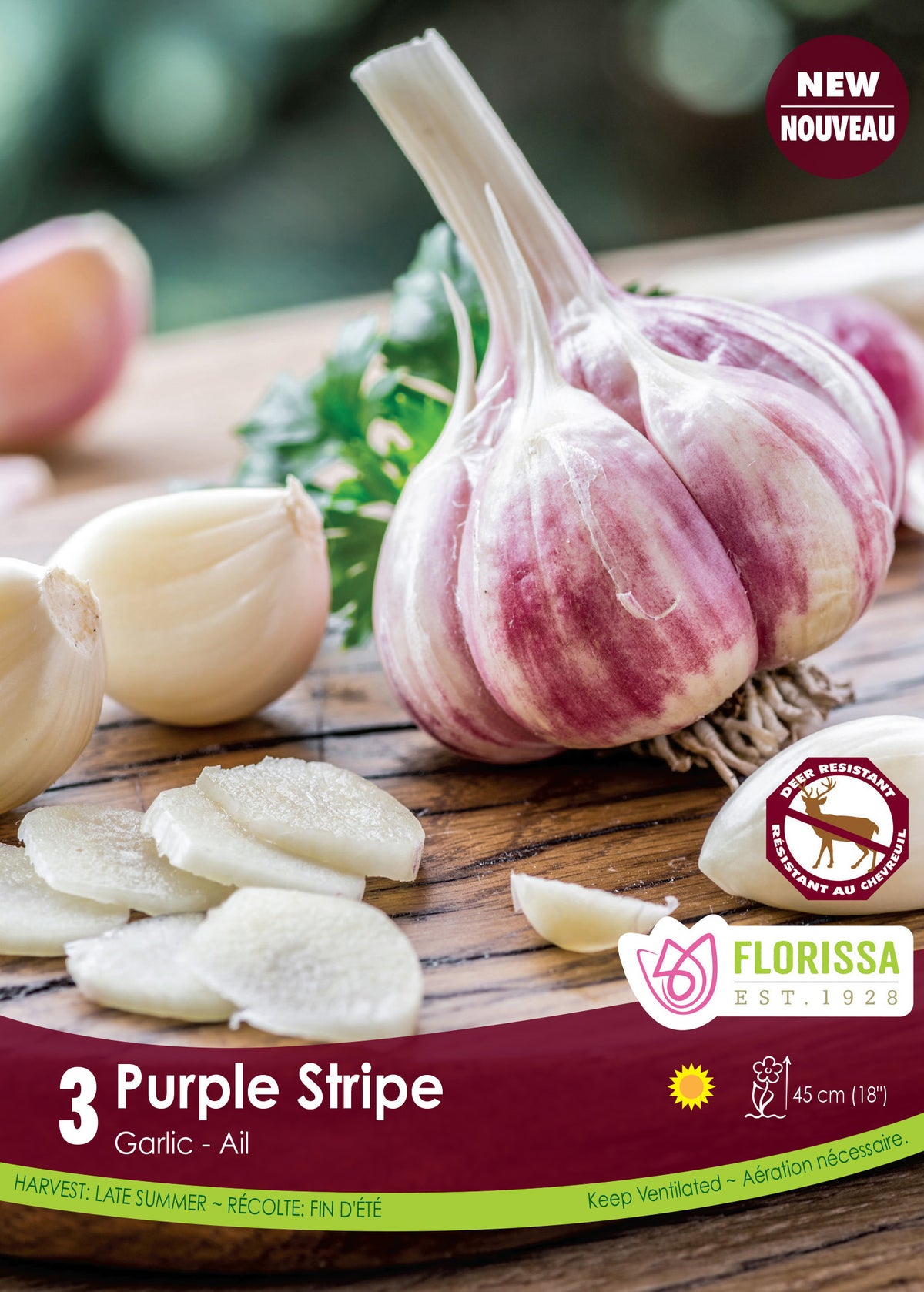
Ail Purple Stripe ( Allium sativum var. ophioscorodon ‘Purple Stripe’) : une tête d’ail rayée de violet avec des gousses blanches sur une planche. Le visuel Florissa présente la plante et son nom dans la partie inférieure de l’étiquette. La photographie occupe presque toute la surface, tandis que le bandeau du bas rassemble les indications du produit. Cette vue permet de reconnaître son apparence et de distinguer la variété présentée.

Planting guide

Plant well.Grow beautifully.

Planting depth

8 cm (3 in), clove point upward

Spacing / density

15 cm (6 in) between plants and 30 cm (12 in) between rows

Best planting time

October to November in Quebec, depending on region and soil freeze

Propagation

Separate bulbs into cloves immediately before planting

Growing method

Choose a full-sun bed in fall that has not grown an Allium crop for at least three years. Loosen soil to 25 to 30 cm (10 to 12 in), incorporate mature compost, and form a slightly raised bed where drainage is slow. Keep all three bulbs intact until planting; then separate cloves carefully and retain only firm, healthy, fully wrapped pieces. Set every clove point upward, 8 cm (3 in) deep and 15 cm (6 in) apart, with 30 cm (12 in) between rows. Water once to settle the soil. After the surface freezes, apply 10 to 15 cm (4 to 6 in) of clean straw or shredded leaves. In spring, loosen mulch around shoots and apply balanced fertilizer. Keep the bed weed-free and provide approximately 2.5 cm (1 in) of water weekly. Cut scapes after their first curl. When lower leaves yellow, stop irrigation, inspect a sample bulb, and harvest in dry weather. Lift with a fork, then cure bulbs for two to four weeks in shade with excellent airflow before trimming roots and storing them. Label the row at planting and record harvest timing. Rotate the next crop away from every onion-family vegetable to preserve healthy soil.

Soil and care

The right care,at the right time.

Soil pH

6.0 to 7.0

Minimum temperature

-40°C (-40°F)

Care level

Moderate

Watering

In spring, provide approximately 2.5 cm (1 in) of water weekly including rain to support bulb formation. Irrigate deeply at soil level rather than frequently at the surface. Reduce moisture as leaves begin yellowing and stop about two weeks before harvest. Constantly wet soil encourages rot, while prolonged drought reduces bulb size. Check beneath mulch before watering because the surface may appear dry while the root zone remains moist.

Soil type

Choose loose, fertile, freely draining loam enriched with mature compost. Soil should retain enough moisture for spring growth without remaining saturated around cloves. A raised bed suits heavy ground. Avoid fresh manure, wet hollows, and beds recently planted with garlic, onions, or leeks to reduce persistent soil-borne disease. A crumbly structure lets roots explore and bulbs expand. Maintain drainage beneath winter mulch as well as during spring thaw.

Fertilization

Incorporate mature compost before planting. In spring, apply balanced fertilizer or a slightly higher-nitrogen formula as leaves resume, followed by a moderate second application before bulbs swell. Stop nitrogen feeding after early June to promote maturation. Avoid fresh manure and heavy rates that create soft foliage, delay harvest, and reduce storage quality. Use leaf colour and growth rate to judge need, and avoid fertilizer contact with emerging shoots.

Moisture

Consistent moisture during active growth, followed by progressively drier conditions before harvest and throughout curing.

Seasonal care

In fall, prepare the bed before soil becomes completely cold, separate bulbs only at planting, and discard spotted, soft, or injured cloves. Water after planting, then wait for the ground to freeze before adding thick mulch. Mark rows clearly. Through winter, let snow and mulch protect the cloves and avoid compacting the bed. In spring, check drainage after thaw, gently loosen mulch around shoots, and feed as foliage resumes. Hand-weed to avoid damaging shallow roots. Water deeply during dry periods and watch for rust, white rot, nematodes, and onion maggot damage. Remove any abnormal plant with surrounding soil immediately and do not compost it. In June, cut each scape after its first complete curl and use it promptly in cooking. Stop nitrogen and reduce water as bulbs begin maturing. In summer, harvest once three to five lower leaves are yellow. Lift without pulling, preserve wrappers, and cure whole plants in a shaded, ventilated place. After two to four weeks, trim roots and stems, sort bulbs, and place them in mesh bags. Store somewhere cool, dry, and dark. Record yield, reserve only healthy cloves for the following fall, and rotate into a different bed. Never wash bulbs before curing, because retained surface moisture encourages decay. Inspect stored bulbs monthly, remove any soft specimen promptly, and maintain ventilation without exposing them to freezing temperatures.

Container growing

A garden,within reach.

Recommended pot size

At least 40 cm (16 in) wide and 30 cm (12 in) deep; maintain 12 to 15 cm (5 to 6 in) between cloves
For a complete container crop, choose a tub at least 40 cm (16 in) wide and 30 cm (12 in) deep with numerous holes. Blend vegetable potting mix, mature compost, and perlite. Separate all three bulbs into cloves and plant only as many as fit at 12 to 15 cm (5 to 6 in) spacing; use multiple containers rather than crowding them. Set points 8 cm (3 in) deep, water, and leave pots outdoors so cloves receive winter cold. Insulate the sides with leaves, straw, or a larger cachepot and raise the base to maintain drainage. In spring, provide full sun, add compost, and water when the upper 3 cm (1 in) is dry. Feed moderately until early June, weed, and cut scapes. Rotate the container for even light. Stop watering approximately two weeks before harvest. Lift bulbs as lower leaves yellow and cure them outside the pot. Do not immediately reuse the same mix for another Allium; replace a substantial portion and grow an unrelated crop. In winter, protect containers from repeated freeze-thaw cycles, which are much stronger than in-ground conditions. Label each container by variety and planting date. Inspect drainage after thaw because ice, roots, or compacted mix can block holes precisely when spring moisture is greatest.
Ail Purple Stripe ( Allium sativum var. ophioscorodon ‘Purple Stripe’) : une tête d’ail rayée de violet avec des gousses blanches sur une planche. Le visuel Florissa présente la plante et son nom dans la partie inférieure de l’étiquette. La photographie occupe presque toute la surface, tandis que le bandeau du bas rassemble les indications du produit. Cette vue permet de reconnaître son apparence et de distinguer la variété présentée.

Bloom and dimensions

Its place,in your garden.

Mature height

45 cm (18 in)

Width / spread

50 cm (20 in) for the group produced from the 3 bulbs

Flower color

White to purple-pink when umbels are allowed to develop

Foliage color

Green to blue-green

Foliage type

Deciduous, strap-like, and aromatic

Growth rate

Moderate

Growth habit

Upright with strap-like leaves and a curling flower scape

Fragrance

Pronounced garlic aroma and flavour in cloves, leaves, and scapes.

Bloom period

In late spring or early summer, hardneck garlic produces a curling scape ending in an umbel. Cut the scape after its first loop to direct energy toward the bulb; the tender stem is edible. If left in place, it may produce bulbils rather than true seed and generally reduces harvested bulb size. Use clean cuts to reduce stem damage and limit openings where disease could enter.

Fruiting

Purple Stripe garlic mainly produces bulbils in its flowering head rather than useful true seed. These small structures can be replanted but require several seasons before forming eating-size bulbs. For a larger main harvest, cut the scape after its first curl. Allow selected stems to mature only when bulbils are wanted for observation or propagation, then separate them once dry and label them clearly.

Harvest

Harvest when three to five lower leaves have yellowed, usually in July or early August; lift with a fork without pulling stems, then cure for two to four weeks.
Ail Purple Stripe ( Allium sativum var. ophioscorodon ‘Purple Stripe’) : une tête d’ail rayée de violet avec des gousses blanches sur une planche. Le visuel Florissa présente la plante et son nom dans la partie inférieure de l’étiquette. La photographie occupe presque toute la surface, tandis que le bandeau du bas rassemble les indications du produit. Cette vue permet de reconnaître son apparence et de distinguer la variété présentée.

Garden associations

In goodcompany.

Companion plants

Plan rotation with legumes, squash, tomatoes, leafy vegetables, or cover crops grown before or after garlic without claiming mutual pest protection. During the season, early lettuce or radishes may briefly occupy spaces between rows if harvested before bulbs enlarge. Most importantly, avoid other Alliums in the same bed for at least three years to reduce persistent disease and specialized pest populations. After harvest, sow an unrelated cover crop to protect soil structure and capture remaining nutrients. Keep companion roots outside the bulb row during late spring so garlic receives water and light without heavy competition.

Recipe idea

From the gardento your plate.

Purple Stripe garlic scape pesto — For one small jar, chop 10 to 12 tender scapes harvested before their bases become fibrous. Add them to a food processor with 40 g (⅓ cup) sunflower seeds or nuts, 40 g (½ cup) grated Parmesan, the zest and juice of half a lemon, and a pinch of salt. Pulse until chopped. Gradually pour in 80 to 100 ml (⅓ to ⅖ cup) olive oil until the mixture is supple but still lightly textured. Taste and adjust the acidity. Serve with pasta, potatoes, toast, or roasted vegetables. For a milder flavour, blanch scapes for thirty seconds and cool them before processing. Refrigerate the pesto in a clean container beneath a thin film of oil and use within three days. For longer storage, freeze it in small portions. Never keep a garlic-and-oil mixture at room temperature because the low-oxygen environment can support botulism toxin production.

Frequently asked questions

Your questions,answered.

Should all three bulbs be planted whole?
No. Keep all three bulbs intact during storage, then separate them into cloves immediately before planting. Every healthy clove becomes one plant and normally forms a new bulb. Retain its papery skin because this limits injury and drying. Discard cloves that are soft, spotted, mouldy, or damaged. Plant the largest for the main crop with points upward, 8 cm (3 in) deep and 15 cm (6 in) apart. Very small cloves may be grown separately. Do not divide bulbs several weeks early because exposed basal plates dehydrate and become more vulnerable to disease before fall rooting. Label each row clearly after planting.
Why should Purple Stripe be planted in fall?
Hardneck garlic benefits from a cold period to differentiate cloves properly and form a well-structured bulb. Planting four to six weeks before lasting soil freeze lets roots begin establishing without producing long exposed leaves. In Canadian regions, this often means October or November depending on location. Use draining soil, then apply mulch only after the surface freezes to stabilize temperature. Spring planting is possible but frequently produces smaller or less divided bulbs if cloves receive insufficient cold. Never plant into saturated ground or soil already frozen deeply. Record the date so timing can be adjusted according to results in future seasons.
When should garlic scapes be cut?
Cut the scape after it forms its first complete curl but before it straightens and becomes fibrous. At this stage, the scape is tender and removal redirects more energy toward the bulb. Use a clean knife or pruner and cut just above the upper leaf without pulling the stem. Harvest in the morning, rinse, dry, and refrigerate in a perforated bag for approximately one week. Scapes cook like an aromatic green vegetable. Leave a stem on selected plants only when bulbils are wanted for observation; expect those bulbs to be somewhat smaller. Never remove the surrounding leaves because they supply the developing bulb.
How can I tell when bulbs are ready to harvest?
Watch the leaves rather than relying on a fixed date. Harvest when three to five lower leaves are yellow or brown while several upper leaves remain green. Each leaf corresponds to a protective wrapper; waiting until all foliage dries exposes cloves and shortens storage. Stop watering approximately two weeks before harvest and inspect a sample bulb. If cloves are well defined beneath intact wrappers, lift the row in dry weather with a fork placed at a safe distance. Do not pull the stems. Brush away only loose soil, then cure whole plants in shade for two to four weeks. Protect curing bulbs from rain and direct sun.
Is Purple Stripe garlic safe around pets?
No. Although bulbs, cloves, and scapes are edible for people, Alliums can damage red blood cells in dogs and cats. Repeated exposure or a substantial amount may cause vomiting, weakness, rapid breathing, pale gums, or dark urine. Keep planting bulbs, harvested garlic, debris, and pesto beyond their reach. Do not intentionally feed garlic to an animal without veterinary guidance. If ingestion is suspected, contact a veterinarian promptly and provide the name Allium sativum and the possible amount. Do not induce vomiting or offer home remedies without professional instructions. Remember that cooked and powdered garlic also remain unsafe for pets. Store safely.

Wildlife and pets

Life,around your plants.

Reported toxicity

Yes

Supporting wildlife

When selected scapes are allowed to flower, their umbels may attract bees and small pollinating insects. In a crop intended for large bulbs, most scapes are harvested before opening. Support biodiversity with other flowers in the vegetable garden rather than sacrificing the entire harvest, and avoid broad-spectrum insecticides. throughout the vegetable season