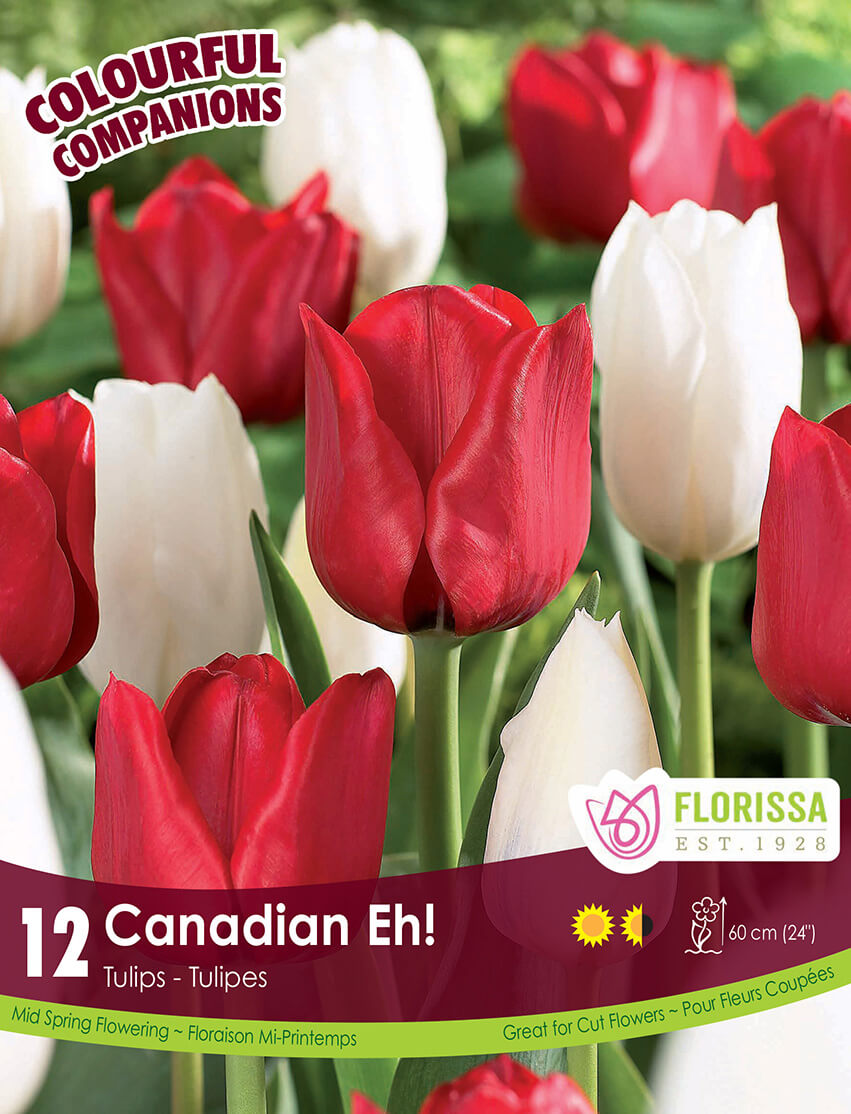
Floral Harmony 'Canadian Eh!' (Tulipa)

Floral Harmony 'Canadian Eh!' (<em>Tulipa</em>)
PÉPINIÈRE.CA

Floral Harmony 'Canadian Eh!' (<em>Tulipa</em>)

BACK-IN-STOCK ALERT

Don’t miss its return.

Leave your email and receive an alert when this product is available again.

An alert for this product only. No newsletter signup. Privacy

Van Noort

Sold out

Pay in 4 interest-free payments withSezzle

Delivery and pickup: view conditions

Product information
Advice adapted to Canada
Secure payment
Next preorder: June 2027 For bulbs to plant in fall.
Expected delivery: October 2027.
Share
Common nameTulip
FamilyLiliaceae
GenusTulip
Bulb typeBulb
Botanical nameTulip
Quantity per pack16 units

Floral Harmony 'Canadian Eh!' (Tulipa) is a tulip blend with bright red and pure white blooms creating a classic and striking spring contrast. This selection produces elegant cup-shaped flowers on sturdy stems, making it perfect for structured plantings and bouquets. Its mid-spring flowering period brings a clean and dynamic presence to beds, borders and containers. Its bold colours create graphic, organized displays that are easy to incorporate into many garden styles.

It prefers full sun and light, fertile, well-drained soil. Bulbs are planted in fall, generally 12 to 15 cm (5 to 6 in) deep and spaced 10 cm (4 in) apart, before the ground freezes. Moderate watering after planting encourages establishment. It adapts well to Canadian gardens and requires little maintenance. Allowing foliage to yellow naturally helps bulbs rebuild their reserves.

This floral harmony is suitable for formal beds, defined borders, decorative containers and cut flower gardens. Its red and white colours pair well with blue muscari, silver foliage or cream tulips. The blooms have excellent vase life and create elegant spring bouquets. It brings a vivid and timeless touch to outdoor landscapes.

In the garden

Exposure
Sun to partial shade
Life cycle
Bulbous perennial

Planting guide

Planting & establishment

Spacing / density

Plant in groups or bands for strong impact

Planting period

September to November

Propagation

Bulb division

Growing method

Harmonie Florale ‘Canadian Eh!’ brings together twelve Van Noort tulip bulbs in a red and white palette inspired by Canadian colors. The cup-shaped flowers stand tall in mid-spring on strong stems reaching about 60 cm (24 in). Presented in size 12/+, the bulbs form a coherent group in beds, borders, and large containers. Plant Canadian Eh! in the fall, when the soil has cooled but is still workable. Choose full sun or very light shade and fertile, loose, and especially perfectly drained soil. Place the bulbs tip-up at about two to three times their height, generally 12 to 18 cm (5 to 7 in), and space them 8 to 12 cm (3 to 5 in) apart. Water after planting to settle the soil, then let seasonal precipitation maintain moderate moisture. Avoid saturated soils and nitrogen-rich fertilizers, which weaken flowering. This maturation recharges the bulbs and improves their chances of returning, even though many horticultural tulips offer their best display in the first year. Group the twelve bulbs near an entrance, along a pathway, or in a dark container that will highlight the red and white. All parts, especially the bulbs, are toxic if ingested.

Soil and care

Soil & care

Soil pH

Neutral to slightly alkaline

Minimum temperature

-40 °C

Care level

Easy

Watering

Moderate

Soil type

Light, fertile and well-drained soil

Fertilization

Bulb fertilizer in spring

Seasonal care

After flowering, remove faded blooms and keep foliage until it naturally yellows. This period allows bulbs to rebuild reserves. Clean dry leaves at the end of the season. Bulbs can remain in place for several years in suitable, well-drained soil.

Container growing

Container growing

Recommended pot size

Container at least 30 cm (12 in) deep
Container growing requires planning for the necessary root volume and the plant's final height. Choose a stable pot with drainage holes and a substrate suitable for planting. Leave enough space to respect recommended depth and spacing, rather than crowding plants to fill the pot immediately. Place the container in the indicated exposure and regularly check the humidity, especially in hot or windy weather. A pot is more exposed to temperature variations than planting in open ground. Therefore, plan for a wintering location from the outset that is compatible with the plant's needs and your region's climate. Plant tulips in the fall, in soil that is still easy to work before it freezes. Choose a sunny, well-drained location, then loosen the soil to a sufficient depth. Place the bulbs tip upwards and respect the planting depth indicated for their size. When planting in groups, leave space between bulbs to allow roots to develop. Water after backfilling if the soil is dry. Avoid areas where water remains on the surface after rain and mark the planting so as not to damage the bulbs during subsequent gardening work. In winter, protect the container according to the plant's needs: its roots are more exposed to cold than in open ground.
Floral Harmony 'Canadian Eh!' (Tulipa)

Size, flowering & harvest

Mature height

50 cm (20 in)

Width / spread

10 cm (4 in)

Flower color

Red and white

Foliage color

Green

Foliage type

Deciduous foliage

Growth rate

Moderate

Bloom period

Mid-spring
Floral Harmony 'Canadian Eh!' (Tulipa)

Garden associations

Companion plants & uses

Companion plants

Blue muscari, cream tulips, silver foliage plants

Garden use

Ideal for symmetrical beds, borders, decorative containers and cut flower gardens. Its bold colours create well-defined spring landscapes.

Frequently asked questions

Frequently asked questions

When should 'Canadian Eh!' tulips be planted?
Plant tulips in the autumn, when the soil is still easy to work before it freezes. Choose a sunny location with well-drained soil, then loosen the soil to a sufficient depth. Place the bulbs with the pointed end facing up and respect the planting depth indicated for their size. When planting in groups, leave space between the bulbs to allow the roots to develop. Water after backfilling if the soil is dry. Avoid areas where water remains on the surface after rain and mark the planting so as not to damage the bulbs during subsequent gardening work. Keep a durable label to easily find this planting while it is dormant.
How tall do these tulips grow?
The recommended exposure is sun to partial shade. Observe the light in your chosen location in the morning and afternoon, as the shade from trees or buildings changes throughout the day. Also consider neighboring plants: their foliage can obscure a young plant as it grows. In a container, place the pot where you can move it if conditions become too hot or too shady. Suitable exposure must go hand in hand with appropriate soil and watering. If you move a plant started indoors outdoors, gradually accustom it to garden conditions to avoid too abrupt a transition for young leaves.
Are these tulips suitable for bouquets?
Water according to the actual soil moisture, taking into account rain, heat, and wind. Check below the surface before deciding on a new watering: soil that is dry on the surface may still be moist at the root level. Direct the water to the base and let it penetrate, without keeping the plant in saturated soil. Containers generally require more frequent checks because they dry out faster. Make sure their drainage holes remain clear and empty any saucers that hold water. Also, adapt care to the plant's cycle: active growth and a resting period do not require the same amount of water.
Can 'Canadian Eh!' be grown in containers?
Container gardening requires estimating the necessary volume for the roots and the plant's final height. Choose a stable pot with drainage holes and a suitable growing medium. Leave enough space to allow for recommended planting depth and spacing, rather than crowding plants to fill the pot immediately. Place the container in the recommended exposure and regularly check the moisture level, especially during hot or windy weather. A pot is more exposed to temperature variations than a plant in the ground. Therefore, plan for a wintering location from the outset that is compatible with the plant's needs and your region's climate.
What exposure should be chosen?
In spring, monitor moisture during growth and water at the base if a dry spell persists. Remove faded flowers while keeping the leaves that are still green. This foliage allows the bulb to replenish its reserves; wait for it to yellow naturally before cutting it and avoid braiding it. In containers, check for dryness more often than in the ground and always allow excess water to drain away. Recovery and flowering in subsequent years depend on the variety and growing conditions. Keep bulbs out of reach of children and animals: tulips are ornamental and not for consumption.

Wildlife and pets

Wildlife & precautions

Complete your purchase

Click a product to build your selection.

Your selection

Total