


Sale
Sold out

Processed
Cucurbits
Pumpkin Moon Stacker White F1
Cucurbita pepo
Product code : NOR-GR04
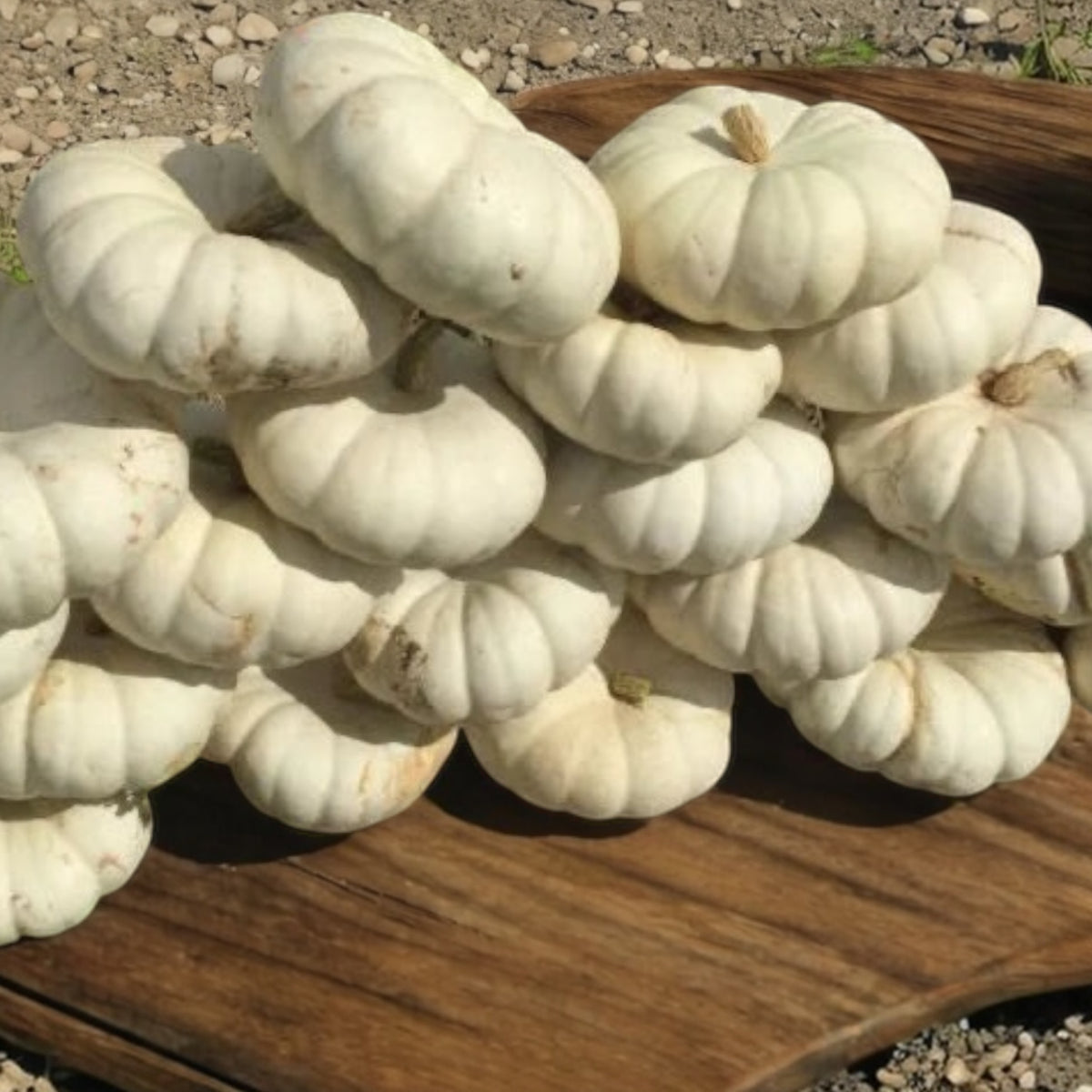
The 'Moon Stacker White F1' pumpkin is an elegant and versatile variety, perfect for autumn decorations and cooking. With its flattened and ribbed shape, it is ideal for stacking, allowing you to create beautiful arrangements in combination with other blue, pink, or red pumpkins. Its bright yellow-orange flesh is thick, tasty, and of high culinary quality. This pumpkin keeps for a long time after harvest. This variety reaches maturity 95 days after sowing. The packet contains 15 seeds to start your planting. Plan the placement of your squash before sowing. Bush types stay around their planting spot, while vines need space to spread into a clear area.
- Quantity
- 15 seeds
- Exposure
- Sun
- Life cycle
- Annual in cultivation in Quebec
Discover the plant
Common nameWhite pumpkin
FamilyCucurbits
GenusCucurbita
Speciespepo
CultivarMoon Stacker
TypeProcessed
Botanical nameCucurbita pepo
'Moon Stacker' White Pumpkin F1 (Cucurbita pepo). The 'Moon Stacker White F1' pumpkin is an elegant and versatile variety, perfect for autumn decorations and cooking. With its flattened, ribbed shape, it is ideal for stacking, allowing you to create beautiful arrangements in combination with other blue, pink, or red pumpkins. Its bright yellow-orange flesh is thick, flavorful, and of high culinary quality. This pumpkin stores well for a long time after harvest. For the 'Moon Stacker' White Pumpkin F1, maturity for this variety is 95 days after sowing.
For the 'Moon Stacker' White Pumpkin F1, germination generally takes 7 to 14 days in soil kept at 25 to 35 °C (77 to 95 °F). For the 'Moon Stacker' White Pumpkin F1, the sowing schedule for this variety is as follows: indoors, 3 to 4 weeks before the last frost. For the 'Moon Stacker' White Pumpkin F1, for this variety, observe this sowing depth: 2.5 cm. For the 'Moon Stacker' White Pumpkin F1, squashes and zucchinis recover better when their roots remain intact. For the 'Moon Stacker' White Pumpkin F1, sowing in individual pots facilitates transplanting; in the garden, wait for warmed soil.
For the 'Moon Stacker' White Pumpkin F1, prioritize rich, well-drained, slightly acidic to neutral soil (pH 6.0 to 7.0) and a full sun location. Harvest the pumpkins when their skin is pure white and hard. Their unique shape and excellent storage make them an ideal choice for autumn decorations and original culinary recipes. Add the 'Moon Stacker White F1' pumpkin to your vegetable garden for an elegant and functional harvest. Its perfect shape for stacking and its flavorful flesh make it a favorite among gardeners and fans of seasonal decorations.

Sowing guide
It all startswith a seed.
Sowing depth
1 in
Spacing / density
Plant four to five seeds 2.5 cm deep in mounds spaced 2 m apart. Thin to 2 or 3 plants. Plant four to five seeds 2.5 cm deep in mounds spaced 2 m apart. Thin to 2 or 3 plants.
Germination temperature
25 to 35 °C (77 to 95 °F)
Germination time
7 to 14 days
Sowing period
Indoors, 3 to 4 weeks before the last frost
Propagation
Sowing
Growing method
Germination typically takes 7 to 14 days in soil maintained at 25 to 35 °C (77 to 95 °F). The sowing schedule for this variety is as follows: indoors, 3 to 4 weeks before the last frost. For this variety, observe this sowing depth: 2.5 cm. To establish this variety, first choose a location corresponding to its exposure: sun. When planting this variety, the spacing to use is to plant four to five seeds at a depth of 2.5 cm in mounds spaced 2 m apart. Thin to 2 or 3 plants. Pumpkins require fertile soil; add a generous amount of organic matter when sowing. Adequate moisture is required for cultivation; water slowly and deeply. What would autumn be without the presence of pumpkins in our gardens! Prefer rich, well-drained, slightly acidic to neutral soil (pH 6.0 to 7.0) and a location in full sun. Water regularly to maintain constant moisture and fertilize moderately to promote healthy growth and abundant production.
Soil and care
The right care,at the right time.
Watering
Water regularly to maintain constant humidity and fertilize moderately to promote healthy growth and abundant production. Harvest the pumpkins when their skin is pure white and hard. To plant this variety, first choose a location that matches its exposure requirements: sun. Pumpkins require fertile soil; add a generous amount of organic matter during sowing. For 'Moon Stacker' F1 white pumpkin, keep the identified packet to track cultivar-specific data throughout the season.
Soil type
Prefer rich, well-drained, slightly acidic to neutral soil (pH 6.0 to 7.0) and a full-sun location. To plant this variety, first choose a spot that matches its exposure: sun. For this variety, prepare fertile soil before planting, then adjust applications for flowering and fruit development; a very leafy plant does not automatically justify more fertilizer.
Fertilization
Water regularly to maintain constant moisture and fertilize moderately to promote healthy growth and abundant production. For this variety, prepare fertile soil before planting, then adjust applications based on flowering and fruit development; a very leafy plant does not automatically justify more fertilizer. To plant this variety, first choose a location that matches its light requirements: sun.
Seasonal care
Water regularly to maintain constant moisture and fertilize moderately to promote healthy growth and abundant production. Pumpkins require fertile soil; add a generous amount of organic matter when sowing. Adequate moisture is required for cultivation; water slowly and deeply. What would autumn be without pumpkins in our gardens! Germination generally takes 7 to 14 days in soil kept at 25 to 35 °C (77 to 95 °F). The sowing calendar for this variety is as follows: indoors, 3 to 4 weeks before the last frost. For this variety, observe this sowing depth: 2.5 cm. For this variety, prepare fertile soil before planting, then adjust applications during flowering and fruit enlargement; a very leafy plant does not automatically justify more fertilizer. Begin monitoring the harvest for this variety as you approach 95 days after sowing; check for the desired color, firmness, and size for picking. This variety has the following characteristic at harvest: fruit weight — 4.5-6.8 kg. This variety has the following characteristic at harvest: fruit shape — flat. Harvest when the pumpkin is dark orange and store them in a cool, dry place. When planting this variety, the spacing to use is to plant four to five seeds at a depth of 2.5 cm in mounds spaced 2 m apart.
Container growing
A garden,within reach.
Recommended pot size
One plant per drained container, with room for its mature size.
Place the container for this variety in this exposure: sun, while checking the light received throughout the day. Germination generally takes 7 to 14 days in soil kept at 25 to 35 °C (77 to 95 °F). The sowing schedule for this variety is as follows: indoors, 3 to 4 weeks before the last frost. For this variety, observe this sowing depth: 2.5 cm. To plant this variety, first choose a location corresponding to its exposure: sun. Pumpkins require fertile soil; add a generous amount of organic matter when sowing. Adequate moisture is required for its cultivation; water slowly and deeply. What would autumn be without pumpkins in our gardens! The packet contains 15 seeds to start your planting. Prefer rich, well-drained, slightly acidic to neutral soil (pH 6.0 to 7.0) and a full sun location. Water regularly to maintain constant moisture and fertilize moderately to promote healthy growth and abundant production. Harvest the pumpkins when their skin is pure white and hard. For varieties suitable for containers, choose a large, stable pot, then let the foliage spread beyond the rim without blocking a path.

Bloom and dimensions
Its place,in your garden.
Fruiting
'Moon Stacker White F1' Pumpkin (Cucurbita pepo) – offered by seed producer WH Perron The 'Moon Stacker White F1' pumpkin is an elegant and versatile variety, perfect for autumn decorations and cooking. Its bright orange-yellow flesh is thick, flavorful, and of high culinary quality. This pumpkin stores well after harvesting. Harvest pumpkins when their skin is completely white and hard.
Days to maturity
95 days after sowing
Harvest
Harvest the fruits at the stage appropriate to the variety by cutting their stem with a clean tool. For zucchinis and cucumbers, frequent harvesting allows you to enjoy tender fruits.
Garden associations
In goodcompany.
Companion plants
When planting this variety, the spacing to use is to plant four to five seeds at a depth of 2.5 cm in mounds spaced 2 m apart. Thin to 2 or 3 plants. To establish this variety, first choose a location that matches its sun exposure. Add the 'Moon Stacker Blanche F1' pumpkin to your vegetable garden for an elegant and functional harvest.
Recipe idea
From the gardento your plate.
Edible parts
Fruits
Recipe idea for your 'Moon Stacker' F1 white pumpkin harvest. Turn the squash flesh into soup. Cut the fruit using a suitable knife on a stable board, remove the seeds, and scoop out the flesh. Sauté an onion in a pot with a little oil, then add the squash pieces. Pour in enough broth to just cover the vegetables and let simmer until the flesh is tender. Blend, adding the liquid gradually to adjust the thickness. A small, diced apple can complement sweet-fleshed squash. When serving, add a spoonful of plain yogurt, pepper, and fresh herbs to taste. The size of the pieces influences cooking time more than their exact shape. Check several pieces before removing the pot from the heat, especially if the harvest includes fruits of different sizes. Moist flesh sometimes requires a bit more evaporation; denser flesh may require more liquid.
Frequently asked questions
Your questions,answered.
When should I start sowing 'Moon Stacker' F1 white pumpkin seeds?
Germination generally takes 7 to 14 days in soil kept at 25 to 35 °C (77 to 95 °F). The sowing schedule for this variety is as follows: indoors, 3 to 4 weeks before the last frost. For this variety, observe this sowing depth: 2.5 cm. Squash and zucchini thrive best when their roots remain intact. Sowing in individual pots facilitates transplanting; in the garden, wait for the soil to warm up. Avoid burying seedlings in cold, saturated soil. Label each location and allow enough surface area for the vines from the start.
When should I harvest 'Moon Stacker' F1 white pumpkin?
Begin observing the harvest of this variety as it approaches 95 days after sowing; then check for the desired color, firmness, and size for picking. This variety has the following harvest characteristic: fruit weight — 4.5-6.8 kg. This variety has the following harvest characteristic: fruit shape — flat. Harvest when the pumpkin is dark orange and store them in a cool, dry place. The maturity of this variety is 95 days after sowing. Pumpkins require fertile soil; add a generous amount of organic matter when sowing. For 'Moon Stacker' F1 white pumpkin, the instructions on the sold packet take priority whenever they specify a date, depth, or quantity.
Which location is suitable for 'Moon Stacker' F1 white pumpkin?
To plant this variety, first choose a location that matches its sun exposure requirements. When planting this variety, the spacing to use is to sow four to five seeds at a depth of 2.5 cm in mounds spaced 2 m apart. Thin to 2 or 3 plants. Sow four to five seeds at a depth of 2.5 cm in mounds spaced 2 m apart. Place the container for this variety in this sun exposure, checking the light received throughout the day. Organize the layout for the squash before sowing. Bush types remain around their planting point, while vines must be able to spread out into an open area.
How should I water 'Moon Stacker' F1 white pumpkins while they are growing?
Pumpkins require fertile soil; add a generous amount of organic matter when sowing. Adequate moisture is required for cultivation; water slowly and deeply. What would autumn be without pumpkins in our gardens! To plant this variety, first choose a location that matches its exposure requirements: sun. Observe the difference between male and female flowers, as the latter bear a young fruit at their base. The presence of flowers does not mean that every flower will produce a squash. Allow insects access to the blooms when the variety depends on pollination.
How to care for 'Moon Stacker' F1 white pumpkins throughout the season?
Pumpkins require fertile soil; add a generous amount of organic matter when sowing. Adequate moisture is required for cultivation; water slowly and deeply. What would autumn be without the presence of pumpkins in our gardens! Emergence generally takes 7 to 14 days in soil kept at 25 to 35 °C (77 to 95 °F). The sowing calendar for this variety is as follows: indoors, 3 to 4 weeks before the last frost. For this variety, observe this sowing depth: 2.5 cm. Start checking for harvest of this variety as it approaches 95 days after sowing; then verify the desired color, firmness, and size for picking.
For a great start to your seeds
The right extras.Right here.
Seed Starting Soil
Shop the collectionSeed starting supplies
Shop the collection





