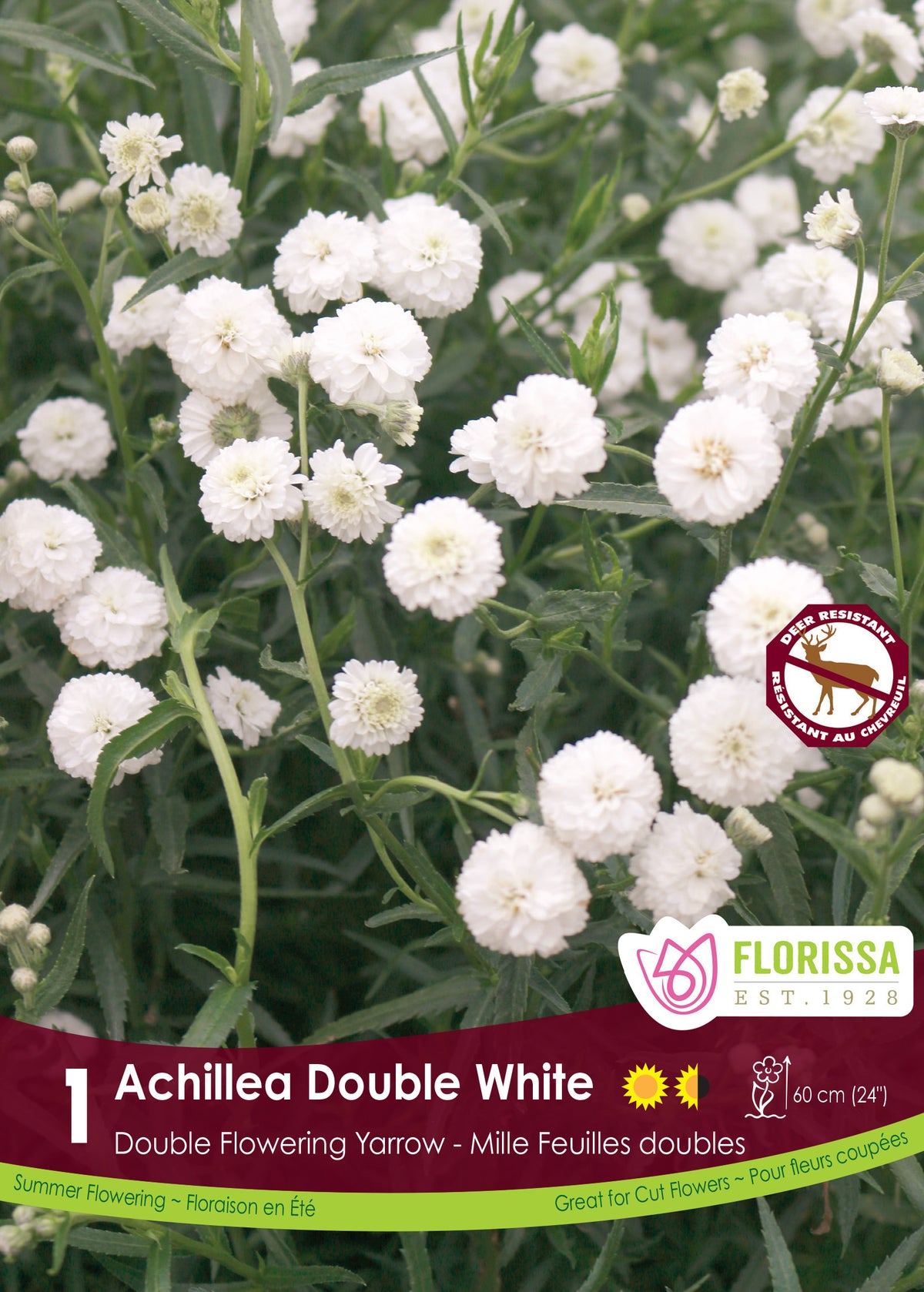
White perennial for borders and bouquets

Double White sneezewort (Achillea ptarmica ‘Double White’)

Product code : 336 120 01

Double White sneezewort is a hardy perennial producing masses of small, pure-white double pompons throughout summer on upright stems approximately 60 cm (24 in) tall. Its narrow, green, lightly aromatic foliage forms a neat clump about 30 cm (12 in) wide. Easy to grow in full sun or light partial shade, it prefers average, well-drained soil and needs little maintenance once established. It works beautifully in borders, cottage gardens, pollinator beds, and cutting gardens. The stems are useful in both fresh and dried arrangements, while Zone 3 hardiness makes this perennial dependable through cold Canadian winters when the crown is not left in saturated soil.
6 49 $
Pay in 4 interest-free payments with Sezzle
Detailed plant guide
Advice adapted to Canada
Secure payment
Share
Quantity
1 rhizome
Exposure
Full sun to partial shade
Life cycle
Perennial
Hardiness
Zones 3 to 9

Discover the plant

Common nameDouble White sneezewort
FamilyAsteraceae
GenusAchillea
Speciesptarmica
CultivarDouble White
TypeBare-root herbaceous perennial
Botanical nameAchillea ptarmica
Reproducible seedsYes

Double White sneezewort (Achillea ptarmica ‘Double White’) forms an upright perennial clump crowned by a profusion of small, pure-white double flower heads. Its narrow, green, finely toothed leaves provide a crisper texture than the feathery foliage of many other yarrows. Bloom continues from early summer into September when spent clusters are removed. The plant reaches approximately 60 cm (24 in) high and 30 cm (12 in) wide. Hardy in Zones 3 to 9, it returns reliably after Canadian winters and maintains a bright, tidy outline near the front or middle of a perennial border.

Plant the bare root in spring as soon as soil has thawed, drained, and become workable, choosing full sun or light partial shade. Set the crown at soil level, spread the roots, and allow 30 cm (12 in) between plants. Average, loose, well-drained soil is suitable; avoid ground that stays waterlogged. Water consistently during establishment, then let the surface dry slightly between soakings. A thin spring layer of compost is usually sufficient. Remove faded stems to encourage renewed bloom, and divide crowded clumps every three or four years. Shelter the stems from severe wind where summer storms are frequent.

Double White adds crisp white punctuation to perennial beds, cottage gardens, pollinator borders, and dedicated cutting gardens. Its small pompons pair effectively with salvias, catmints, fine grasses, coneflowers, and hardy geraniums without hiding their structure. The flowers support bees, hoverflies, and butterflies, while the aromatic foliage is generally passed over by deer. Cut stems when most buds have opened for fresh arrangements, or hang them upside down for drying. The plant is not edible and may irritate pets that consume substantial material. Gloves are sensible for gardeners whose skin reacts to aromatic foliage or sap.

Achillée Double White ( Achillea ptarmica ‘Double White’) : de nombreuses petites fleurs blanches doubles sur des tiges fines. Le visuel Florissa présente la plante et son nom dans la partie inférieure de l’étiquette. La photographie occupe presque toute la surface, tandis que le bandeau du bas rassemble les indications du produit. Cette vue permet de reconnaître son apparence et de distinguer la variété présentée.

Sowing guide

It all startswith a seed.

Sowing depth

Crown at soil level; roots spread beneath 5 to 8 cm (2 to 3 in) of soil

Spacing / density

30 cm (12 in) between plants

Sowing period

April to June in Quebec, once soil is workable

Propagation

Division of clumps in spring or early fall

Growing method

In spring, open the package promptly and inspect the bare root. Soak it in cool water for thirty to sixty minutes if it appears dry, without submerging the crown for an extended period. Choose full sun or light partial shade, preferably sheltered from winds that could flatten the flowering stems. Loosen soil to 25 to 30 cm (10 to 12 in), remove competing perennial weeds, and incorporate a modest amount of compost only where soil is very poor. Dig a hole wide enough to spread the roots without bending them upward. Set the crown exactly at soil level, arrange roots downward, and refill with the original soil. Space plants 30 cm (12 in) apart. Firm gently and water deeply to remove air pockets. Keep soil evenly moist for four to six weeks without saturating it. A thin 3 cm (1 in) mulch suppresses weeds, but keep it away from the crown. When new shoots reach 10 to 15 cm (4 to 6 in), remove only weak growth. Hand-weed carefully and avoid rich fertilizer. After the first bloom, cut faded clusters above a pair of leaves to encourage another flush and limit excessive self-seeding. Monitor emerging crowns weekly.

Soil and care

The right care,at the right time.

Soil pH

5.5 to 7.5

Minimum temperature

-40°C (-40°F)

Care level

Easy

Drought tolerance

Yes

Watering

Water deeply after planting and keep soil evenly moist during the first four to six weeks. Once the clump is rooted, irrigate when the upper 3 to 5 cm (1 to 2 in) has dried. Apply water at soil level, preferably in the morning. Reduce irrigation after prolonged rain because the crown handles a brief dry interval better than saturated soil.

Soil type

Choose loose, average to moderately fertile soil that drains surplus water promptly while retaining some moisture around the roots. Sandy loam or garden soil amended with a modest amount of compost works well. Avoid compact clay, waterlogged hollows, and rich amendments that promote soft, floppy stems at the expense of balanced flowering. A crumbly structure lets young roots expand quickly after planting and supports even establishment.

Fertilization

In spring, spread a thin layer of mature compost around the clump without burying the crown. In poor soil, a balanced slow-release fertilizer may be used at half strength as growth begins. Avoid nitrogen-rich feeding, which stretches stems, increases flopping, and reduces flower quality. No late-season fertilization is needed before dormancy. Judge stem strength and leaf colour before deciding that any additional feeding is truly required.

Moisture

Average moisture; keep soil moist during establishment, then allow slight drying between waterings without prolonged saturation.

Seasonal care

In spring, remove dry stems left for winter before new shoots lengthen. Check whether freeze-thaw cycles have lifted the crown and reset it at soil level if needed. Spread 1 to 2 cm (0.4 to 0.8 in) of mature compost around the clump, and divide plants that have become hollow-centred or crowded. Water divisions until growth resumes. During summer, monitor moisture through dry periods but let the surface drain and dry slightly between applications. Harvest stems regularly for bouquets and cut faded clusters above a node to extend flowering. In windy locations, an unobtrusive support ring installed early prevents lodging. Thin congested growth if foliage remains damp, and promptly remove leaves affected by powdery mildew, rust, or spotting. In fall, stop feeding, reduce irrigation, and allow some stems to dry before cutting them to 10 cm (4 in), or retain several structural stems until spring. Discard diseased debris instead of composting it. A light mulch may be applied after lasting frost in exposed sites, without covering the crown. No winter intervention is required beneath snow, but prevent standing water and foot traffic over the dormant clump. Divide every three or four years to maintain vigour, control rhizomatous spread, and preserve upright flowering stems. If late summer becomes unusually wet, improve airflow, stop overhead watering, and remove collapsed flowers before decay reaches healthy stems. Mark the clump’s position before snowfall so spring cleanup does not damage emerging crowns.

Container growing

A garden,within reach.

Recommended pot size

At least 30 cm (12 in) wide and 30 cm (12 in) deep for one plant
Choose a frost-resistant container at least 30 cm (12 in) wide and 30 cm (12 in) deep for one bare root. Several drainage holes are essential; raise the pot slightly so they remain unobstructed. Fill it with perennial potting mix enriched with compost and lightened with perlite or another mineral fraction. Set the crown level with the mix, spread the roots, and water slowly until moisture drains through. Position the container in morning sun or full sun where watering can be monitored. Check moisture more often than in the ground: water when the upper 2 to 3 cm (0.8 to 1.2 in) is dry, and never leave water in a saucer. In spring, add compost and a half-strength application of balanced slow-release fertilizer. Remove faded flowers and rotate the pot weekly to maintain even growth. A small circular support can protect stems on a windy balcony. Before a Canadian winter, water once after foliage declines, then move the container beside a sheltered wall. Insulate the sides or sink it temporarily because roots in pots experience sharper temperature swings than garden soil. In spring, clear drainage, replace exhausted surface mix, and divide or repot the clump every two or three years.
Achillée Double White ( Achillea ptarmica ‘Double White’) : de nombreuses petites fleurs blanches doubles sur des tiges fines. Le visuel Florissa présente la plante et son nom dans la partie inférieure de l’étiquette. La photographie occupe presque toute la surface, tandis que le bandeau du bas rassemble les indications du produit. Cette vue permet de reconnaître son apparence et de distinguer la variété présentée.

Bloom and dimensions

Its place,in your garden.

Mature height

60 cm (24 in)

Width / spread

30 cm (12 in)

Flower color

Pure white

Foliage color

Medium to dark green

Foliage type

Deciduous, herbaceous, and aromatic when crushed

Growth rate

Moderate

Growth habit

Upright, clump-forming, and gently rhizomatous

Fragrance

Foliage lightly aromatic when crushed; flowers with a subtle scent

Bloom period

From June through September, the plant produces loose clusters of small, pure-white double flower heads above the foliage. Cutting just above a node after the first flush encourages new side stems. Flowers suit fresh and dried arrangements; harvest in the morning when most pompons are open but remain firm and free of rainwater. Regular cutting also keeps the centre of the clump bright, visible, and well ventilated through humid weather.

Fruiting

After pollination, flower heads may produce small dry achenes that mature in late summer and fall. Highly double flowers often yield fewer viable seeds than single forms, and seedlings may not reproduce the cultivar faithfully. Dried heads add subtle texture, but they are usually removed to extend flowering or maintain a tidy appearance. Division remains the dependable propagation method. Birds are not a documented primary attraction for this cultivar.

Harvest

Cut stems for bouquets when most pompons are open, ideally early in the morning. For drying, gather small bunches and hang them upside down in a dark, dry, well-ventilated location. Remove foliage below the water line to improve vase cleanliness and longevity.
Achillée Double White ( Achillea ptarmica ‘Double White’) : de nombreuses petites fleurs blanches doubles sur des tiges fines. Le visuel Florissa présente la plante et son nom dans la partie inférieure de l’étiquette. La photographie occupe presque toute la surface, tandis que le bandeau du bas rassemble les indications du produit. Cette vue permet de reconnaître son apparence et de distinguer la variété présentée.

Garden associations

In goodcompany.

Companion plants

Pair Double White with perennial salvias, catmints, hardy geraniums, coneflowers, speedwells, and fine-textured grasses that share its preference for sun and drainage. Blue and violet flowers emphasize the pure white heads, while bronze or purple foliage creates a more graphic contrast. Leave enough space for airflow. Select companions with moderate water needs rather than bog plants because constantly saturated soil damages the crown. Compact daylilies and later asters extend interest before and after its main flowering period. Avoid pairing it closely with highly vigorous spreaders that would invade the crown, block airflow, or compete heavily for moisture during establishment.

Frequently asked questions

Your questions,answered.

How should the Double White bare root be planted?
Plant in spring once soil has thawed, drained, and become workable. If roots appear dry, soak them in cool water for thirty to sixty minutes without leaving the crown submerged for long. Dig a broad hole, spread roots naturally downward, and set the crown exactly at soil level. Deep burial delays establishment, while an exposed crown dries quickly. Refill with the original soil, firm gently, and water thoroughly. Space plants 30 cm (12 in) apart and maintain even moisture for four to six weeks. Keep mulch away from the crown so it does not remain constantly wet. New growth may be slow initially while roots rebuild.
Why are the yarrow stems flopping?
Flopping often results from insufficient light, nitrogen-rich soil, excessive irrigation, or exposure to strong wind. Move or thin neighbouring plants to provide at least six hours of direct light whenever possible. Stop rich feeding and let soil drain and dry slightly between waterings. Install a support ring early in spring rather than tying stems after they have fallen. Following heavy rain, gently shake water held by the double flowers. A light cut after the first flush also produces shorter side stems. Finally, divide an older clump if its centre has opened and no longer supports new shoots. Avoid crowding, which weakens stems and reduces airflow.
How can flowering be extended into September?
Begin by growing Double White in full sun or very light partial shade, in draining soil that does not become completely dry while buds are developing. Cut fading stems as soon as pompons turn brown, working just above a pair of leaves or a side bud. This pruning prevents energy from being directed into seed and encourages new branching. Water deeply during extended drought without keeping foliage constantly wet. A thin spring layer of compost is sufficient; too much fertilizer mainly produces leaves. Continue harvesting selected stems for bouquets and remove rain-damaged flowers. The second flush is usually lighter than the first, but it keeps the border fresh into early fall.
When should a Double White clump be divided?
Divide the clump every three or four years, or sooner if its centre becomes hollow, stems collapse, or flowering declines. Early spring is ideal in Canada, when new shoots are only a few centimetres tall. Early fall division is also possible where at least six frost-free weeks remain. Lift the entire root mass, discard woody or diseased sections, and separate pieces carrying several buds and healthy roots. Replant immediately at the same depth, space them 30 cm (12 in) apart, and water until growth resumes. Division rejuvenates the plant and controls gradual rhizomatous expansion without requiring barriers. Label young pieces if they are moved to another bed.
Is Double White safe around pets?
Yarrows contain aromatic compounds that may cause digestive upset or irritation when a dog, cat, or horse consumes substantial material. Double White should therefore be treated as non-edible and unsuitable for pets that chew plants. Position it away from play areas, collect pruned stems, and keep dried arrangements out of reach. Simply passing beside the plant in a border is not normally an exposure; ingestion is the primary concern. If an animal develops drooling, vomiting, diarrhea, weakness, or irritation after eating the plant, contact a veterinarian promptly and provide the name Achillea ptarmica. Do not induce vomiting or offer home remedies unless a professional specifically directs you.

Wildlife and pets

Life,around your plants.

Reported toxicity

Yes

Supporting wildlife

Summer flower heads attract bees, hoverflies, small beneficial wasps, and butterflies able to reach accessible florets around the double pompons. The plant contributes nectar and pollen within a diverse border. To maximize this value, avoid insecticides during bloom and leave several flowering stems whenever others are harvested for arrangements.