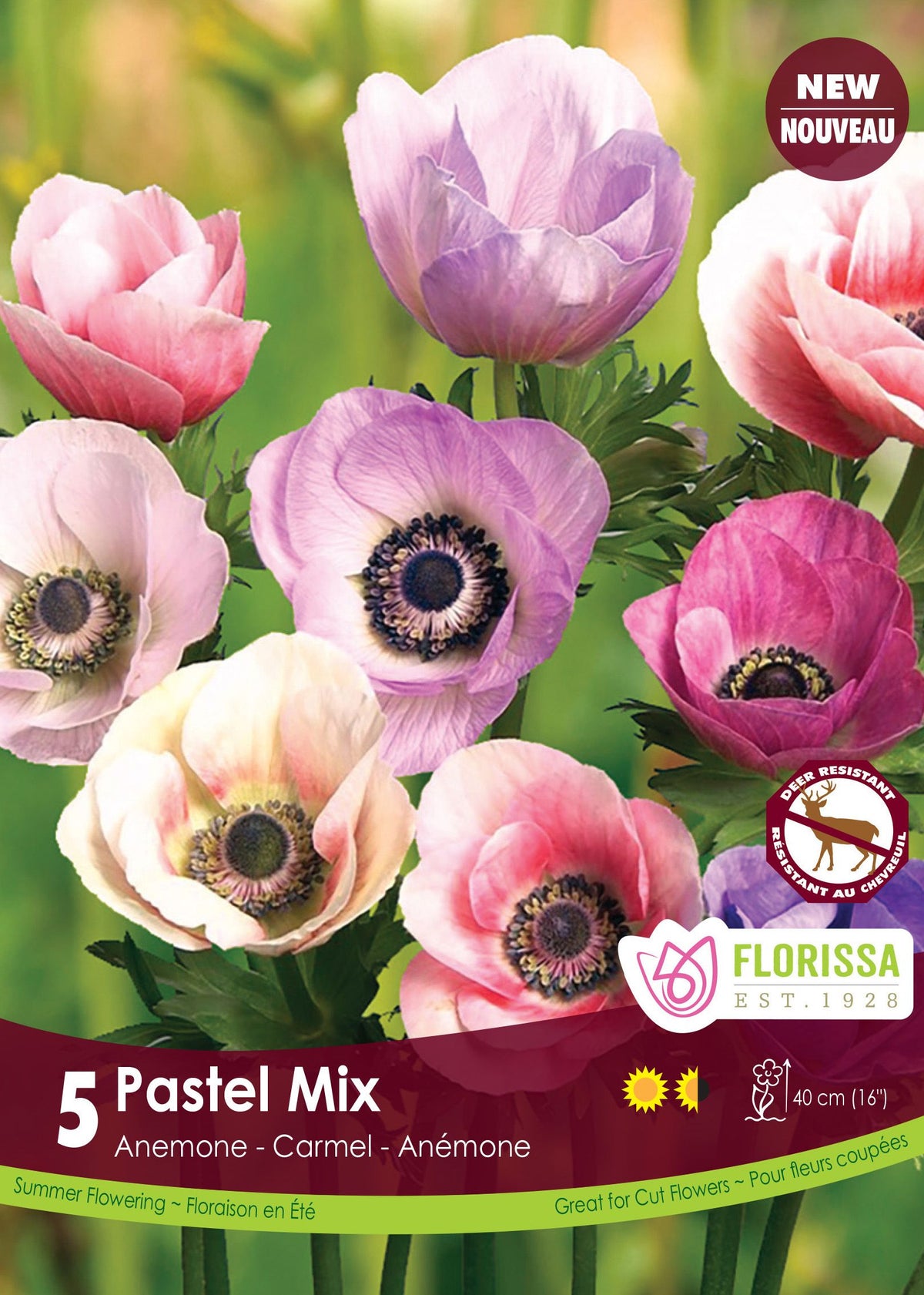
Pastel anemone for arrangements and containers

Carmel Pastel Mix anemone (Anemone coronaria ‘Carmel Pastel Mix’)

Anemone coronaria

Carmel Pastel Mix is a florist-selected Anemone coronaria bearing large 8 to 10 cm marbled blooms in soft pink, peach, cream, lavender, and white. Five Van Noort size 5/6 corms produce clumps 40 cm tall and 15 cm wide. Plant them in spring 50 mm deep in sun and moist, sharply drained soil. Stems suit arrangements and dark centres emphasize the nuanced pastel palette. In Quebec, spring planting after frost provides the most predictable route to summer flowering. Fast drainage protects the corms, while even moisture supports bud development and useful stem length. The five size 5/6 corms perform well as a group, creating a coherent pastel display without excessive competition.
9 99 $
Pay in 4 interest-free payments with Sezzle
Detailed plant guide
Advice adapted to Canada
Secure payment
Share
Quantity 5 tubers
Exposure Full sun
Hardiness Zones 7 to 10; overwinter frost free in Quebec
Difficulty level Easy to moderate

Discover the plant

Family Ranunculaceae
Genus Anemone
Species coronaria
Cultivar Carmel Pastel Mix
Type Summer-flowering cormous anemone
Cycle Tender cormous perennial grown as an annual in Quebec

Carmel Pastel Mix anemone (Anemone coronaria ‘Carmel Pastel Mix’) provides a romantic display of large marbled blooms in soft pink, lavender, cream, peach, and white. The Van Noort package contains five size 5/6 corms that form upright clumps about 40 cm tall and 15 cm wide. Each flower, often 8 to 10 cm across, surrounds a dark centre and rises on a stem suitable for arrangements. Finely divided foliage creates a light base beneath the blooms. Planted in spring, this anemone flowers during summer and continually renews its nuanced pastel palette.

Plant the corms after hard frost in a sunny site protected from drying wind. Soak them briefly in room-temperature water, then set them 50 mm deep and approximately 150 mm apart in loose, fertile, sharply drained soil. Water to establish soil contact, then maintain even moisture without saturation. A moderate addition of compost and balanced fertilizer supports stems without creating excessively soft foliage. In Quebec, the supplier’s Zones 7 to 10 rating generally means lifting corms before winter or treating them as annuals. Mark their position and avoid disturbing emerging shoots during early growth.

Carmel Pastel Mix suits sunny borders, cutting beds, and containers where its colours can be appreciated closely. Pair it with late tulips, ranunculus, love-in-a-mist, sweet alyssum, salvias, and fine grasses to extend texture without hiding the blooms. Harvest when a bud shows colour and begins to open, preserving enough leaves to feed the corms. Flowers welcome bees and other flower-visiting insects. This anemone is not edible and its sap may irritate; wear gloves, keep corms away from children and pets, and clean tools after use. Good air circulation helps keep petals and foliage healthy.

Carmel Pastel Mix anemone (<em>Anemone coronaria</em> ‘Carmel Pastel Mix’)

Planting guide

From planting to establishment.

Planting depth 50 mm (2 in)
Spacing / density 150 mm (6 in) between corms
Establishment temperature 15 to 18°C (59 to 64°F)
Establishment time 14 to 21 days
Best planting time Late May to early June in Quebec
Propagation Division of new corms after dormancy
Growing method
After hard frost, soak the five size 5/6 corms in room-temperature water for several hours to rehydrate them gently. Prepare a sunny, sheltered site with loosened soil amended with compost. Drainage must remain rapid after rain. Set corms 50 mm deep and approximately 150 mm apart; their irregular shape does not require perfect orientation. Backfill without compacting, water deeply, and mark the area. Keep soil moist but never saturated during emergence. Apply light balanced fertilizer after leaves develop. Protect young shoots from slugs and avoid wind that flattens stems. Harvest flowers when buds show colour. After flowering, let foliage yellow, then reduce water. In Quebec, lift dry corms and store them cool, dry, and frost free. In Quebec, spring planting after frost provides the most predictable route to summer flowering. Fast drainage protects the corms, while even moisture supports bud development and useful stem length. The five size 5/6 corms perform well as a group, creating a coherent pastel display without excessive competition. Remove faded flowers but let foliage yellow naturally so every corm can rebuild its reserves. In cold regions, lift corms after foliage declines and store them cool, dry, and frost free. In Quebec, spring planting after frost provides the most predictable route to summer flowering. Fast drainage protects the corms, while even moisture supports bud development and useful stem length.

Soil and care

The right conditions.

Exposure Full sun
Soil pH Slightly acidic to neutral
Hardiness zone Zones 7 to 10; overwinter frost free in Quebec
Minimum temperature Overwinter frost free in Quebec
Watering
Water deeply after planting, then maintain even moisture through emergence, bud formation, and flowering. Let the surface begin drying between applications. Empty saucers and reduce water after foliage yellows. Stored corms must remain dry because persistent moisture during dormancy quickly encourages rot. In Quebec, spring planting after frost provides the most predictable route to summer flowering. Fast drainage protects the corms, while even moisture supports bud development and useful stem length.
Soil type
Choose loose, fertile, humus-rich, sharply drained soil. Light loam amended with compost is suitable, while compact clay traps too much water around corms. In containers, blend potting mix, compost, and perlite or pumice. Avoid wet hollows, full saucers, and thick mulch directly over emerging shoots. In Quebec, spring planting after frost provides the most predictable route to summer flowering. Fast drainage protects the corms, while even moisture supports bud development and useful stem length.
Fertilization
Incorporate a moderate amount of mature compost before planting. Once leaves are active, apply diluted balanced fertilizer every three to four weeks. Stop after yellowing begins. Avoid heavy nitrogen, which stretches tissue and weakens stems. In containers, flush the mix occasionally to limit salts. In Quebec, spring planting after frost provides the most predictable route to summer flowering. Fast drainage protects the corms, while even moisture supports bud development and useful stem length.
Seasonal care
In spring, inspect the corms, discard soft material, and soak firm corms for several hours before planting. Prepare soil after frost, plant 50 mm deep, and water. Protect the first shoots from slugs. During summer, keep soil moist, feed lightly, and support stems only in windy sites. Cut flowers at the coloured-bud stage and remove faded blooms to extend production. Always preserve enough foliage. In autumn, let leaves yellow completely, then reduce irrigation gradually. Lift corms before frost, remove soil, and dry them in shade. In winter, store them in a paper bag or ventilated crate under cool, dry, frost-free conditions. Inspect monthly and remove rot. Label the pastel selection and size clearly to prevent mixing. In Quebec, spring planting after frost provides the most predictable route to summer flowering. Fast drainage protects the corms, while even moisture supports bud development and useful stem length. The five size 5/6 corms perform well as a group, creating a coherent pastel display without excessive competition. Remove faded flowers but let foliage yellow naturally so every corm can rebuild its reserves. In cold regions, lift corms after foliage declines and store them cool, dry, and frost free. In Quebec, spring planting after frost provides the most predictable route to summer flowering. Fast drainage protects the corms, while even moisture supports bud development and useful stem length. The five size 5/6 corms perform well as a group, creating a coherent pastel display without excessive competition.

Container growing

A controlled environment.

Recommended pot size
Pot at least 30 cm wide and 25 to 30 cm deep
Use a container at least 30 cm wide and 25 to 30 cm deep with several drainage holes. This size accommodates five corms with roughly 15 cm between them. Fill it with light potting mix amended with compost and mineral drainage material. Plant 50 mm deep, water until surplus drains freely, and place in sun. Check moisture often during flowering because containers dry faster than garden soil, yet never leave water in the saucer. Feed lightly and rotate the pot for balanced stems. Cut flowers as needed. After foliage yellows, reduce water and let the mix dry. Before frost, move the pot under cover or remove the corms, dry them, and store them frost free. Refresh the mix the following spring. In Quebec, spring planting after frost provides the most predictable route to summer flowering. Fast drainage protects the corms, while even moisture supports bud development and useful stem length. The five size 5/6 corms perform well as a group, creating a coherent pastel display without excessive competition. Remove faded flowers but let foliage yellow naturally so every corm can rebuild its reserves. In cold regions, lift corms after foliage declines and store them cool, dry, and frost free. In Quebec, spring planting after frost provides the most predictable route to summer flowering.
Carmel Pastel Mix anemone (<em>Anemone coronaria</em> ‘Carmel Pastel Mix’)

Bloom and dimensions

The complete profile.

Flower color Pastel mix of pink, lavender, peach, cream, and white
Foliage color Green
Foliage type Deciduous, finely divided
Growth rate Fast
Bloom period
Summer flowering produces large 8 to 10 cm blooms in a blend of pink, lavender, peach, cream, and white, each emphasized by a dark centre. Flowers appear successively on stems about 40 cm tall. Spring planting, moist drained soil, and regular removal of faded flowers extend the display. In Quebec, spring planting after frost provides the most predictable route to summer flowering. Fast drainage protects the corms, while even moisture supports bud development and useful stem length.
Fruiting
None
Harvest
None
Carmel Pastel Mix anemone (<em>Anemone coronaria</em> ‘Carmel Pastel Mix’)

Garden associations

What to plant with it.

Good companions
Pair Carmel Pastel Mix with ranunculus, late tulips, love-in-a-mist, sweet alyssum, lobelia, salvias, and fine grasses. These companions provide complementary heights or textures without hiding flowers. Choose plants enjoying sun and similar drainage, but separate those requiring much more water. Grey or purple foliage particularly emphasizes peach and lavender tones. In Quebec, spring planting after frost provides the most predictable route to summer flowering. Fast drainage protects the corms, while even moisture supports bud development and useful stem length. The five size 5/6 corms perform well as a group, creating a coherent pastel display without excessive competition.
Avoid planting with
Avoid invasive plants, dense groundcovers, and neighbours requiring constantly saturated soil. They compete with the small corms, reduce airflow, and complicate autumn lifting. Compact soil, standing water, and thick mulch against shoots encourage rot. Also avoid tall plants that create dense shade or push stems over in wind. In Quebec, spring planting after frost provides the most predictable route to summer flowering. Fast drainage protects the corms, while even moisture supports bud development and useful stem length. The five size 5/6 corms perform well as a group, creating a coherent pastel display without excessive competition.
Use Carmel Pastel Mix in sunny borders, large containers, and cutting beds. Its 40 cm height suits the middle of a planting, while pastel colours soften brighter palettes. Harvest at the coloured-bud stage for arrangements while preserving leaves. Five corms create a coherent group beside a patio or along a path. In Quebec, spring planting after frost provides the most predictable route to summer flowering. Fast drainage protects the corms, while even moisture supports bud development and useful stem length. The five size 5/6 corms perform well as a group, creating a coherent pastel display without excessive competition.

From the garden to inspiration.

The flowers are not intended for consumption. They are grown primarily for their exceptional ornamental value and excellent vase life. Their long stems produce beautiful spring bouquets, while the soft pastel shades create delicate and refined floral arrangements.

Frequently asked questions

Everything toknow.

Plant the corms in spring after hard frost, once soil has warmed and can be worked without remaining sticky. In many parts of Quebec, this means late May or early June. Soak firm corms for several hours in room-temperature water, then set them 50 mm deep and 150 mm apart. Choose sun and fast drainage. Water after planting, mark the position, and keep soil moist during emergence. Starting indoors four to six weeks earlier may advance flowering, but shoots must be acclimated before their final move outdoors. Never plant into cold saturated ground because dormant corms can rot before roots develop. In Quebec, spring planting after frost provides the most predictable route to summer flowering.
After flowering, let foliage yellow completely so corms rebuild their reserves. Reduce water, then lift them before soil freezes. Remove soil gently, dry the corms for several days in shade, and discard soft tissue. Store them in a paper bag or ventilated crate labelled Carmel Pastel Mix and size 5/6. Choose a cool, dry, dark, frost-free room. Inspect monthly for mould, rot, or excessive shrivelling. Never seal them in damp plastic. In spring, keep only firm corms and rehydrate them before planting again. Clean storage containers between seasons to reduce disease carryover. In Quebec, spring planting after frost provides the most predictable route to summer flowering. Keep the storage location consistently ventilated and protected from condensation.
Yes. Carmel Pastel Mix was selected for large 8 to 10 cm flowers and stems approximately 40 cm long. Cut early in the morning when a bud shows full colour and has just begun opening. Use a clean tool, place the stem immediately in fresh water, and remove only leaves that would sit below the waterline. Refresh vase water regularly and keep the arrangement away from direct sun and ripening fruit. Never harvest all foliage because leaves must feed the corm. Wear gloves if your skin is sensitive to anemone sap, and clean cutting tools after use. In Quebec, spring planting after frost provides the most predictable route to summer flowering.
Anemone corms may require several weeks to begin growth, especially while soil remains cool. Check the planting date first and avoid continual digging. A firm corm may simply be slow. Failure can result from cold saturated soil, planting too deeply, dried corms that were not rehydrated, rodents, or rot. Mark the position and maintain light moisture without saturation. If no shoots appear after a long period and soil is warm, uncover one corm carefully. Soft or odorous material is lost; a firm corm can be replanted in a more freely drained mix. Protect the site from disturbance while waiting. In Quebec, spring planting after frost provides the most predictable route to summer flowering.
Yes. Anemone coronaria contains irritating compounds and must not be eaten. Corms present a particular risk because they may be mistaken for a dry food product. Wear gloves while planting, lifting, dividing, or cutting stems, then wash hands and tools. Keep fresh or stored corms, pruning waste, and arrangements away from children and pets. Avoid positioning the container beside an edible garden. After ingestion or significant irritation, promptly contact a poison centre, medical professional, or veterinarian. Label stored material clearly throughout winter and never reuse its container for food. In Quebec, spring planting after frost provides the most predictable route to summer flowering. Fast drainage protects the corms, while even moisture supports bud development and useful stem length.

Its strengths, naturally.

Not recommended for pets

Pets

Pollinators
Attracts or supports pollinating insects

Pollinators

Butterflies
Plants that attract butterflies

Butterflies