


Trees and shrubs
Dwarf Korean Fir 'Cis'
Korean fir
Products and available quantities may vary between Brossard and Laval. To check a store’s inventory, please contact us directly.
Even better: visit us in store to discover the full selection available!
- Exposure
- Sun to partial shade
- Hardiness
- Zone 3–7
Discover the plant
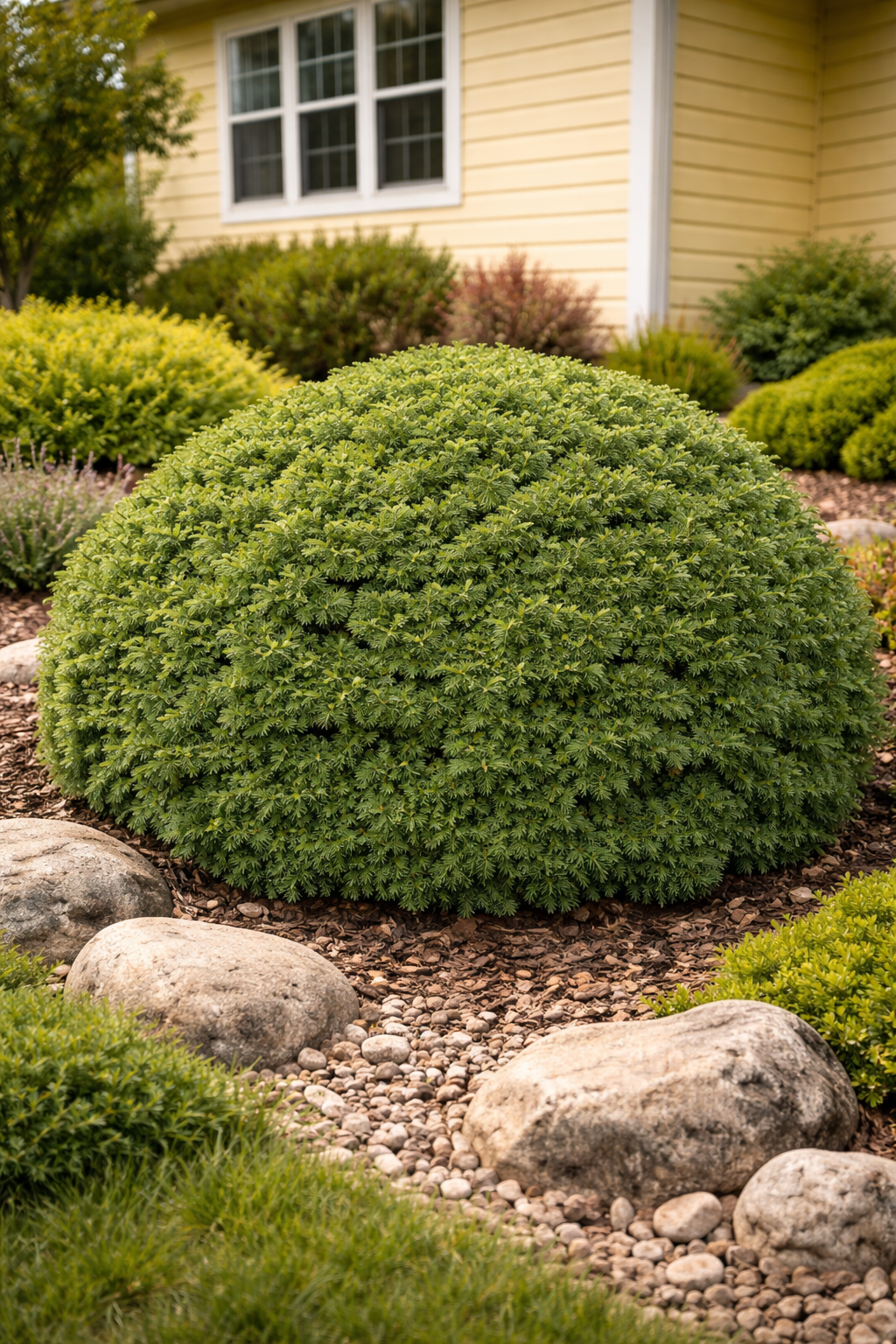
Dwarf Korean Fir 'Cis' (Abies koreana 'Cis'). Abies koreana ‘Cis’, or Dwarf Korean Fir ‘Cis’, is a miniature conifer of great refinement, appreciated for its very compact, low, and naturally cushion-like habit. Its dense, dark green, slightly glossy foliage forms a neat plant mass that maintains a beautiful presence throughout the year. Thanks to its regular, flattened silhouette, it easily integrates into rock gardens, alpine gardens, green walls, or small spaces where every plant must be chosen with precision. Even without apparent flowering, its tight texture and persistent appearance bring a discreet but very elegant structure to the garden.
Its extremely slow growth makes Abies koreana ‘Cis’ an ideal choice for durable, low-maintenance landscaping. It naturally maintains a low and orderly shape, without requiring frequent pruning, which makes it particularly interesting for minimalist compositions, Zen gardens, or decorative container plantings. Placed near natural stones, pale gravel, low perennials, or other miniature conifers, it creates a subtle and refined contrast. Its compact habit also allows it to be used as a border, an accent in a flower bed, or as a structural element in a small-scale setting.
Very hardy and well-suited to cold climates, the Dwarf Korean Fir ‘Cis’ prefers fresh, well-drained, and slightly acidic soil, with sunny to semi-shaded exposure. Regular watering during the first seasons helps promote solid rooting, especially when grown in pots or installed in a drier rockery. Once well established, it requires very little intervention and naturally maintains its neat appearance. With its miniature size, evergreen foliage, and calm, structured look, Abies koreana ‘Cis’ is a perfect conifer for creating an elegant, stable, and hassle-free landscape.

Planting guide
From planting to establishment.
Soil and care
The right care,at the right time.
Soil pH
Minimum temperature
Care level
Watering
Soil type
Fertilization
Moisture
Seasonal care
Container growing
A garden,within reach.

Bloom and dimensions
Its place,in your garden.
Mature height
Width / spread
Foliage color
Foliage type
Growth rate
Growth habit
Bloom period
Fruiting
Garden associations
In goodcompany.
Companion plants
Plants to avoid
Wildlife and pets